


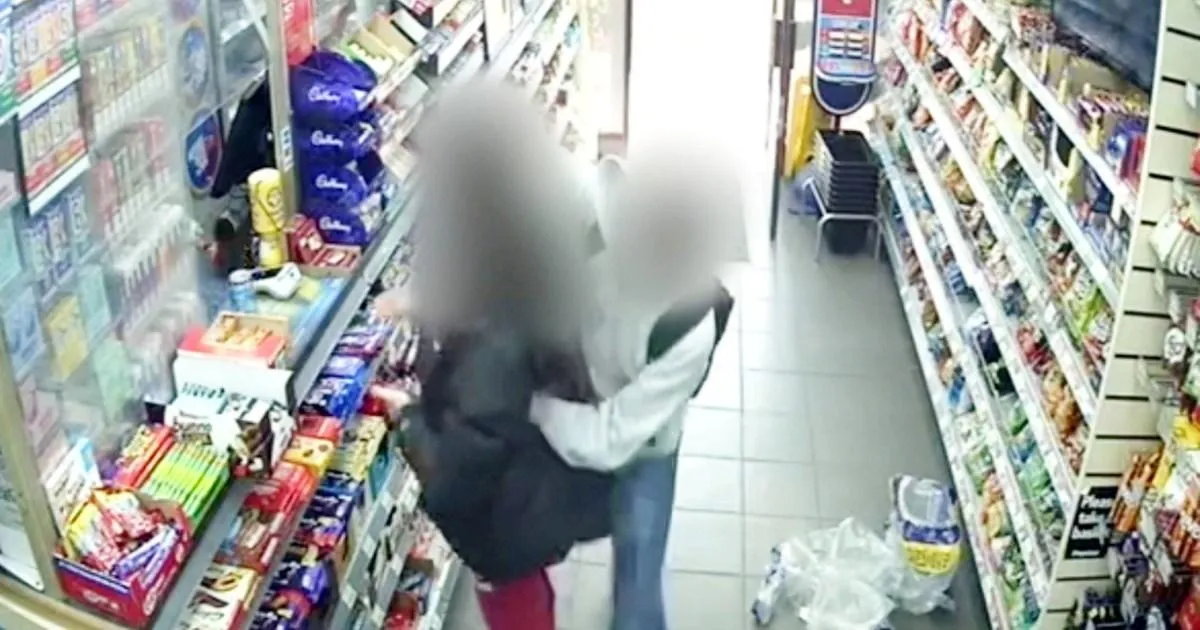
In the quiet market town of Cirencester, Gloucestershire, an ordinary March afternoon was torn apart by an act of violence so sudden and so chilling that it is hard to look away from the footage that captured it. On March 15, a 14-year-old girl was attacked inside a shop by a boy her own age, a boy who, police say, had become obsessed with her after she refused to go out with him. The security camera shows him walking toward her calmly, his hands in his pockets, betraying none of the rage that must have been boiling beneath the surface. He does not run. He does not shout. He simply approaches her, pulls out a knife, and strikes. The girl, also 14, is seen trying to defend herself, struggling to escape as he stabs her repeatedly. The attack has been described as frenzied, but that word does not fully capture the deliberate nature of the act. The boy had followed her into the shop, a place of everyday errands and small purchases, a place that should have been safe. He had a knife with him and he used it on a girl who had done nothing more than say no. The victim suffered cuts to her face and neck, injuries that could easily have been fatal. She survived, in large part, because a brave shopkeeper stepped in and put their own body between the girl and the blade, suffering a stab wound in the process. The boy, from Wiltshire, later admitted inflicting grievous bodily harm and was given a one-year referral order by Bristol Crown Court. For the young victim, the sentencing is only the beginning of a long and uncertain journey through the aftermath of violence, one that no teenager should ever have to walk.
This attack did not come out of nowhere. Months before the knife was pulled, the girl had made it clear that she did not want to be with the boy. That decision, which should have ended any question of a relationship, instead triggered a disturbing pattern of behaviour. He began creating fake social media accounts and using them to send her a barrage of messages, a digital campaign of harassment that continued over a significant period of time. It was a way of refusing to accept her autonomy, a way of telling her that her choice did not matter. This was not harmless adolescent crush behaviour; it was a warning sign that was apparently missed or ignored. By the time he walked into that shop, he had already been engaging in the obsessive behaviour that domestic abuse charities see in far too many adult cases, just in younger bodies. Detective Superintendent Ian Fletcher likened the case to the hard-hitting TV drama Adolescence, in which a teenage boy kills a female classmate after she rejects him. The comparison is not comfortable, because that show exposed how easily young people absorb toxic messages about entitlement, ownership and revenge, often in plain sight. Fletcher told reporters that Gloucestershire police are now looking “quite strongly” at teenage relationship abuse, and he was blunt about the legal gap at the centre of the case. Because both the victim and the offender are under 16, the attack does not meet the legal definition of domestic abuse. That means behaviour that would be taken seriously in adults is not recognised in children, leaving a dangerous space where early intervention and prevention are too often absent.
To understand what is at stake, you have to listen to the girl’s own words. In a victim impact statement read to Bristol Crown Court, she described a life transformed by fear. “I’m scared and nervous anywhere that I go,” she said. “Even if someone puts their hand up next to me I flinch as I don’t know what they are about to do to me. I know this is as a result of the incident, as I wasn’t like this before.” She described the immediate aftermath as a blur of shock, so overwhelming that she did not leave the house for days. She had never imagined that something like this could happen to her, or to anyone she knew. But it did. Now she relives the attack in nightmares that are always shifting; in these dreams, the same violent scene unfolds in different places, stripping away any sense of safety. She sleeps in the dark, and when she wakes she feels as if someone is there in the room with her. “I can’t stop thinking about it,” she said. The fear has seeped into the smallest routines of her daily life. She no longer walks outside alone. She has to be dropped off at work because the simple act of being on the street feels too dangerous. “This is going to affect my ability to trust people,” she said. And then, in one heartbreaking sentence, she summed up the cruel injustice of her situation: “I shouldn’t have to feel like this as a teenager in my own area.” Those words should stay with everyone who hears them, because they speak to a loss that no sentence can repair.
The police investigation has also highlighted a broader social failure. Detective Superintendent Fletcher was clear that the violence was not a random act but part of a pattern that society is only beginning to take seriously. “This is an area that we in Gloucestershire are now looking at quite strongly in teenage relationship abuse,” he said. “It doesn’t get classified as domestic abuse currently in law because they were both under the age of 16. So, this isn’t something that we would normally see in children. It’s something that we may see in adults – that obsessive behaviour leading to a violent attack.” His words should trouble everyone. The legal framework, which is supposed to protect the vulnerable, currently fails to name abuse when it happens between young people. If a 14-year-old boy had been harassing and stalking an adult woman, the response would likely have been very different. But because both parties are minors, the behaviour is all too easily dismissed as a schoolyard crush gone wrong. It is not. It is a symptom of the same epidemic of violence against women and girls that campaigns such as This Is Not Right, launched by Metro with Women’s Aid, are working to expose. That campaign has repeatedly argued that violence against women starts early, often in schools and online, and is too often tolerated as boys being boys. This case proves the point in the most graphic way possible, and it is a reminder that the problem is not just found in adult relationships. It is being learned, practised and acted out by children.
The sentence handed down to the boy, a one-year referral order, has inevitably raised difficult questions. A referral order is intended to make young offenders confront the consequences of their behaviour through a youth offending panel. It is not a custodial sentence, and many will struggle to understand how a boy who calmly walked into a shop and stabbed a girl multiple times can be allowed to remain in the community. The police themselves acknowledged the gravity of what could have happened. “They were both really, really lucky,” Detective Superintendent Fletcher said. “You can see from the CCTV that our young victim has been stabbed multiple times with a knife but she’s actually got away very, very luckily with minor injuries. This could have been far more serious.” The word lucky is hard to accept. It was pure chance that the blade did not pierce an artery. It was pure chance that a shopkeeper was nearby and brave enough to intervene. It was pure chance that the girl survived. Luck is not justice. The boy now has to engage with the referral order, and for that to offer any real protection, it must involve deep, honest work on the beliefs and attitudes that led him to violence. There are also questions that must be answered. How did he get the knife? How many warning signs were missed during the months of fake social media harassment? What support is being provided to the victim, not just for now but for the years ahead? And what happens next time, if he does not change? The stakes, as the detective said, are literally life and death.
In the end, this story is not only about a crime and its punishment. It is about a teenage girl whose sense of safety has been destroyed by someone she rejected. It is about a boy who turned that rejection into obsession, and obsession into violence. And it is about all of us, parents, teachers, police, lawmakers, and communities, who have to look honestly at the world we are creating for young people. The girl’s words, spoken in court, should remain in our minds. “I shouldn’t have to feel like this as a teenager in my own area.” No child should. The attack could have been fatal, and the fact that it was not is a matter of chance, not of good design. To prevent the next tragedy, we need more than outrage. We need education that teaches young people about respect, consent and healthy relationships, and we need to recognise that obsessive, controlling behaviour in a 14-year-old is not a phase. It is a red flag. We need to close the legal gaps that leave teenage relationship abuse outside the definition of domestic abuse. We need interventions before a knife is pulled, not just after. The girl who survived has shown immense courage in speaking about her trauma. Her voice is the reason this story matters. If it can open even one eye, change one attitude, or protect one other girl, then her pain has not been entirely in vain. But that is a heavy burden to place on a child who should still be worrying about school, friends and the ordinary anxieties of being fourteen.