

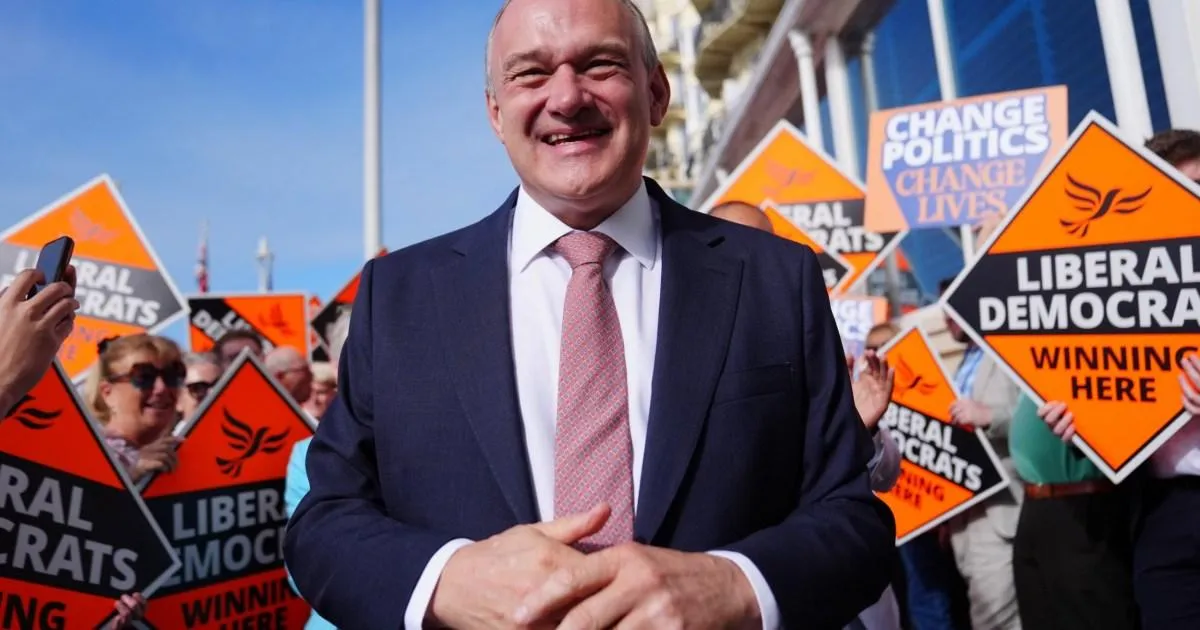
The Liberal Democrats arrived in Brighton this week like a quiet relative turning up to a loud family party: present, polite, and a little bit awkward, while everyone else argued over the future of the country. Sir Ed Davey headed to the south coast with his legion of Lib Dem members for their conference, but there was something unusual in the sea air. Beyond the ice creams and the pebbled beach, the people gathered in the Brighton Centre were not just thinking about their party’s policy platform or election strategy. They were thinking about why nobody else thinks about their party at all. Every so often, social media reminds us that men spend an inexplicable amount of time thinking about the Roman Empire. The Liberal Democrats, by contrast, could probably go days without crossing the average voter’s mind, and that strange invisibility had become the quiet obsession of this conference. It is a peculiar position for a party that, in conventional political terms, should be thriving. Since the last general election, British politics has splintered dramatically: Labour, Reform and the Greens have all experienced dizzying peaks and troughs in the opinion polls, while the Liberal Democrats have puttered along in the background, never really straying beyond the mid to low teens. At a time when Westminster drama can loom large over daily life, with fierce arguments over the future of the UK, the truth appears to be that the country simply doesn’t spend very long thinking about the Lib Dems. And that, for a party with ambitions of returning to government, is a problem far more unsettling than any bad poll.
Of course, none of this applies to the people inside the conference halls. The attendees in Brighton weren’t just thinking lots about the Lib Dems; they were thinking lots about the reasons why nobody else thinks about the Lib Dems. It is a bit like being the kind, unassuming friend at a party who is always pleasant but never quite the centre of attention: you wonder whether being liked is actually the same as being noticed, and whether being noticed even matters in the end. That question, more than any leadership contest or policy row, was the real soundtrack to this year’s gathering.
The evidence that the Lib Dems have a brand problem is hard to ignore. Since the departure of Sir Keir Starmer two months ago, Davey is comfortably the longest-serving of the UK’s main party leaders. Yet when pollster More in Common asked people to describe the Liberal Democrats in a word or two, the most common answer was “don’t know.” Not “weak,” not “irrelevant,” not “centrist dad energy” – just a shrug in text form. Luke Tryl, the pollster’s director, shared a word cloud from the research that told its own story: where people did offer words, they tended toward things like “boring,” “irrelevant,” “local,” or phrases that suggested the party lacked any real presence on the national political stage. One would-be parliamentary candidate in a Labour area put it even more bluntly: if anyone in the party says they’re happy with its current direction, they’re lying. That is a striking thing for a prospective candidate to say out loud, particularly at a conference where the leadership was busy projecting confidence. But it captured a broader anxiety that seemed to hang over the event. They summed up the current Lib Dem approach as “vanilla” and “blancmange-y” – an effort to appeal to as many voters as possible, so they can present themselves as the most acceptable alternative for sensible people who don’t like their incumbent. Vanilla is a flavour almost nobody hates, but it is also a flavour that rarely inspires passion. Blancmange, that wobbly, pale dessert of childhood memory, is pleasant enough but leaves no lasting impression. For a party trying to position itself in the chaotic centre of British politics, being perceived as the political equivalent of blancmange might seem like a sensible survival strategy. But it also risks making the Liberal Democrats seem less like a serious contender for power and more like a particularly well-mannered pressure group with delusions of grandeur. The conference-goers appeared to have arrived at the same answer to their own question: Sir Ed Davey. What is holding the Lib Dems back? In the eyes of many activists, the answer is not the party’s policies, not the party’s history, but the man at the top. Davey, with his stunts and his genuinely disarming personal warmth, has made the Lib Dems more visible than they have been in years. Yet there is a strange disconnect between the affection people feel for him as a human being and the blankness they feel about his party as a national force. He can fall off a paddleboard with the best of them; he can talk candidly about caring for his disabled son; he can be funny, self-deprecating and authentically emotional. But when asked what the Liberal Democrats actually stand for, too many voters still draw a blank. And that, many in Brighton believe, is a problem that starts at the very top.
But here is the thing: the Lib Dems’ “vanilla” approach is not an accident. It is a deliberate strategy, crafted by people who have looked at the shattered remains of British politics and decided that the safest route to power is to be everyone’s second choice. Party leaders are proud of research that suggests they are the top “second choice” for Labour, Green and Tory voters. In the brave new world of UK politics, where the range of viable parties means candidates can win a seat with 30% of the vote or less, the Lib Dems reckon that fact could allow them to expand their record-breaking 72-seat haul from 2024. The logic goes something like this: if you are a Labour supporter who cannot bear the thought of Reform sneaking in, the Lib Dems are the acceptable, sensible option. If you are a Tory voter horrified by your own party’s antics, the Lib Dems are the comfortable, moderate landing spot. If you are a Green voter worried about the economy, the Lib Dems are the grown-ups in the room. By positioning themselves as the ultimate second preference, they hope to hoover up seats in places where nobody actually loves them, but enough people find them tolerable. This is not a strategy designed to produce wild surges in national opinion polls. It is a strategy designed to produce parliamentary majorities one constituency at a time. The ambition is bold, even if the brand is beige. Davey has effectively ruled out working with the Tories again, so the plan is simple: win enough seats to go into coalition with Labour, then use that leverage to secure priorities such as voting reform and EU single market access. In other words, the Liberal Democrats are playing a long game. They are not trying to be the most exciting party in Britain; they are trying to be the most useful party in a hung parliament. It is a theory of political change that has worked before–look at the 2010 coalition–and one that many in the party genuinely believe can work again. The problem is that it puts party activists in a deeply awkward position. What are they supposed to say on the doorstep to convince Labour voters to go Lib Dem instead? It is all very well for the leadership to talk about second preferences and strategic voting in a fragmented electoral landscape. But when you are standing in a drizzle on a Tuesday evening, trying to persuade someone who has voted Labour all their life that they should lend you their vote, “we are a very acceptable second choice” is not exactly a rallying cry. One prospective candidate wondered, half-jokingly, what the “doorstep pitch” actually is anymore. The struggle has become more pronounced since Andy Burnham became prime minister with a platform including reforming social care, getting closer to Europe and fixing the water industry – in other words, the Lib Dems’ three core issues. If the Labour government is already doing the things you campaigned on, why would anyone need to vote for you? It is the oldest problem in politics: being right is not the same as being necessary. The party has tried the bold route before, and the results were not encouraging. In the 2019 general election, with the country still bitterly divided over Brexit, the Lib Dems went big and audacious, campaigning on a promise to cancel Brexit altogether. They secured just 11 seats, and then-leader Jo Swinson lost her own constituency. The memory of that disaster looms large over every conversation about being braver or more distinctive. It is no wonder many in the party have concluded that the safest route to survival is to be the bland but reliable option, the political equivalent of a well-insured Toyota Corolla. But the cost of that caution is now visible in the conference halls, in the worried conversations between activists, and in the parties’ own research showing that the public literally cannot say what they are for.
That frustration has developed, inevitably, into questions over whether Ed Davey is the right person to lead the party into the next election. This debate has played out not so much in formal sessions as in the energetic afterparties and evening social events that form the backbone of this particular party’s conference. Over warm white wine and slightly soggy crisps, members have been asking each other the question that nobody wants to answer directly: should Ed Davey get the boot? It told you a lot that when one reporter asked a broad question about the current direction of the party, one pro-Davey MP immediately launched into a full-throated defence of his leadership, as if the very question was a threat. “He got us our best ever result,” the MP said, referring to the 2024 election, “and he deserves to lead the party into the next election.” That is true, up to a point. Davey did lead the Lib Dems to their best result in a century, smashing through the 72-seat barrier and turning the party into a serious parliamentary force again. But even his defenders concede that he is better on a personal, one-to-one level than he is at capturing national attention. He can be brilliant in a room, warm and funny and genuinely interested in people; on a television screen, by contrast, he can sometimes seem like a slightly chaotic uncle doing his best to be taken seriously. Davey himself certainly seemed phlegmatic when asked why voters still don’t appear to know exactly what the Lib Dems are all about. He told reporters: “When they come to vote they do. We got our best result for 100 years at the last general election, some great Liberal Democrat MPs. And of course, in the council elections, we’ve had eight years of successive gains – that’s never happened before. Councillors up and down the country.” Laughing, he added:“I think that’s what really counts, isn’t it?” There is something quietly stubborn about that response, a belief that the politics of pavement-level incrementalism is more enduring than the politics of the news cycle. In an era when British politics has become increasingly volatile, when leaders rise and fall with alarming speed, and when the national conversation is dominated by megaphone rhetoric, there may be something almost radical about a party that is happy to be boring. Davey’s argument, in essence, is that voters do not need to think about the Lib Dems every day. They need to know, when the election comes, that the Lib Dems are a sensible, decent, locally rooted option. If they do that, he believes, the votes will follow. It is not a message designed to set your heart racing. But it is a message that has produced eight years of council gains and a parliamentary party larger than anyone expected. I doubt many people at the Brighton Centre would disagree with that. The only minor sticking point is what happens next.
So what is next for the Liberal Democrats? The party may never be the thing anyone thinks about unprovoked, like the Roman Empire or a sudden leadership crisis. But perhaps that is the point. In a political era defined by shouting, “vanilla” might actually be a quiet superpower. Exhausted voters, tired of drama and division, might decide that the bland but competent party is exactly what they need. On the other hand, in a politics where attention is currency, invisibility can be fatal. If the public cannot describe what you stand for, if the only word they associate with your party is “don’t know,” then all the council seats in the world may not save you from being squeezed out of the national conversation entirely. The party conference in Brighton did not resolve that tension. It simply made it more visible. The activists who gathered there are not complacent; they are anxious, but also quietly hopeful. They have won elections by being the sensible, unflashy option; they have built a formidable local machine; they have a leader who has already exceeded expectations. But they know that the next election will be different. With a Labour government under Andy Burnham already stealing their clothes on social care, Europe and water, with the Tories fighting for their political lives, and with Reform and the Greens snapping at everyone’s heels, the space for a centrist party of gentle reasonableness is crowded and contested. The Liberal Democrats can no longer rely on simply being the most acceptable alternative; they need to give people a reason to actively want them. Whether they can do that without abandoning the careful, incremental strategy that brought them this far remains the great unanswered question. Davey seems content to let voters discover his party at the ballot box, as they have done before. But the danger is that by the time they do–if they ever do–the moment may have passed. For now, the Brighton sea continues to churn, the pebbles shift underfoot, and the Liberal Democrats are thinking about the Liberal Democrats a great deal. The rest of us, probably not. And that, in the end, is the mystery at the heart of this conference: a party with power within reach, yet still struggling to make itself matter in the national imagination. Perhaps the answer is not a new leader, not a bolder message, but simply time: time for voters to realise that in a world of chaos, being a little bit vanilla might be exactly what they need. Or perhaps the answer is that the Lib Dems will always be the political equivalent of the Roman Empire’s quieter provinces: important in their own way, admired by a few, but never the subject of everyday conversation. Either way, Sir Ed Davey seems determined to enjoy the ride. And maybe, for a party that has spent decades being underestimated, that is enough.