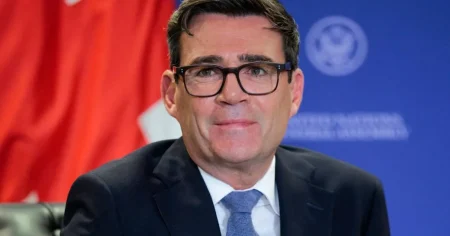

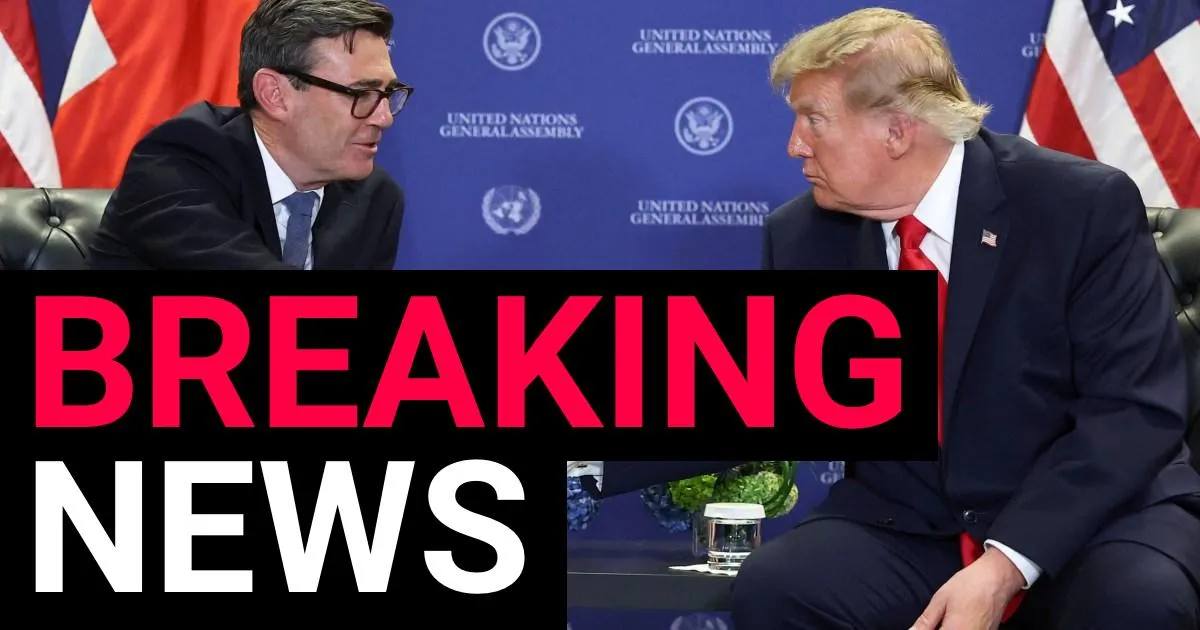
It was supposed to be a diplomatic photo-op, the sort of carefully stage-managed encounter that happens dozens of times during United Nations General Assembly week. But when Andy Burnham and Donald Trump sat down together in a cramped, low-ceilinged room in New York—described by one aide as a “crusty basement”—the script went pleasantly off the rails. This was the first meeting between the new British Prime Minister and the American President, and both men seemed aware that the cameras would capture every hand gesture, every smile, every loaded aside. Outside, the city hummed with the usual UN commotion: motorcades, security briefings, officials checking phones. Inside, the air was thick with diplomacy, ego, and the strange chemistry of two politicians who operate in very different registers. Trump, never one for understatement, opened by calling Burnham a “natural business person” and predicting he would be a “great Prime Minister,” while also taking care to mention everything from Rolls-Royce to energy to immigration. Yet the warmth came with a familiar edge: the President had just as publicly criticised the UK’s Chagos Islands deal, a decision that has stirred anxieties on both sides of the Atlantic. Burnham, for his part, did not arrive in New York simply to be charming. He came to make a point—and before the encounter was over, he had politely but firmly corrected the most powerful man in the world about the status of his own city. It was a moment of political theatre that revealed something deeper about the odd, compelling relationship now forming between these two very different leaders, and about the way Britain is trying to find its footing in a turbulent era.
For Burnham, the most important audience was not just the President but the British public watching at home. He had been waiting years for this small, symbolic victory. Trump had once referred to Manchester as “some town,” a dismissive phrase that had lingered in the north of England like a cold draught. As a former mayor of Greater Manchester, Burnham took that comment personally, and he was not about to let it slide in front of the world’s press. With a smile and a gentle lean toward the President, he said: “I like to remind the President every now and again that you once called the great city of Manchester ‘some town,’ and I don’t hold it against you as the former mayor.” It was disarming, cheeky, and unmistakably human. But Burnham quickly turned the joke into something bigger. He explained that he was patriotic, that Britain had been through too much turbulence, and that people feel a sense of not knowing where the country is going. The new Prime Minister spoke of laying out a ten-year direction for Britain, a plan to turn the national story into a positive one and generate hopefulness across the country. Leaning closer to Trump, he said, “And I think you were saying today that very much is how you see it, right?” It was a deft political move: by gently teasing the President about Manchester, Burnham made himself relatable, then immediately pivoted to the message he actually wanted to broadcast—that Britain is open, confident, and ready to move forward. The subtext was clear. He may be from the north, he may speak about community and fairness, but he could stand toe-to-toe with an American president and still hold his own.
Trump, for his part, was visibly comfortable with the exchange, even if he did not quite know what had hit him. The US President opened the meeting by declaring it an honour to be with the Prime Minister, praising Burnham’s “great election win” and predicting that he would do well because he has “a lot of assets on his side.” That phrase was vintage Trump: everything is transactional, everything is leverage. He said the two men had covered a lot, from Rolls-Royce to energy to immigration, and he called Britain “a really special country” that the United States is “with all the way.” Burnham answered with equal warmth, thanking the President and saying that the relationship matters enormously. He said he and Trump had established a good connection in their early discussions and had taken it further that day. The scene was almost theatrical: two leaders, one a former reality-TV star turned president, the other a boy from Leigh turned Prime Minister, performing mutual respect in a basement room that could have been a set for a political drama. There was flattery, yes, but there was also a sense of genuine engagement. Trump seemed to enjoy the back-and-forth, perhaps because Burnham did not grovel. Instead, the Prime Minister offered something Trump respects: directness, pride, and a willingness to disagree without being disagreeable. In the strange theatre of international diplomacy, that counts for a great deal.
The most telling moment came when Trump was asked about the state of UK-US relations. He could have given a bland answer about shared values and historical ties. Instead, he delivered a pointed comparison. “I think you’re up,” he said. “Well they’re more now than they were with your last prime minister, let me put it that way.” That was an obvious dig at Sir Keir Starmer, and it was exactly the kind of comment that makes British diplomatic handlers wince. But Trump was just getting started. He brought up the Rolls-Royce deal, calling it a deal that nobody else could make, and boasted that he had made sure Rolls-Royce was “properly taken care of.” Then came the strange detail: “We didn’t force them to do things like build the Rolls-Royces in Brooklyn, New York. We didn’t do that.” It was a bizarre aside, but it was also Trump’s way of saying he had been an unusually accommodating partner. He then circled back to Burnham, calling him a “natural business person” who “understands what he needs to do.” For Trump, those are the highest words of praise. He was not talking about ideology or welfare states or the NHS. He was talking about instinct, deals, and winning. Burnham, who spent his career in Labour politics, suddenly looked like a man who could speak Trump’s language without losing his own accent. That balancing act—being a progressive northern leader while earning the grudging respect of a Republican president—is no small feat.
Underneath the pleasantries, however, there was a serious geopolitical crack: the Chagos Islands deal. Trump had criticised the agreement, which has become a flashpoint in British politics and a source of tension with Washington. The Chagos archipelago, home to Diego Garcia, hosts a crucial US military base, and the deal involves handing sovereignty to Mauritius while leasing the base back to Britain and America. Critics on both sides of the Atlantic worry that it could undermine security in the Indian Ocean. Trump, never shy about voicing displeasure, made sure reporters knew he was not happy. Burnham did not directly confront the President on the issue in public, but he did not have to. His refusal to be thrown off message—his decision to steer the conversation back to Manchester, to patriotism, to a ten-year plan for Britain—was itself a subtle rebuttal. He was showing that the relationship between London and Washington is not a one-way street. The Prime Minister appeared to understand that Trump respects strength and clarity, and that the best way to handle a difficult conversation is to hold your ground while keeping the relationship warm. By the time the press conference ended, the striking image was not of a British leader being lectured by an American president, but of two men leaning toward each other, acknowledging that they see the world in different ways yet still need each other. That is diplomacy, messy and human.
What will linger from this meeting is not the basement setting or the photo lines, but the sense that Andy Burnham is determined to write a new chapter for Britain on the world stage. He did not simply stand up to Trump; he stood up for something. He talked about a country that has been knocked around, that has lost confidence, that has spent too long telling itself a negative story. His ten-year plan may be vague, but his message was clear: Britain will no longer define itself by its recent turbulence. Instead, it will lean on its assets—its people, its culture, its engineering, its creativity—and turn the narrative around. Trump seemed to pick up on that energy, and for once, he sounded almost optimistic about Britain’s future. There is something human about the whole scene: the new Prime Minister, only months into the job, flying across the Atlantic to face a president who dismantles diplomatic norms as a hobby. Burnham could have played it safe. He could have smiled, said all the right things, and avoided any friction. Instead, he gently mocked the man in the most powerful job on Earth and then asked him to be part of a positive vision. It was a gamble, but it seems to have worked. In the end, the meeting was never really about the Chagos Islands or even about Rolls-Royce. It was about respect. And in that echoing, windowless room beneath the UN, Andy Burnham earned his share without losing his soul. The photographs show two leaders, one in a blue suit, the other in a dark one, standing close, smiling, none of the tension visible to the naked eye. But the real story is underneath, in the words, in the asides, in the refusal to bow. It is the story of a British leader who knows where the power lies, but also knows who he is. That, perhaps, is the most hopeful sign yet.