


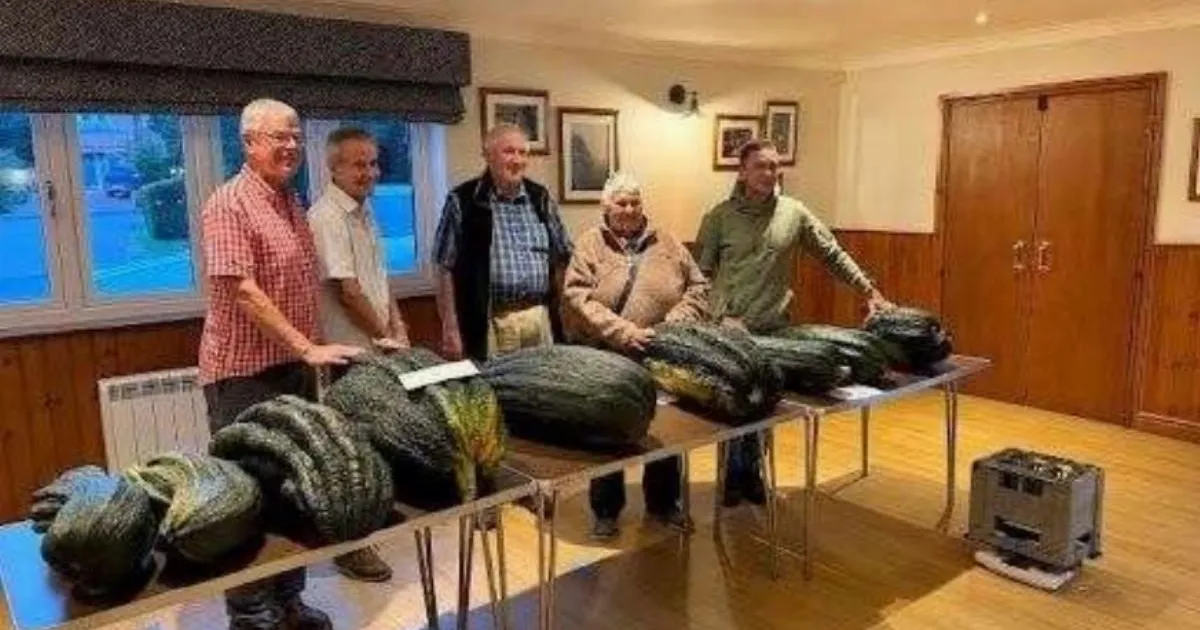
On a crisp late-summer morning in the Lincolnshire village of Stubton, the modest village hall was transformed into a spectacle of giant produce. Tables groaned under the weight of marrows so large they looked more like misshapen boulders than vegetables, while one particular carrot stretched the entire length of a judging table, its orange tip curling ever so slightly at the end. This was Stubton’s annual vegetable competition, a much-loved event that had drawn people from across the parish to celebrate the quirks, triumphs, and occasional absurdities of local gardening. In a scene that could have come straight from a novel about village life, groups of neighbours leaned over entries, exchanging growing tips, shaking their heads at the weather, and cheering as the winners were announced. By the end of the day, one name was on everyone’s lips: Mike Libby, a gardener whose achievements will now be remembered in Stubton folklore. Mike walked away with not one but two coveted prizes: first place for the longest carrot, measured at an astonishing full metre, and first place for the heaviest marrow, which tipped the scales at 30.5 kilograms. For most people, producing one such vegetable in a lifetime would be a story worth telling. Mike did both in the same year, and he did it with a modest shrug and a smile, insisting that the real joy of the day was the community coming together. The hall, decorated with hand-written labels and carrying a faint smell of damp earth and fresh leaves, felt less like a competition and more like a harvest festival of neighbours proud of what they had grown and eager to share the stories behind their entries. Children darted between the tables, pointing at the giant vegetables with wide eyes, while older residents recalled shows from decades past. There was laughter, friendly banter, and the unmistakable sense that this small village had found something worth gathering for.
The longest carrot competition, which proved to be one of the most hotly contested events of the day, attracted eleven hopeful entrants. Their carrots, laid out like exhibits in a museum, ranged in length from a relatively modest 170 millimetres to the full metre that Mike had managed to coax from his soil. It was a dominant performance, but he was not alone on the podium: Ted Critchley secured second place with a carrot of considerable length, while Cath Senior took third, earning admiring nods from the assembled crowd. The competition, however, had humble beginnings. Mike recalled that the whole idea of a longest carrot contest started not as an official village event, but as a small private challenge between two friends, Ted Critchley and Ian Phillips. What began as a bit of banter between gardeners soon grew into something larger, and around five years ago the challenge was opened up to the whole of Stubton. Since then, the competition has become a fixture in the village calendar, with residents eagerly planting their carrots early in the year and secretly measuring them in their gardens as autumn approaches. Mike laughed as he described how the entire village is told when the contest begins, making sure nobody can claim they missed the chance to enter. The measuring itself is a precise operation: each carrot is measured from the top of the orange to the bottom of the roots, with no allowances made for stretched stems or creative interpretations. The sight of those long orange specimens lined up on the table, their green tops trimmed back to reveal every centimetre of growth, was a testament to the patience and care that went into producing them. For Mike, the carrot competition holds a special charm precisely because of the mystery involved; until the day of the show, nobody has any idea how their rivals have done, and the first time the carrots are revealed is the moment of truth. It is a moment of genuine suspense, the kind that makes gardeners feel like children on Christmas morning, and it is what keeps them coming back year after year.
Mike’s passion for giant vegetables did not end with carrots. The heaviest marrow competition, which has quickly become one of the most dramatic events of the show, was his own creation, born out of an unexpected encounter a few years ago. Mike explained that he had been inspired by a friend who ran a shop in the Lake District and held the title of North West Giant Marrow Champion. On a visit to the shop, Mike noticed a newspaper clipping displayed behind the counter, a photograph of his friend standing next to a marrow that was nearly as big as he was. The image stuck in Mike’s mind. As a gardener, he was immediately fascinated, and the two men fell into conversation about how such a thing was possible. Before Mike left, his friend gave him a handful of seeds, a gift that would eventually transform Stubton’s village competition. Mike invited other people in the village to have a go at growing their own giant marrows, and so the challenge was born. This year, nine entries were submitted, with weights ranging from a jaw-dropping 8.5 kilograms to the winning 30.5 kilograms. Once again, Mike took first place, but he was closely followed by Lindsay Critchley in second and Tony Gelsthorpe in third. Although the marrows were smaller than those entered the previous year, Mike was not disheartened. He put the difference down to the challenging weather, which had made it particularly difficult for growers to coax their plants into producing enormous fruit. The marrows themselves, with their thick, bumpy skins and bloated bodies, sat on the table like strange sculptures, each one a little different in shape and colour. Growing them, Mike noted, requires an enormous amount of space, and villagers are already racking their brains for the next unlikely competition they can dream up to keep the community entertained. There is something delightfully mad about the idea of deliberately growing a vegetable to be as heavy as a small child, yet the laughter and pride on the faces of the growers suggested that this particular madness was a wonderful thing.
Alongside the headline acts of carrots and marrows, Stubton’s show included a series of other competitions that added to the sense of fun and friendly rivalry. The potato-in-a-bucket competition proved to be the most popular event of the day, attracting around forty-five entrants of all ages. The rules, as far as anyone could tell, were delightfully simple: grow a potato in a bucket, bring it along, and hope it outshines the rest. There is something inherently charming about the idea of a potato, a vegetable so humble that it is usually hidden away underground for months, suddenly being brought into the light for its moment of glory. Mike noted that this is exactly what makes the potato and carrot competitions so appealing: unlike marrows, which sit visibly swelling in the garden for weeks, you cannot see what is happening beneath the soil until the moment you unearth it. The element of surprise is part of the fun. The official business of measuring and weighing was overseen by parish council chairman Sam Kirk, who carried out his duties with the solemn air of a man judging a national championship. He was ably assisted by his son Ralph, who took his responsibilities very seriously, making sure each vegetable was placed exactly right on the scales and that the tape measure was held perfectly straight. For Sam, the event was about more than just numbers; it was a way of celebrating the hard work and good humour of the village. The potato entries alone filled several buckets, and the sight of them was enough to make even the most seasoned gardener smile. Some were enormous, some were oddly shaped, and some seemed determined to resemble something other than a potato, but all were entered with the same spirit of enthusiasm. The competition categories, from the serious to the faintly absurd, reflect a community that is not afraid to laugh at itself while still taking immense pride in what it produces. It is this balance of seriousness and silliness that makes the day so memorable.
Throughout the day, a recurring theme emerged from conversations among the growers: this year’s weather had been particularly difficult. Ted Critchley, who had already claimed second place in the carrot competition, summed up the general feeling when he said that the weather had been especially challenging for everyone. But, as he was quick to add, “it’s all just for a bit of fun.” That phrase, repeated in various forms by the competitors, seemed to capture the spirit of the entire event. No one was going to let a little rain, or perhaps too much rain, or the unseasonable cold, spoil the enjoyment of getting together and showing off their produce. The challenges were real, and Mike himself acknowledged that the marrows were not as enormous as they had been the previous year. Yet the tone of the day was overwhelmingly cheerful. The growers swapped stories of sleepless nights before the competition, of measuring their carrots with a tape measure in the moonlight, of building elaborate frames to protect their marrows from slugs. They laughed about the absurdity of devoting so much time to vegetables that would ultimately be eaten or, in some cases, displayed on a mantelpiece until the next season. The friendly rivalry between neighbours was palpable, but it was the kind of rivalry that brings people closer together rather than driving them apart. Ted’s comment, delivered with a grin, was a reminder that at its heart, the Stubton vegetable competition is not about winning at all. It is about the joy of planting a seed, nurturing it, and watching it grow, and then sharing that experience with others who understand the strange satisfaction of producing a carrot that looks like it belongs in a record book or a marrow that requires two hands to lift. In a world that often moves too fast, there is something grounding about gathering in a village hall to admire the slow, patient work of a growing season.
By the time the last prize had been handed out and the hall began to empty, the conversation had already turned to next year. Mike and his fellow gardeners are racking their brains for new forms of competition, a phrase that suggests Stubton’s vegetable show will only continue to grow in imagination. The success of this year’s event, with its giant marrows, metre-long carrots, and buckets of potatoes, has shown just how much appetite there is for these gatherings. In an age when many traditional village events are fading, Stubton appears to have found a formula that works: keep it simple, keep it local, and do not take it too seriously. The competition is a reminder of the value of community, of the simple pleasure of seeing something you have grown with your own hands admired by your neighbours. For Mike, the double win was undoubtedly a personal triumph, but he was far more eager to talk about the people who had taken part, the seeds given to him by his Lake District friend, and the enjoyment of watching others discover the strange thrill of growing giant vegetables. The parish council chairman, Sam Kirk, and his son Ralph were already being asked whether they would return to officiate next year, and the answer, one suspects, is a warm yes. Stubton may be a small village, but its vegetable competition has a big heart. It brings together generations, teaches a little about patience and persistence, and provides a welcome excuse for a community to spend a day surrounded by carrots, marrows, potatoes, and laughter. In a world that often feels complicated, there is something wonderfully straightforward about a competition that rewards a person for growing the longest, heaviest, or perhaps just the most unusual vegetable. As the growers packed up their prized produce and headed home, the talk was of new challenges, better seeds, and the hope that next year’s weather would be a little kinder. But win or lose, the real triumph of the day was the community itself, standing together in a village hall, celebrating the simple miracle of things that grow and the enduring joy of sharing that miracle with neighbours.