
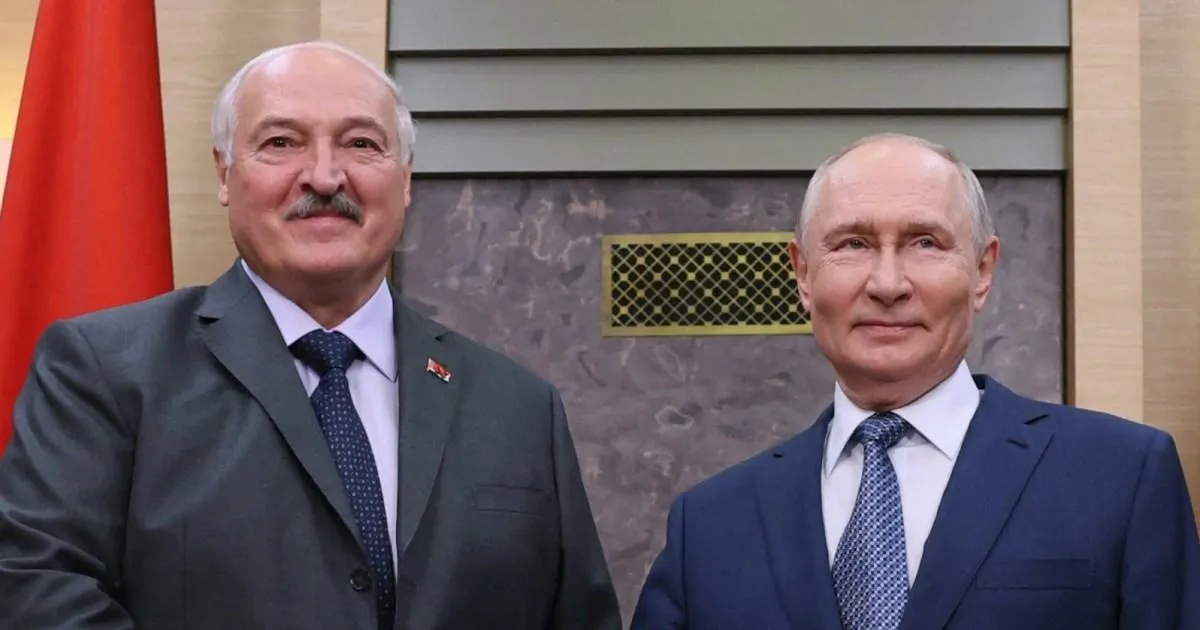
Imagine two men, both condemned for years as autocrats, sitting together and joking about which one of them is the bigger dictator. That was the scene at a youth forum in Minsk, where Belarusian President Alexander Lukashenko revealed that he and Russian President Vladimir Putin often have exactly that conversation. “They say I’m the last dictator, the last dictator in Europe. Dictator — so be it. Well, Vladimir Vladimirovich Putin and I often argue, jokingly, about which of us is the bigger dictator,” he said, according to Novaya Gazeta, an independent Russian newspaper now reporting from exile. The comment was classic Lukashenko: defiant, self-aware and wrapped in a layer of dark humour. He has ruled Belarus, one of Russia’s neighbours, since 1994, making him one of the longest-serving leaders in Europe. Putin, meanwhile, has been in charge of Russia since 2012, having previously served as president from 2000 to 2008, and as prime minister from 1999 to 2000 and again from 2008 to 2012, serving under President Dmitry Medvedev. Both men have faced accusations of rigging elections, silencing opponents and crushing independent media. Yet here they were, laughing about the very label that the West has used to condemn them. It was a moment that revealed something important about the psychology of authoritarian power: once you have been called a dictator for long enough, you can either fight the word or own it. Lukashenko has chosen to own it. By turning the insult into a joke, he tried to take away its sting. But the joke also exposed how comfortable he has become with his own reputation, and how far removed he is from the democratic norms that most of Europe claims to uphold. For many observers, the image of the two men sharing a laugh was a reminder that tyranny can be casual, even friendly, and that the most dangerous ideas are often dressed up as ordinary conversation.
Yet for all the bravado, Lukashenko has spent years sending out a curious mixed message: he wants people to believe he is tired of power, but he also wants them to know that no one else can handle it. At the same youth forum, officially called Youth. Belarus. Future, he said he has had enough of the presidency and would happily step down, but he does not think anyone is ready to take over. “The only question is whether you’re able today to take the country and hold on to it,” he told the young audience. “If you are, get to work tomorrow. To be honest, I can’t yet say that you are.” According to the independent outlet Zerkalo, he has claimed at least twenty times over the past six years that he is “sick” of the presidency. This is a familiar pattern for autocrats who want to appear reluctant to hold power while making it clear that they are indispensable. It is a way of shifting blame onto the people around them: the problem is not that he refuses to leave, but that no one is worthy of succeeding him. There is something almost tragic in the repetition. A man who has spent nearly three decades in office, who has weathered protests, sanctions and international isolation, still cannot bring himself to imagine a future without himself at the centre. He speaks of weariness, but his actions tell a different story. He clings to control, reshapes the constitution to extend his rule, and crushes any sign of opposition. The fatigue he describes may be real, but it is overshadowed by a deeper fear: the fear of what happens when the power is gone. In that sense, his repeated complaints about being sick of the presidency are not a resignation letter. They are a survival strategy, a way of reminding everyone that the system he built is so dependent on him that stepping aside would be irresponsible. It is a lonely argument, and one that has kept him in power for decades, even as the country around him has grown more isolated and more dependent on Russia.
Lukashenko’s willingness to embrace the dictator label did not come out of nowhere. He has long claimed that he “became a dictator” when he stood up against the entire “civilised world” over Belarus’s nuclear weapons after the collapse of the Soviet Union. In his telling, the West demanded that Belarus give up its nuclear arsenal and destroy its weapons stockpile, and he refused to simply bow to those demands. That defiance, he says, is what earned him the title. The story is part of his larger self-image as a man who protects Belarus from foreign interference, even if the world despises him for it. Whether or not his version of events is historically precise, it has become a powerful part of his political mythology. He also acknowledged that his views on Ukraine and his decision to build a nuclear power plant have added to the label. The nuclear power plant, in particular, has been a source of tension with Lithuania and the European Union, with concerns about safety and geopolitics. For Lukashenko, these controversies are badges of honour. He seems to believe that if the West calls him a dictator, he must be doing something right. It is a classic authoritarian mindset: the enemy’s criticism is proof of one’s strength. But the nuclear issue also points to a deeper truth about Belarus’s place in the world. After the Soviet Union collapsed, Belarus remained incredibly close to Russia, and that closeness has defined its politics ever since. Lukashenko’s refusal to distance himself from Moscow, and his willingness to use nuclear rhetoric as a weapon, have made Belarus a flashpoint in European security. His joke about being a dictator, then, is not just a personal quip. It is a reference to a long history of confrontation, a history that has left Belarus isolated but, in Lukashenko’s eyes, unbowed. It is also a way of rewriting his own story, turning what others see as reckless behaviour into a heroic stand against foreign pressure.
At the forum, Lukashenko also offered a stark warning about what would have happened if Belarus had tried to break away from Russia. He claimed that efforts to distance Belarus’s relationship with Moscow could have ended badly, and he explicitly linked the 2020 election protests in Belarus to the war in Ukraine. “If it had succeeded, we would have had what is happening in Ukraine now,” he said, referring to the mass protests that erupted after he claimed victory in a vote widely seen as rigged. It was a chilling statement, and one that revealed how he sees the world. In his mind, the protests were not a genuine demand for democracy; they were an attempted coup, a Western-backed plot to drag Belarus into chaos. And the war in Ukraine, in his telling, is not a brutal invasion but a cautionary tale about what happens when a country turns away from Russia. This is the narrative that has kept Lukashenko aligned with Putin, even as Russia’s war has brought death and destruction to Ukraine. For Lukashenko, survival is the only ideology that matters. He needs Russia’s support to stay in power, and Russia needs Belarus as a loyal ally on NATO’s border. It is a marriage of convenience, but one that has become increasingly difficult to ignore. The 2020 protests were the closest Lukashenko has come to losing power. Hundreds of thousands of people took to the streets, and for a moment it seemed as though the regime might fall. But he held on, with Putin’s backing, and the crackdown that followed was brutal. By invoking Ukraine, he was not just justifying his own actions; he was warning Belarusians that the alternative to his rule is not freedom, but war. It is a dark and cynical argument, but one that has worked. The fear of ending up like Ukraine has helped him maintain a grip on a population that has seen what happens to countries that defy Russia, and it has also deepened the sense that Belarus has no real future outside Moscow’s orbit.
Outside Belarus, however, the world has not accepted Lukashenko’s version of events. The European Union has had sanctions in place on Belarus since 2020, and those sanctions are currently set to remain in force until February 2027. Lithuania’s Minister for Foreign Affairs, Kęstutis Budrys, has been among the most vocal advocates for keeping the pressure on Minsk. “We do not see any reasons why our position on Belarus should soften as Belarus is not changing its behaviour,” he told Reuters. “On our side, we have to be very exact and continue what works, and that is the pressure on the regime.” The sanctions are not just about punishing Lukashenko; they are about trying to force a change in behaviour. But so far, they have not succeeded in loosening his grip on power. Instead, they have deepened Belarus’s dependence on Russia, pushing the two countries even closer together. The regime has become more isolated, but also more entrenched. For ordinary Belarusians, the cost has been high. The country is cut off from much of Europe, its economy is struggling, and its political opposition has been largely crushed or driven into exile. Yet Lukashenko remains in place, and he continues to speak as though he is the victim, not the cause, of the country’s isolation. The international community’s response has been firm, but it has also been limited. There is little appetite for military intervention, and no clear path to a political transition. The sanctions are a statement of principle, but they are also a recognition that the tools available to the West are not enough to change the reality on the ground. For now, the pressure continues, but so does Lukashenko’s rule. The joke he made with Putin about being dictators may have been lighthearted, but the situation it reflects is anything but. Belarus is a country caught between a repressive leader and a powerful neighbour, and the rest of Europe can only watch and wait, hoping that pressure will eventually produce change while knowing that it may not.
In the end, the image of Lukashenko and Putin joking about dictatorship is almost too perfect a metaphor for the strange world they inhabit. Here are two men who have spent their careers being condemned by the West, sanctioned by democratic governments, and accused of crushing their own people, and yet they can sit together and laugh about it. There is a dark humour in that, but also a warning. Authoritarianism is not always a shouting, angry thing. Sometimes it is comfortable, familiar, even funny. The joke about who is the bigger dictator is a way of normalising something that should never be normal. It turns a serious accusation into a game, a competition between friends. It also reveals how far the two leaders have drifted from the values that much of Europe claims to hold. For Lukashenko, the label of “last dictator in Europe” is not a shameful burden; it is a title he wears with a shrug. He has said he is sick of power, but he has also made it clear that he will not let it go. He has warned of the dangers of distancing from Russia, but he has also made Belarus more dependent on Moscow than ever. He has faced sanctions, protests and international isolation, and yet he remains, seemingly unbothered, making jokes at a youth forum. Maybe that is the most human thing about him: the ability to keep going, to laugh at his own reputation, to convince himself that he is the only one who can hold the country together. But for the people of Belarus, the joke is not funny. They live with the consequences of his choices every day. And as long as Lukashenko and Putin can laugh together about being dictators, the rest of the world cannot afford to look away. The laughter is not a sign that things are fine. It is a sign that the two men have made peace with who they are, and that is perhaps the most frightening thing of all.