
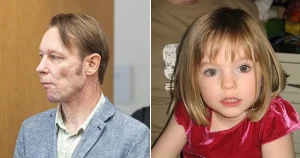


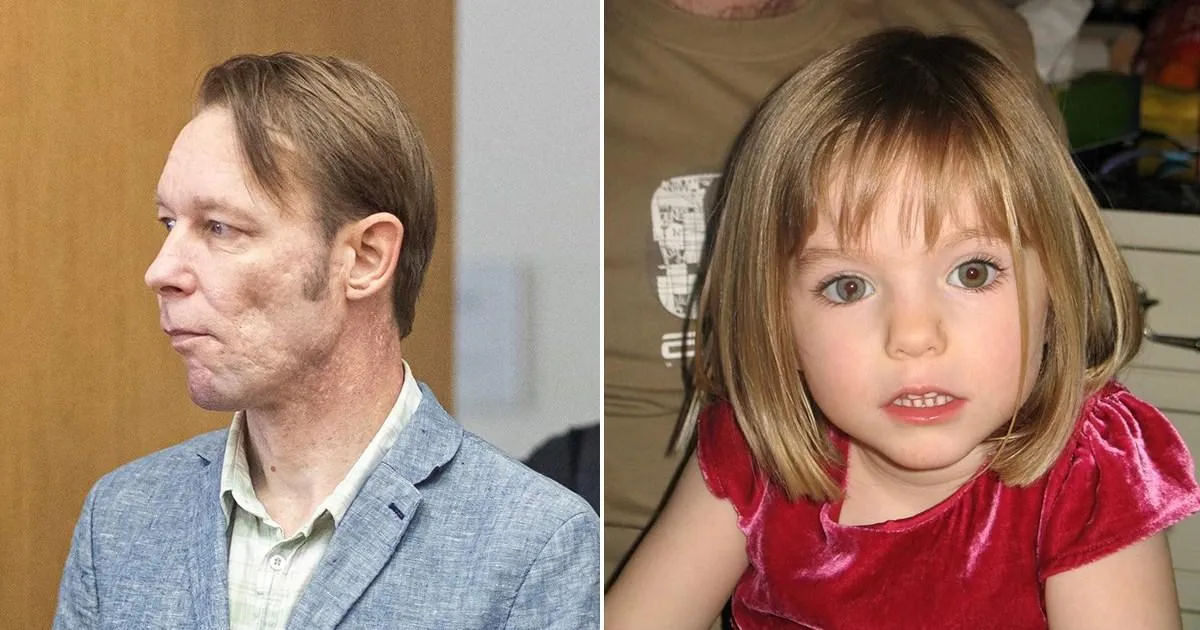
For more than seventeen years, the name Madeleine McCann has carried with it a mixture of heartbreak, mystery, and public fascination. Few missing-person cases have gripped the world so completely, and few have left so many lingering questions. The little girl who vanished from a holiday apartment in Praia da Luz, Portugal, in May 2007 would be a young woman today, but instead she remains frozen in memory as a three-year-old with bright eyes and a trusting smile. Her disappearance tore through the quiet world of a family holiday, leaving behind a pain that has never faded. Now, in yet another strange and unsettling twist, the man formally identified by German police as the prime suspect in her case is reportedly planning to turn his version of events into a memoir. Christian Brueckner, who has always insisted that he had nothing to do with the child’s disappearance, reportedly wants to publish a tell-all book that would be sold in both German and English. For Madeleine’s parents, Kate and Gerry McCann, the news can only feel like another cruel turn in a long ordeal. The thought of a man suspected of taking their daughter profiting from her name is almost unbearable. Retired British police detective Kevin Moore put it bluntly when he told reporters that he would not buy such a book, describing the idea as “abhorrent.” It is hard to disagree. Yet the legal reality remains that Brueckner has never been charged with any offence connected to Madeleine’s disappearance, and in the eyes of the law, he remains a suspect rather than a convicted criminal. That distinction, though important, does little to soften the outrage many people feel at the idea of him cashing in on the tragedy.
According to reports, Brueckner is already working on a first draft of the manuscript and has approached at least one professional writer to help him shape his story. The plan is ambitious: he wants the memoir to be published in both German and English, reaching audiences across Europe and beyond. An unnamed insider has said that Brueckner is “desperate to tell his side of the story” and genuinely believes that writing about his innocence will help him. The same source added that Brueckner also sees the book as a way to secure his financial future. Whether any publisher would actually take on such a project remains unclear, but Brueckner has reportedly told friends that he believes the memoir could earn him a seven-figure sum. His advisers, however, are said to be far more cautious, and the final figure, if the book ever appears, could be much smaller. Still, the very fact that he is considering this speaks to a peculiar and uncomfortable side of modern media culture, in which notoriety itself can become a commodity. A man linked to one of the most famous missing-child investigations in history does not need to have been convicted in order to attract attention, and for some, attention is its own kind of currency. But for the McCann family, the news has a darker meaning. They have spent more than half a lifetime searching for answers, asking questions, and trying to keep their daughter’s memory alive. The prospect of a suspected figure from that story sitting down to write a book, perhaps with the aim of reshaping public perception and earning money, must feel like a violation of everything they have fought for. It turns their daughter’s disappearance into a story to be marketed, and that is something no parent should ever have to endure.
The background to all of this is as haunting as any true-crime drama. Madeleine’s parents had left their three children sleeping in the holiday apartment while they dined with friends at a nearby restaurant in the resort complex. At around 10 p.m., Kate McCann discovered that Madeleine was missing. The search began almost immediately, but no trace of the little girl was ever found. Despite one of the largest missing-person investigations in European history, the case remains unsolved in the formal sense. For years, suspicion moved in many directions, and the parents themselves were briefly treated as suspects by Portuguese police before being cleared. Then, in 2020, thirteen years after Madeleine vanished, German authorities announced that they had identified Christian Brueckner as the prime suspect. Brueckner, now 49, has a criminal history that includes convictions for other offences, and at the time of the announcement he was already in prison in Germany for rape. He has consistently denied any involvement in Madeleine’s disappearance and has never been charged with it. But the sheer weight of suspicion has followed him ever since. For the McCanns, the identification was both a new ray of hope and another source of pain. Finally, there was someone the police believed could be responsible, but still there was no charge, no trial, and no verdict. The family has learned to live in a strange limbo, caught between hope for justice and the crushing reality that their daughter may never be found. The idea that Brueckner might now be writing a memoir while that legal limbo continues only adds to a sense of injustice. It is as if the system, the media, and even the suspect himself are all moving forward, while the search for a lost child remains stuck in time.
Brueckner has historically said very little about where he was on the night Madeleine disappeared, but now he has made an admission that raises still more questions. In a recent interview with the Mail on Sunday, he acknowledged that he was just 150 yards from the holiday apartment where the McCann family was staying. He said he was on the beach that night, not far from the hotel, selling drugs. His story goes that he had been in Spain and smuggled cannabis into Portugal, and that he spent part of the evening dealing drugs near the resort. He also claimed that his van was stopped by police three times that evening, but that on each occasion he was not searched. “Luckily they didn’t find the drugs,” he was quoted as saying. When asked why he had stayed silent about his whereabouts for so many years, he said that he had been afraid because he believed the police wanted to frame him for Madeleine’s disappearance. His explanation is deeply unsettling. It places him exactly where a child vanished, at exactly the right time, and yet he insists it was only a coincidence. For investigators, such an admission is likely to be of enormous interest, even if it is not proof of guilt. It is the kind of detail that could have been checked long ago, and it raises the question of why he did not come forward with this information when the investigation was in its early days. Whatever one believes about his guilt or innocence, the image of a convicted offender sitting on a beach near a holiday complex, dealing drugs, and being stopped repeatedly by police on the very night a child disappeared from a nearby apartment, is one that refuses to fade. It does not convict him, but it certainly does not put his mind at ease.
The legal picture around Brueckner is shifting, too, and that adds another layer of complexity to the idea of him writing a book. He was cleared of rape in 2024, but he is due back in court in Germany for an appeal hearing in January. According to reports, that hearing is likely to be followed by a retrial. A source close to the case in Germany described the upcoming court date as a “gamechanger” for those who want to see Brueckner charged over Madeleine’s disappearance. The source explained that, under the German legal system, every part of the original trial will be reconsidered, and the judge overseeing the process is said to be exceptionally sharp. “She will miss nothing,” the source said. Perhaps most importantly, the source suggested that Madeleine’s investigators are beginning to feel, for the first time, that there is a genuine will to see a retrial and for something to be done about Brueckner. For the McCann family, every legal development offers a fragile thread of hope. They have spent years watching courtroom dramas unfold, hearing legal arguments, and waiting for some kind of resolution that never seems to arrive. The news that a retrial may be in sight is the kind of development that could change everything, not only for him, but for Madeleine’s case as well. At the same time, it makes the prospect of a memoir even more troubling. A man whose legal situation is still active, who remains a suspect in the disappearance of a child, and who has yet to face formal charges in that case, would be writing about his life while the courts are deciding his fate. That does not sound like a search for truth. It sounds like an attempt to shape a narrative, to win sympathy, and perhaps to make money from a story that is not his to tell.
In the end, the possibility of a memoir by Christian Brueckner forces us to confront some uncomfortable questions about justice, memory, and the ethics of telling painful stories. Madeleine McCann is not just a name in a headline. She was a real child, loved by her parents, adored by her siblings, and infinitely precious to everyone who knew her. Her disappearance left a hole in an entire family that can never be filled, and the years have only made the waiting more cruel. Whatever Brueckner writes, whatever stories he tells, and however much money he hopes to make, none of it will bring her home. None of it will answer the question that her parents have carried in their hearts every single day. If his memoir is ever published, it will not be a contribution to justice; it will be a reminder that even the most terrible tragedies can be turned into entertainment. It is easy to understand why so many people would refuse to buy it, and why so many would find the whole idea repulsive. But there is also something undeniably human in the instinct to tell one’s own story, especially when the world has judged you in the most public and brutal way. Brueckner may genuinely believe that he has been wronged, that the police have focused on him unfairly, and that his voice has never truly been heard. That possibility does not excuse the idea, but it does make the situation more complicated. For Kate and Gerry McCann, the truth is simpler and more devastating. Their daughter is still missing. A man suspected of taking her is planning to profit from her story. And somewhere, in the silence left by a little girl’s disappearance, the truth remains hidden. Perhaps one day the courts will reveal it, but until then, the world must choose what to read, what to believe, and whose story deserves to be told. Madeleine deserves better than a suspect’s memoir. She deserves the truth.