


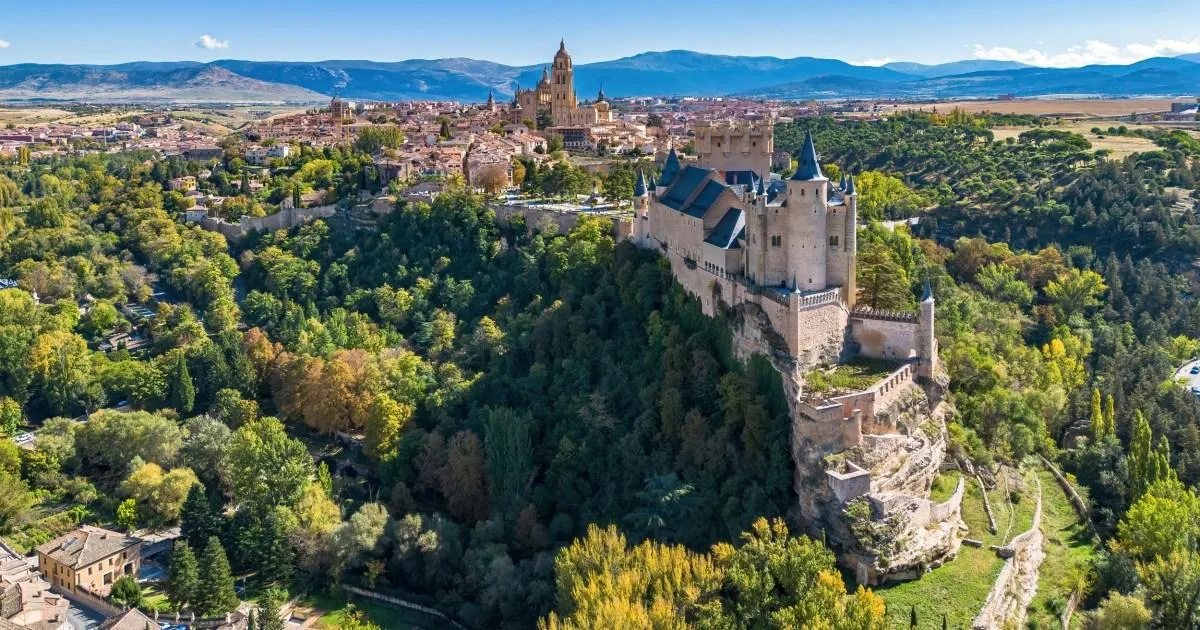
In a quiet, unassuming town in central Spain, a shocking discovery shattered the silence of a family home. For over a year and a half, a 25-year-old man had been living alongside a secret too heavy to bear: the preserved body of his deceased father, carefully concealed in a wardrobe. When the Spanish Civil Guard finally entered the house in Torrecaballeros, near the historic city of Segovia, they found the remains exactly where the young man admitted they would be. The father was believed to have died of natural causes, though his age at death remains unknown, and the circumstances surrounding his final days are still under investigation. The son, in a moment of confession that must have felt like both relief and surrender, told officers that he had hidden the body for about eighteen months, all while continuing to claim his father’s pension. It is a story that seems ripped from the pages of a dark novel, yet it is all too real—a poignant, unsettling reminder of how grief, financial desperation, and perhaps an inability to let go can twist the human heart into choices that defy logic and morality.
The young man now faces the possibility of up to two years in prison if charged with concealing the whereabouts of a corpse, but authorities have not ruled out more serious allegations, including fraudulently collecting his father’s pension for more than a year and accessing a deceased person’s finances. As the investigation unfolds, questions mount about how such a situation could persist unnoticed. Was it purely economic gain, or was there something deeper—an unwillingness to accept the finality of death, a pathological denial, or a desperate attempt to preserve a semblance of normalcy in a household already fractured by loss? The father’s body, stored in a wardrobe as if it were an old coat, speaks to a chilling compartmentalization of the mind. For those who knew the family, the revelation has been devastating. Neighbors describe a quiet household, unremarkable in every way, where the father was simply not seen for months. No one asked too many questions, or perhaps no one wanted to. This case is not isolated; it echoes similar incidents across the world, where people who should be grieving instead turn to macabre concealment, blurring the line between love, loss, and larceny.
Only a month earlier, thousands of miles away in Greece, a 55-year-old man from the Peloponnese was arrested for hiding his dead father in a basement freezer for two and a half years. He had told investigators that his father had moved to Athens, a lie that unraveled when authorities discovered the cottage in a former hotel in the town of Mystras. In 2023, two Canadian hikers stumbled upon an even more bizarre scenario in a cave some 250 kilometers from the Italian region of Puglia—the body of Bruno Delnegro, an 81-year-old man, hidden by his own sons. The family had wrapped his body in a sleeping bag and driven it across the country to a remote village, all in order to continue claiming his €3,000-a-month pension. In each of these cases, the motivation appears to be financial, but the sheer extremity of the actions reveals a deeper dysfunction. These are not cold-blooded murderers; they are ordinary people, often acting out of fear and panic, who then find themselves trapped in a spiraling web of lies. The initial decision to hide a death may stem from a sudden, primal unwillingness to face the end of a life—and the end of an income—and then becomes a secret that consumes them.
From a psychological perspective, hiding a loved one’s body is a profound manifestation of unresolved grief and denial. The impulse to preserve a corpse, to keep it close, is almost vampiric in its intensity, yet it is also deeply human. In some rare cases, people have been known to keep deceased relatives at home because they cannot bear to say goodbye, treating the body as if it were still a sleeping occupant. But when the body is hidden for the purpose of claiming benefits, the motive becomes mercenary, though not always purely so. A son who relies on his father’s pension may think only of survival—he may fear losing the family home, or being unable to pay basic bills. He hides the body not out of malice, but out of a catastrophic inability to cope with the realities of death and debt. There is also an element of social disconnect; modern life often isolates us from death, and when it comes, we are unprepared for the administrative and emotional burdens that follow. Instead of calling a doctor or an undertaker, these people compartmentalize, convincing themselves that as long as the body is undiscovered, the person is not truly gone. It is a fragile, tragic illusion, one that eventually crumbles under the weight of time, as odors, suspicions, and financial anomalies begin to surface.
Legally, these cases often result in relatively light sanctions for corpse concealment, but the economic crimes can carry heavier sentences. In Spain, the maximum penalty for hiding a corpse is two years, but fraud and financial exploitation could extend that. The systemic failure in such situations is that pension systems are often slow to verify whether beneficiaries are still alive, especially in rural communities where paperwork is scarce and digital records are incomplete. This creates an opportunity for those who are grieving and financially desperate to exploit a loophole, and once they cross that line, there is no going back. The authorities eventually close in, but not because they are actively hunting for such crimes; rather, they stumble upon them through other investigations, a missed renewal, a tipped-off neighbor, or a strange smell. Behind every such headline is a family destroyed twice—once by death, and again by the cover-up. Communities are left to wonder how they missed the signs, and the surviving relatives must live with the shame of having desecrated the memory of their loved one in the name of a bank balance. It is a deep betrayal of trust, not just of the dead, but of the entire social contract.
These stories, bizarre as they are, force us to confront our own attitudes toward mortality, money, and the bonds that tie generations together. We read them with a shiver of revulsion, but also with a flicker of understanding. For in the terrifying silence of a home where a father’s body rests in a wardrobe, or a freezer, or a cave, there lies a human being who was so desperate—or so paralyzed by grief—that he abandoned the rituals of death that have comforted humanity for millennia. We cannot excuse the fraud, nor the disrespect shown to the departed. But we can choose to see past the headlines and recognize the loneliness, the fear, and the brokenness that must have crept through that house day after day. The young man in Segovia is not a cartoonish villain; he is a grieving son who made a terrible choice and then had to live with it, waking every morning to the weight of a secret that eventually consumed him. As the judicial system processes these cases, society would do well to ask how we can better support families in their moments of deepest vulnerability, so that no one feels that the only way to keep a father present is to hide him in the dark. Ultimately, these are tales of love gone wrong, of survival mistaken for greed, and of the desperate lengths to which we go when we believe we have no other options.