


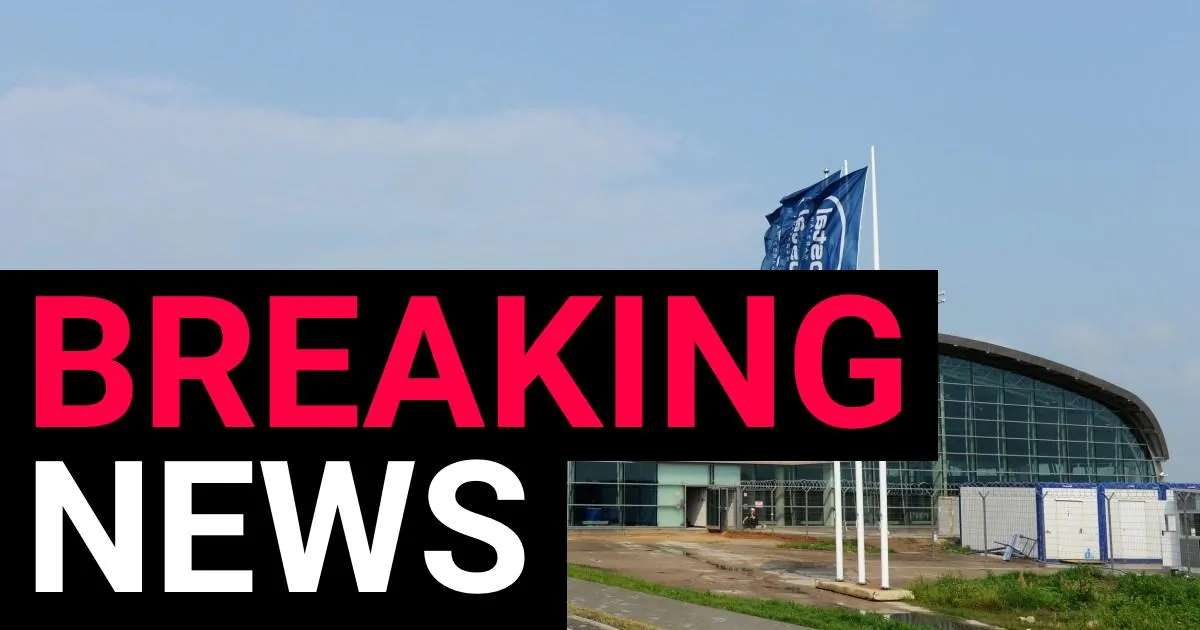
At a moment when the cabin lights blinked on and the familiar hum of the engines changed to something quieter, the passengers on LOT Polish Airlines flight LO286 realized that this was not going to be a routine arrival. The plane had taken off from London with the easy promise of a short hop across Europe to Warsaw, but as the aircraft approached Polish airspace, a shiver of alarm ran through the flight deck and the cabin. The pilot’s voice, calm but carrying a weight that no traveler wants to hear, announced that the aircraft would be making an unscheduled landing. The destination was not Warsaw Chopin Airport as planned, but the smaller Warsaw-Modlin airport, chosen as a precaution. On board were 181 people, each with their own story, their own itinerary, their own loved ones waiting at the other end. Some were heading home after a business trip; others were visiting family, starting holidays, or simply connecting through Poland to somewhere else. In the space of a few minutes, their ordinary journey was transformed into an uncertain ordeal. The reason for the diversion was a bomb threat. Somewhere in the chain of communication, an anonymous report had suggested that an explosive device might be on board. Nothing had been confirmed, but in the world of modern aviation, any warning is taken seriously. The airport statement was terse and official, but behind the bureaucratic language lay a highly tense scene. Security services were verifying the reported threat. The airport was closed until further notice. Bomb disposal experts were expected to inspect the aircraft and every piece of luggage. For the passengers, the news arrived in fragments, through murmurs, through the sight of emergency vehicles on the tarmac, through the sudden presence of uniformed officers. The plane touched down safely, and in that moment, relief mixed with fear. No one knew if the threat was real, if a device was hidden in the cargo hold, or if this was simply a cruel hoax. What mattered was that they were down, alive, and in the hands of professionals.
Once the aircraft rolled to a stop at Warsaw-Modlin, the normal rhythm of an airport arrival dissolved into a carefully choreographed emergency response. Fire trucks, police cars, and unmarked security vehicles took up positions around the jet. Passengers were likely held in their seats, told to remain calm, and then eventually led away from the plane, perhaps to a sterile area or a terminal room where they could be accounted for. The order of events after a bomb threat follows strict protocol: isolate the aircraft, evacuate the passengers, search every cabin, every cargo hold, every bag, and bring in the specialists. According to reports, bomb disposal experts inspected the aircraft and passengers’ luggage after the jet touched down with 181 people on board. That detail is significant because it shows the level of seriousness attached to the report. A bomb threat is not something to wave off. Even if most are false alarms, each one is treated as the worst possible scenario. The airport in Modlin, which serves as a secondary hub for the Warsaw region and is used mainly by low-cost carriers, found itself suddenly at the center of a security operation. Officials closed the airport until further notice, meaning that no flights could land or take off. This would have ripple effects not only for the diverted plane but also for other travelers expecting to pass through Modlin that day. The atmosphere inside the airport must have been charged with tension. Passengers from other flights, if any were present, would have watched as the diverted aircraft was surrounded by emergency services. Meanwhile, the crew aboard LO286 would have been performing their duties under enormous pressure, trying to keep passengers informed and calm without adding to the panic. The bomb threat itself was still being verified. No one was saying whether it came from an anonymous call, a written note, a tip-off, or something found during a routine check. The lack of information only added to the anxiety. In the age of social media, rumors spread quickly, but official information was sparse. For the families and friends waiting at Chopin Airport, the notification that the flight had been diverted would have been terrifying. They had perhaps watched the flight tracker on their phones, seen the plane turn away from its scheduled destination, and wondered why. Then came the news, either from the airline or from news reports, that there had been a bomb scare. Their wait now would be longer and far more agonizing. They could do nothing but hope, refresh their screens, and wait for the reassuring message that all passengers and crew were safe.
To truly humanize this event, we have to think about the people in those seats. Flight LO286 from London to Warsaw was not just a flight; it was a vessel of ordinary life. Perhaps there was a young student who had just finished a semester in London and was flying home to see their parents. Perhaps there was an elderly couple returning from a visit to relatives in the UK, tired but content. Perhaps there was a mother traveling with small children, trying to keep them entertained during the journey. Perhaps there was a businesswoman who had an important meeting the next morning, or a musician with an instrument in the hold, or a nurse going back to work at a Warsaw hospital. All of them were now sitting in an unfamiliar airport, or perhaps still on the tarmac, surrounded by armed police and men in protective suits. The psychology of a bomb threat is deeply unsettling. It attacks the very thing that passengers must trust implicitly: the safety of the machine that carries them thousands of feet above the earth. The cabin, which had felt like a familiar, compartmentalized space, now felt vulnerable. Every overhead bin, every seat pocket, every suitcase became a potential source of danger. The human mind cannot easily rest in such a state. Some passengers would have felt faint, some would have cried, some would have tried to make jokes to lighten the mood, and some would have sat in silence, staring at the emergency exit signs. The flight crew, trained for emergencies but still human, would have moved through the cabin with practiced calm, repeating instructions, checking that everyone was present. The pilot, who had communicated with air traffic control and made the decision to divert to Modlin, would have been on the radio with authorities, coordinating the next steps. The bomb disposal experts, once they arrived, would have gone through their training with methodical precision. For the passengers, time may have moved both too fast and too slowly. There would have been moments of terrible imagining, of wondering what would happen if the worst came to be. But there would also have been moments of solidarity, strangers exchanging phone numbers, offering each other water, holding hands, or comforting a crying child. Disasters reveal the best and the worst of humanity, and even a bomb scare at high altitude can bring out quiet acts of courage and kindness. The fact that the plane landed safely and that the reported threat was being investigated is ultimately a testament to the professionalism of everyone involved, from the pilots who got the aircraft on the ground to the first responders who treated the situation with the gravity it deserved.
This incident did not happen in a vacuum. It is a reminder of the long shadow that aviation security has cast over the modern world. Since the attacks of September 11, 2001, and through subsequent incidents in Europe and beyond, airports and airlines have developed an elaborate system of checks and responses to threats. A bomb threat on a commercial flight is relatively rare, but it is not unheard of. Often, they turn out to be hoaxes, sometimes called in by troubled individuals, sometimes by people trying to disrupt travel, sometimes by criminals hoping to cause panic. But the authorities have no way of knowing that at the moment the threat is received. They must take every measure as if the threat were real. That is why the decision to divert the flight to Warsaw-Modlin was made. The aircraft was due to land at Warsaw Chopin Airport, the main international gateway to the Polish capital. Chopin is a busy, crowded airport with a large terminal and many connecting flights. Diverting to Modlin, which is smaller and situated to the northwest of the capital, allowed the authorities to isolate the aircraft with less disruption to the main airport, though of course it caused disruption at Modlin, forcing the closure of the airport. The choice of Modlin was a practical one, born of the need to create a perimeter around the suspect aircraft and to give bomb disposal teams the space to work. In such situations, the priority is not the convenience of the airline or the passengers; it is the safety of all. The Polish authorities would have activated their emergency procedures the moment the threat was communicated. This likely involved coordinating with the pilot, air traffic control, military liaison officers, police, and airport emergency services. In some cases, fighter jets are scrambled to intercept a potentially hijacked or threatened aircraft; in this case, the plane landed without incident, so such extreme measures may not have been necessary, but the threat level would have been high. Once the aircraft was on the ground, the verification process began. This is not a quick or simple task. A full search of an aircraft can take hours, especially when passengers’ luggage is involved. Every bag must be removed, opened, and examined. Dogs trained to detect explosives may be brought in. Electronic devices are scrutinized for anything unusual. The report from officials that the threat was being verified reflects the careful, meticulous nature of this work. The airport would remain closed until the search was completed and the area declared safe. For the passengers, the wait could feel endless. They might be offered water and refreshments, but they would not be allowed to leave until the authorities had determined that they were safe to do so. For the airline, there would be endless paperwork, rerouting arrangements, and communication with worried relatives. It is a logistical and emotional burden that falls on everyone involved.
The impact of the bomb threat at Warsaw-Modlin airport extends beyond the 181 people on board. The closure of the airport until further notice affected countless other travelers, including those who were waiting to depart on other flights, those who were due to land later in the day, and those who were meeting arriving passengers. Poland’s aviation network is robust but not infinite, and closing a regional airport sends shockwaves through timetables. Flights may have been diverted to other airports, or canceled outright. Passengers at Modlin would have been left in a state of limbo, watching the news unfold on their phones, listening to garbled announcements, and wondering when normal life would resume. The economic cost of such a closure is considerable, but it is a cost that airports are willing to pay in exchange for safety. For the authorities, the investigation into the bomb threat would be thorough. They would need to trace the source of the threat, interview the flight crew and passengers, review security footage, and determine whether a crime had been committed. If the threat proved to be a hoax, the perpetrator could face serious criminal charges. Bomb hoaxes are not jokes; they cause real trauma, real costs, and real danger, as emergency services are stretched and resources diverted. If, on the other hand, the threat was credible, the response may have prevented a catastrophe. The fact that bomb disposal experts were called in suggests that the warning was serious enough to warrant the highest level of response. The phrase “information on an explosive device on board” in the airport’s statement is chilling in its specificity. It does not say “suspicious object” or “possible threat”; it says “information on an explosive device.” This is an unusual formulation, and it indicates that those in charge had received some form of notification that referenced a bomb. In a world where misinformation can spread in an instant, the public is often left with questions. Why was the threat made? Was it credible? Were the passengers in immediate danger? How did the authorities learn about it? Many of these questions may remain unanswered for days or even weeks, depending on the investigation. In the meantime, the story dominated news headlines in Poland and the UK. The image of the plane sitting on the tarmac, surrounded by emergency vehicles, served as a stark visual reminder of how fragile our sense of normalcy can be. A routine journey from London to Warsaw had become an international security incident, and the passengers aboard LO286 were living proof that a single phone call or message can bring a plane out of the sky and turn an ordinary day into a memory that will stay with them forever.
As the hours passed and the search continued, the overriding hope was that the bomb threat would prove to be false and that everyone would walk away unharmed. In these situations, the recovery process begins long after the all-clear is given. Passengers who have experienced a bomb scare may feel a lingering anxiety, a reluctance to fly, a heightened sense of vulnerability. They will need time to process what happened. Some may find themselves replaying the moment the plane changed direction, the sound of the landing gear coming down at an unfamiliar airport, the sight of emergency lights flashing through the windows. The crew, too, may need support after the intense pressure of the ordeal. The airline would be wise to offer counseling and clear communication. The public, meanwhile, should remember that real people were at the center of this event, not just a news story. In our haste to click on headlines and share dramatic images, we can forget the human cost. This is why humanizing such stories matters. It is not just about a diverted flight, a closed airport, or a security procedure. It is about the passengers who boarded a plane expecting to arrive in Warsaw and instead found themselves caught in a nightmare of uncertainty. It is about their families, who endured hours of not knowing. It is about the ground crew and emergency responders, who ran toward a possible threat while others would have run away. It is about the resilience of the human spirit, the ability to sit in the face of fear and wait, to trust in the people who are working to keep you safe. The bomb threat on LOT Polish Airlines flight LO286 will eventually be resolved. The passengers will eventually be on their way, either reunited with their loved ones or on another flight to their final destination. The airport will reopen. The news cycle will move on. But for the 181 people on that plane, the experience will leave a mark, a reminder that safety is never guaranteed, that every flight is an act of faith, and that the mundane miracle of modern air travel can be interrupted in an instant. We can only be grateful that, in this case, the emergency landing was successful, that the plane landed without incident, and that the only thing awaiting the passengers was a huge and necessary security operation. The story is still developing, but the essential truth is already clear: when a bomb threat shakes the sky, the best response is not chaos but calm, not panic but protocol, not fear but the quiet courage of those who do their jobs under the most trying circumstances. As more details emerge, our thoughts rightly remain with everyone affected. For now, what matters most is that no one was hurt, and that the system designed to protect us did exactly what it was supposed to do.