

For weeks, the village of Komyshuvakha had been a quiet stubborn symbol of life under war. Tucked southeast of the regional capital Zaporizhzhia, it was not a front-line city, but it lived with the constant hum of distant artillery and the long shadow of occupation. In the middle of that grey existence stood a school, ordinary apart from the role it had taken on: a place where humanitarian aid was distributed, where the elderly, the sick, and mothers with children could still receive food, water, and a few moments of hope. That school became a grave. Russian forces struck it with guided bombs, killing at least 24 people, including two members of a rescue crew who had arrived to help. Emergency services worked through the debris, pulling the dead and the wounded from shattered classrooms and hallways. The building had never held weapons, never sheltered any soldiers. It had been a refuge for civilians who had refused to leave their homes, people whose only defiance was survival. The attack did not happen by accident. It was a precise, devastating choice, one that turned a place of care into a place of catastrophe. In a single afternoon, a school that had represented the possibility of normal life became another broken name on a long list of Ukrainian suffering, another site where children’s drawings and textbooks now lay buried under concrete and ash. The human weight of that is almost impossible to absorb: families who walked there to collect basic supplies, volunteers who saw familiar faces each week, and older residents for whom the school was both memory and lifeline. Now, instead of a warm hall filled with quiet conversation, there is only smoke, silence, and the terrible sound of rescue workers calling out for survivors.
President Volodymyr Zelensky would later describe the attack with shocking clarity, and his words only deepen the horror. Russian forces first dropped an aerial bomb on the school, then waited, then released nine more bombs in what is known as a double-tap strike. The second wave, he wrote, was aimed specifically at the shelter where people had rushed to take cover. This is not a strategy of war as it has been understood for generations. It is a deliberate effort to kill more people by targeting the one place they believed offered safety. The shelter was a basement, a cramped space that meant survival during the first strike. It became a trap. Zelensky’s message carried both grief and fury: “The Russians could not have been unaware that every week residents who have remained in Komyshuvakha were receiving assistance right there. This is yet further proof that Russia does not want any kind of de-escalation, any real justice.” The phrase “could not have been unaware” is important. It removes the excuse of poor intelligence or battlefield confusion. A routine was known, watched, and exploited. The humanitarian aid point was visible to anyone who tracked the village, and yet the school was hit not once but twice. First came the chaos, then came the calm, and then came murder. For the people of Komyshuvakha, that sequence will never fade. It was a lesson in what Russian power can mean: pretending to allow mercy, then attacking mercy itself. The world is asked to believe that such strikes are errors, that civilian deaths are sad side effects of conflict. But a double-tap against a shelter is not an accident. It is a message written in blood, a statement that no school, no aid worker, and no human being is safe.
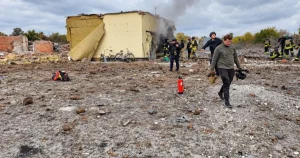
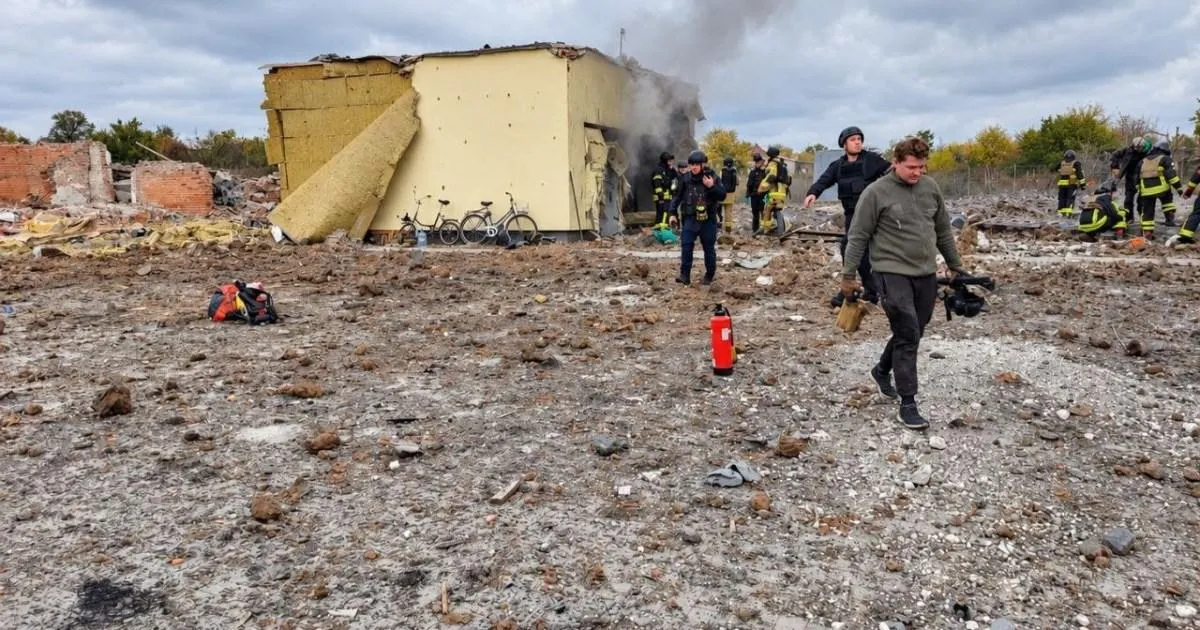
In the hours after the strike, the full scale of the loss remained unclear. Regina Kharchenko, secretary of the Zaporizhzhia City Council, said 27 people were still missing. That number is not a statistic. It means families gathering outside the rubble, clutching photographs, whispering names, waiting for any word about a grandmother, a neighbor, a child. Police officers and rescue teams tried desperately to reach residents believed to be trapped under broken beams and walls. Photographs from the scene showed smouldering rubble strewn across the grounds, bits of furniture, papers, and personal belongings mixed with mud and glass. For every person pulled out alive, there was hope; for every body, there was grief; and for every missing, there was the unbearable limbo that war creates. The rescue workers who died were part of that effort, killed while trying to save strangers. They were people who ran toward danger when everyone else ran away. Their deaths are a reminder that heroism in Ukraine is not a word used lightly. It is measured in medics kneeling in the dust, in firefighters carrying stretchers over broken glass, in volunteers who know the next strike could erase them too. The living had to keep digging that night, not only because there might be survivors, but because burying the dead is also an act of humanity. In the village, every new siren would have reignited fear, every distant explosion a horrible echo of the moment the school disappeared. The psychological wound is invisible but real. Even those who escaped physically will carry the memory of the shelter, the thunder above them, the darkness, and the scream of the wounded. For a rural community, already strained by war, this attack may be the point of no return. Some will leave, unable to face another day in a place where a place of learning and aid became a target. Others will stay, stubbornly, clutching the ruined ground like a promise that will not be broken.
The attack came at a moment when hope had flickered, however faintly, and then died. A day earlier, a six-day local ceasefire brokered by American first lady Melania Trump had expired. The ceasefire was not a peace deal, not a political settlement, but a pause in the killing intended to allow humanitarian aid into the embattled city of Oleshky, to the southwest in Kherson region, and to let civilians leave if they wished. For six days, the possibility of a safer path seemed real. Families may have packed their bags, waiting for a quiet moment to escape. Aid workers prepared supplies, imagining their trucks rolling through streets that had been too dangerous to enter. But the ceasefire ended, and within hours, the bombs came down on Komyshuvakha. The timing is not just painful; it is revealing. It suggests that the promise of peace was a cruel illusion, that the pause was merely a ceasefire until the will to attack returned. The village school was not in Oleshky, but it was in the same broad region, part of the same landscape of Ukrainian life under threat. For those who had dared to believe that a ceasefire might lead to something bigger, the attack was a brutal wake-up call. History may record the so-called ceasefire as a diplomatic footnote, but for the people of Komyshuvakha, it will be remembered as the moment the world blinked and looked away, and then the bombs returned. Each six days of quiet only raised the cost of the violence that followed. The hope itself became a weapon, because when it collapsed, it left behind disappointment as heavy as the debris now scattered across the schoolyard. In war, even a pause can be used against you.
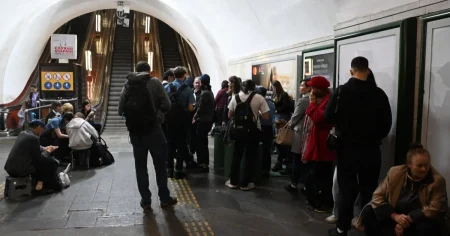
As if grief and shelling were not enough, Ukrainian civilians were then subjected to another form of attack: a false alarm that flooded every phone in the country with fear. Millions of people, already living on the edge, received a message through Ukraine’s Air Alert system shortly before 11pm local time, warning in Russian of an imminent nuclear attack involving an Oreshnik missile. The message was written in Russian, not Ukrainian, the language required in official communications, and it warned of radiation and chemical attacks as well. The purpose was obvious. It was not a technical glitch. It was designed to turn a quiet night into a nightmare, to make mothers clutch their children, to send people toward shelters, to make the heart stop for just a moment—and that moment is enough. Imagine sitting in your living room after another exhausting day, hearing the air-raid alarm, and then reading on your phone that nuclear war is beginning. Imagine checking on your child, opening your door, thinking about whether there is time to reach a basement. Then imagine learning that it was all false, that the panic was the entire point. The psychological wounds from such an alert may be invisible, but they are profound. People who have already been bombed, displaced, and buried in grief now know that their own warning system—the very technology meant to protect them—can be used against them. Uncertainty is a weapon in itself, and the Russians who orchestrated this false alert understand that a tired, frightened population can be worn down by fear even when no missile is in the sky. The mention of the Oreshnik missile, a weapon Russia has brandished in recent weeks, made the lie more believable. It was not random. It was a strike against the mind, an attack as deliberate as the double-tap on the school.
Taken together, the bombing and the false alert paint a terrifying picture of Russia’s approach to this war. There is no desire to de-escalate, no impulse toward justice, no recognition that schools, shelters, and humanitarian aid are sacred. Instead, there is a calculated strategy of cruelty that attacks the body and the psyche at the same time. In Komyshuvakha, a school was reduced to rubble because it was a place of life. In every corner of Ukraine, millions of phones lit up with the false promise of nuclear catastrophe because a population already in agony was the target. The people of this country are resilient, but resilience has a price. Every attack, physical or digital, leaves a mark. The world must understand what is happening here, not just in terms of casualties and dates, but in terms of human experience. A rescue worker who dies in the rubble is someone who loved, laughed, and carried courage like a second skin. A village that loses its school loses its center, its children’s futures, its memory. A false nuclear alert steals hours of sleep and months of confidence. War is not just fought on battlefields; it is fought inside people, in their deepest hopes and worst fears. The village of Komyshuvakha will one day have to rebuild, but the grief will remain tangled in the roots of every new wall. The people who waited in line for humanitarian aid will not forget that the hand that offered them food was attacked by the hand that sent the bombs. And in the dark, when the air-raid sirens sound, even after the false alert, every Ukrainian will check their phone and feel a moment of dread. That is the true cost of this violence. It is not only measured in the dead, but in the trembling of the living, in the loss of trust, in the knowledge that somewhere, someone can decide at any moment to make a school a target and a shelter a tomb. The only answer to such brutality is the one Ukrainian civilians have already given: a refusal to disappear, a commitment to remember, and a stubborn insistence that even in the middle of ruin, life is still worth protecting. But the world cannot simply admire their strength. It must act, not only with words of sympathy, but with the kind of support that makes attacks like these unthinkable. Until then, every school in Ukraine remains a potential target, every phone a potential instrument of terror, and every human life a stake in a war that refuses to end.