



On an ordinary evening, when millions of Ukrainians were settling down after another exhausting day of war, their phones suddenly erupted with a sound that has become synonymous with terror. The air alert app, designed to warn civilians of incoming missiles, flashed a message in Russian: “Don’t worry, an Oreshnik is overhead! A nuclear alert has been activated across Ukraine.” For a moment, time seemed to stop. This was not just another air raid warning; this was the scenario that had haunted every Ukrainian since the start of the full-scale invasion. The message, sent shortly before 11pm local time, was written in Russian rather than Ukrainian—a glaring violation of the official communications rules—and it warned of a nuclear attack involving the hypersonic Oreshnik missile. A second message followed, warning of radiation and chemical attacks. In cities like Kyiv, residents received even more alarming instructions about street fighting and were told to cover their faces with a cloth. Imagine sitting in your living room, holding your phone, reading those words, and wondering if this was the moment you had been dreading for years. The air outside was silent, but the phone in your hand screamed annihilation. That was the reality for millions of people across Ukraine that night, as a wave of terror swept through homes, shelters, and basements, leaving families clinging to each other in uncertainty, not knowing if the next ten minutes would be their last.
The false alarm did not come out of nowhere. It was a deliberate act of psychological warfare, a cruel manipulation of people already living under constant threat. The message was sent through Ukraine’s official Air Alert system, a service that many citizens trust with their lives. When that trust is weaponized, the damage goes far beyond a few minutes of panic. In Kyiv, the additional warnings about street fighting and instructions to cover faces with cloth only deepened the confusion. People who had lived through months of missile strikes knew the protocols: get to shelter, close windows, wait for the all-clear. But this time, the protocols seemed useless. How do you protect yourself from a nuclear strike? How do you calm a crying child when the message on your phone says radiation is coming? For ten agonizing minutes, Ukraine existed in a state of suspended horror. Then, at last, the country’s air force issued a statement: the air alert app had been subjected to enemy influence. There was no radiation threat. The message was a lie, designed to destabilize the population. On Telegram, the official channel reassured citizens: “The air alert app appears to have been subjected to enemy influence. There is no radiation threat! Stay calm and follow our updates on our channel!” Yet even after the all-clear, the psychological wound remained. For thousands of people, that ten-minute eternity will leave scars that no statement can heal. The fear was real, even if the missile was not.
Ukraine was not the only country caught in this web of digital deception. On the same night, Russia’s own emergency alert system was reported to have been hit by a suspected cyber attack. Russian citizens received fake messages claiming that an attack drone mounted with a nuclear warhead had been “launched at all regions of Russia.” The message urged people to stock up on food for three weeks, to hide, and warned of a “risk of getting lively”—a strange, awkward phrase that only added to the surreal nature of the ordeal. Imagine the scene in a quiet Russian town: an elderly woman looks at her phone and reads that a nuclear-armed drone is flying toward her home. She doesn’t know whether to run, pack, or pray. The message tells her to gather supplies, but for what? She has no shelter, no basement, no three weeks of food. In both countries, ordinary people were reduced to pawns in a vast information war, their fears weaponized by unseen actors. The attack on Russia’s alert system was attributed by authorities to a cyber assault, but the origin and purpose remained murky. What is clear is that the goal was to sow chaos, fear, and distrust. When official channels are compromised, people start to question everything. If a warning message can be fake, can a reassurance also be fake? This erosion of trust is exactly what those who wage information warfare hope to achieve. It makes populations more anxious, more divided, and more vulnerable to manipulation. The false alerts on both sides of the front line were not accidents; they were tactics in a war where the battlefield extends into every smartphone, every home, and every human mind.
While civilians in both countries grappled with the terrifying warnings, the real war never stopped. The false alerts were accompanied by genuine violence, as Russian and Ukrainian forces exchanged fresh strikes through the night. In Kramatorsk, a city in eastern Ukraine, the administrative building was gutted by an overnight Russian air strike. The images that emerged the next morning showed a shattered facade, twisted metal, and debris scattered across the street—a stark reminder that the menace of missiles is not just virtual. Russian strikes targeted at least four energy production sites across Ukraine, continuing the deliberate campaign against the country’s critical infrastructure. These attacks are designed to plunge cities into darkness and cold, to break the will of the population, and to make everyday life unbearable. Meanwhile, inside Russia, the Kstovo oil refinery was reportedly struck, a sign that Ukraine is also reaching deep into Russian territory to hit military and economic targets. In the chaotic hours of the night, as people in Kyiv hid in subway stations and residents of Russian cities wondered if the drone warning was real, the skies above both countries were filled with aircraft and missiles. The false alerts had created a fog of confusion, but the explosions were unmistakably real. For the people of Kramatorsk, the administrative building was not a symbol—it was their local government, their services, their connection to the state. Seeing it reduced to rubble is a daily reminder that war does not pause for psychological games. The real and the fake are intertwined, and ordinary civilians are left to navigate the chaos, never fully sure which threat is genuine and which is a trick designed to manipulate their emotions.
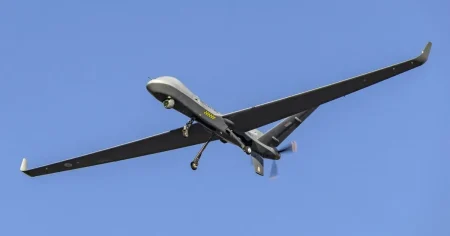
The missile named in the fake alert, the Oreshnik, is not a phantom. It is a real weapon, and its history makes it a particularly terrifying symbol. Russia has previously deployed the Oreshnik, a nuclear-capable ballistic missile, against Ukraine, though with a conventional warhead. The missile is hypersonic, meaning it travels at extreme speeds, and experts have warned that it could reach Britain in just eleven minutes if launched from certain positions. It can also target other parts of Europe, making it a central element of Russian military intimidation. As of December of last year, the missile system was believed to have been stationed in Belarus, a Russian ally on Ukraine’s northern border. This is why the name “Oreshnik” carries so much weight in Ukrainian society. It is not an abstract military term; it is a threat that has been used before and could be used again. When the fake alert announced that an Oreshnik was overhead, Ukrainians did not need an explanation. They knew what it meant. They knew the missile’s capabilities, its speed, its destructive potential. They knew that if the warning had been true, there would have been little time to react. The choice of the Oreshnik in the false alert was deliberate. It was chosen because it would elicit maximum terror, because it would trigger an instinctive, visceral response. It worked. For ten minutes, the fear was all-consuming, not because people were naive, but because they understood the reality of the threat. The missile exists. It is deployed. And in a war where rules are constantly broken, the possibility of its use in a nuclear capacity cannot be ruled out entirely. The false alert preyed on that legitimate dread, turning it into a weapon of psychological torment.
In the aftermath of this unsettling episode, it is worth reflecting on what it reveals about the nature of modern warfare. The physical destruction is real, but so too is the assault on the mind. By hacking into official alert systems, the perpetrators demonstrated that no communication channel is sacred. They showed that the very tools meant to protect civilians can be turned against them, transforming warnings into instruments of fear. This is a dangerous escalation, because it undermines the ability of governments to communicate with their people in genuine emergencies. The next time an air alert sounds, some Ukrainians will hesitate. They will wonder if it is real or another cruel joke. That hesitation, even for a few seconds, could cost lives. The attackers know this. They are not just trying to frighten; they are trying to break the social trust that holds a nation together during wartime. And yet, amidst the chaos, there were signs of resilience. Ukrainian authorities responded quickly, reassuring the public and urging calm. Ordinary citizens shared information, checked on their neighbors, and tried to make sense of the conflicting reports. They have endured so much for so long that even a fake nuclear warning cannot drive them to despair. But the human cost is immense. Every false alert, every sleepless night, every moment of terror leaves a mark. The people of Ukraine and Russia are caught in a conflict that is fought with missiles and machines, but also with lies and half-truths. They are the ones who suffer when technology is abused, when trust is shattered, and when the most basic sense of safety is stolen. As the world watches, one thing becomes clear: the war is not only over territory and power. It is a war over reality itself, and the most vulnerable casualties are those who simply want to live in peace. In the face of such cruelty, the determination to stay human, to care for one another, and to refuse to be broken may be the truest form of resistance.