


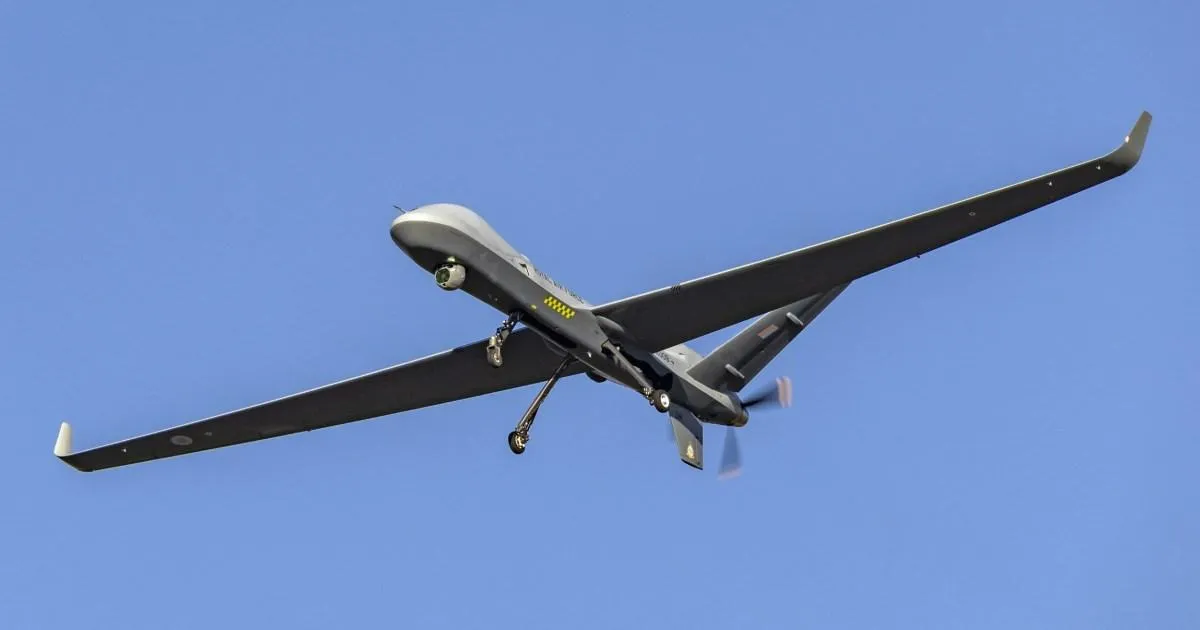
The first time it happened, there was no fanfare. No thunder of jets, no dramatic launch sequence. Just a sleek, unarmed aircraft cutting through the cold, grey skies above the English Channel, its sensors fixed on the waters below. The RAF’s Protector RG Mk1—a remotely piloted aircraft system, better known to most of us simply as a drone—had quietly taken up its position, beginning a ten-hour vigil that would mark a significant milestone in Britain’s defence history. Between late September and mid-October, this cutting-edge machine watched over the busy seaway, scanning for foreign vessels, its unblinking electronic eyes providing a level of surveillance that would have been unthinkable just a generation ago. This was not a training exercise or a demonstration for dignitaries. This was the real thing: the very first operational deployment of a drone in UK airspace, tasked with keeping an eye on Russian warships lingering far too close to British shores for comfort.
The Protector RG Mk1 itself is a marvel of modern engineering, a British interpretation of the American MQ-9B drone, but with its own distinct character and capabilities. It can tear through the sky at speeds of up to 390 miles per hour and soar to altitudes approaching 40,000 feet—higher than commercial airliners cruise. It can remain aloft for a remarkable 40 hours at a stretch, far surpassing any human pilot’s endurance, and is controlled not by someone sitting in a cockpit, but by highly trained personnel stationed hundreds of miles away at RAF Waddington in Lincolnshire. This means a single aircraft can loiter over a target for days, watching, waiting, and gathering intelligence without ever needing to land or refuel. And while the Protector that flew over the Channel was unarmed, its siblings in the fleet are equipped with a formidable arsenal, including Paveway guided bombs and the notorious Brimstone missile—a “fire-and-forget” weapon that uses artificial intelligence and advanced sensors to distinguish between, say, a military tank and a civilian bus, all without requiring human oversight for every single decision. It represents a new breed of warfare, one where machines do the watching, the waiting, and even the striking, while humans remain safely at a distance.
But technology alone does not protect a nation. Behind every flight, every sensor reading, and every grainy image beamed back from the Channel, there are people—sailors, pilots, and commanders—working in quiet coordination to piece together the broader picture of what is happening in the waters around Britain. During the first half of October, the Royal Navy’s HMS Dauntless and HMS Tyne were themselves shadowing a Russian frigate, the RFN Neustrashimy, as it transited through the Channel. Commander Neil Skinner, the commanding officer of HMS Dauntless, spoke about the operation with the calm professionalism typical of a naval officer. Tracking such vessels, he explained, “contributes to the wider maritime picture and supports UK maritime security.” It sounds almost routine, the way he put it. But there is nothing routine about the reality on the water. The crews of these warships are engaged in a high-stakes game of cat and mouse, constantly monitoring, intercepting, and shadowing foreign military assets in some of the busiest shipping lanes in the world. At one point, HMS Tyne intercepted the RFN Aleksandr Shabalin, a Russian landing ship, with photographs showing the two vessels drifting perilously close together—a chilling reminder of how quickly these encounters could escalate if something were to go wrong.
The drone’s debut over the Channel, however, is just one piece of a much larger, more worrying puzzle. Across Europe, the Kremlin has been increasingly bold, using drones in the airspace of Denmark, Lithuania, Moldova, Norway, and Poland, testing the patience and defences of NATO member states. One senior military commander, speaking to the MailOnline, delivered a stark warning: Moscow could launch drones from a ship positioned just off the British coast in a matter of minutes. The threat is no longer hypothetical or distant. The Royal Navy’s own anti-Russian monitoring activity has surged by an alarming 25 percent during just the first seven months of this year, a statistic that underscores the escalating tension beneath the surface of everyday civilian life. We go about our business, commuting, scrolling through our phones, and going to work, while just beyond the horizon, a complex ballet of espionage and deterrence plays out day and night. Great power rivalry, once thought to be a relic of the Cold War, is back with a vengeance, and the front lines are no longer trenches—they are the invisible electromagnetic spectrum and the cold, dark waters surrounding our island nation.
Perhaps the most frightening aspect of this new geopolitical reality, though, is the threat that lies literally beneath our feet, at the bottom of the sea. Last month, Moscow was caught “rehearsing” attacks on a vast undersea cable network in the Arctic—a network that helps power the UK’s internet connection to the rest of the world. Think about that for a moment. The internet, which we depend on for everything from banking to talking to loved ones, from streaming television to running our hospitals and businesses, is carried through thin, fragile cables laid along the ocean floor. Some 920,000 miles of these cables lace the globe, and they are astonishingly vulnerable. According to a report in The Telegraph, some 500 incidents of Russian fishing trawlers “spying” on these cables have been documented. Fishing trawlers. Vessels that look entirely innocuous, bobbing along the surface, going about their business, when in reality they are likely mapping, monitoring, and potentially preparing to sever the lines that keep our modern world connected. It is a chilling thought. The drones in Denmark, the warships in the Channel, the trawlers in the North Atlantic—they are all pieces of a coordinated strategy designed to probe and exploit the vulnerabilities of Western nations.
Defence Secretary Wes Streeting acknowledged the gravity of the situation, offering a rare glimpse into the relentless pace of military operations. “Our Armed Forces work together every day, around the clock, to keep our country safe and safeguard our national interests,” he said. “For the first time, Protector has joined Royal Navy warships and helicopters monitoring activity around our shores, demonstrating how we are constantly innovating to monitor and deter threats and irresponsible provocation.” His words are a stark reminder that the security we so often take for granted is purchased through the tireless, often overlooked efforts of those who serve. They are out there in the grey dawns and the stormy nights, watching, waiting, and preparing for the worst even as they hope for the best. The Protector RG Mk1’s first mission over the English Channel was a quiet achievement, celebrated by a few and noticed by fewer. But it marks the beginning of a new chapter in how Britain defends itself—one where artificial intelligence, satellite links, and remotely piloted aircraft will increasingly share the burden with sailors on the deck of a destroyer, bracing against the wind and spray. It is a story of adaptation, of vigilance, and of quiet resolve. And as the waters around Britain grow ever more crowded with potential adversaries, the need for new eyes in the sky, new tools and new partnerships, has never been greater. The drone has landed, the data has been analysed, and the message has been received. The watch, as ever, continues.