
Opening a theme park has always been something of a gamble. The great ones, the Disneylands, Universal Studios and Alton Towers of the world, manage to keep the turnstiles spinning year after year, drawing millions of visitors who come for the magic, the thrill and the escape from everyday life. But for every glittering success story, there are countless others that fade into obscurity, becoming ghostly monuments to broken promises and bankrupt dreams. Parque Europa Baku is one such place. Tucked into the landscape of Corralejo on the island of Fuerteventura, it was once a popular tourist destination, a sprawling 159,000 square metre family leisure complex that opened its gates in the early 2000s with great ambitions. In its heyday, it was home to sharks, seals, reptiles and birds, and visitors could wander through botanical gardens, watch live performances, try their luck in bingo halls, or bowl a few frames with friends. There was even a full-scale replica of Christopher Columbus’ famous ship, La Santa Maria, adding a touch of seafaring history to the modern resort atmosphere. It was meant to be a place where families could spend entire days, moving from one attraction to the next, caught up in the wonder of it all. But the dream did not last. The park quickly ran into financial trouble, its many attractions closing one by one, until the whole site shut its doors for good in the early 2010s. Since then, it has sat abandoned, slowly rotting under the Atlantic sun, a once-vibrant world left to crumble in silence.
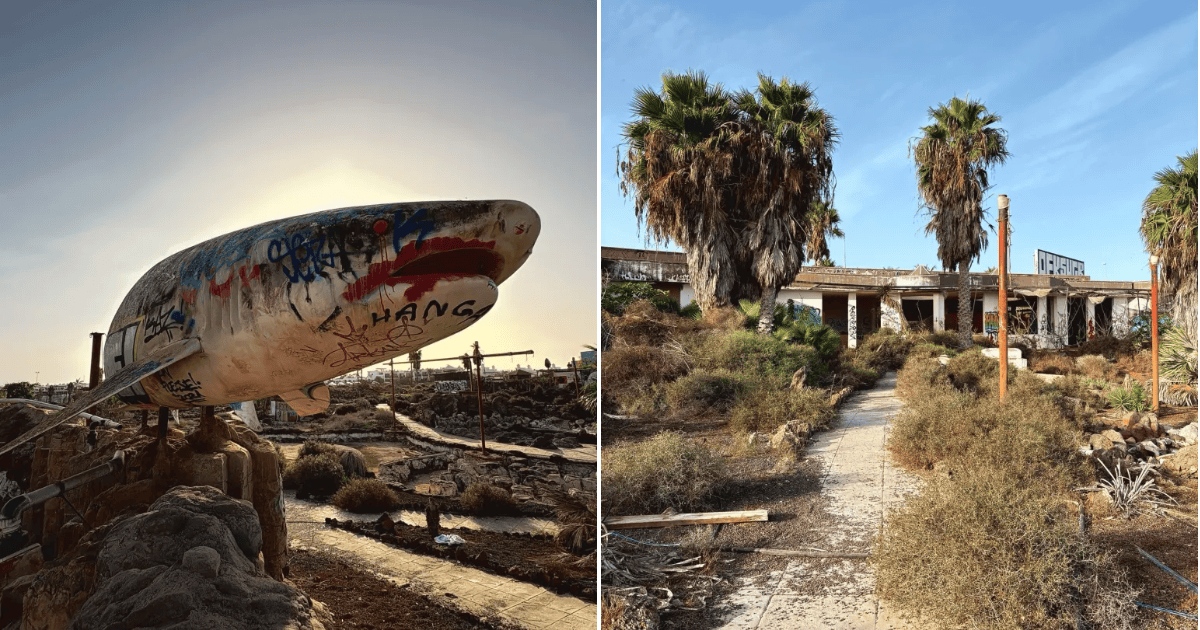
When urban explorer and photographer SeanUrbex made his way to the ruins, he found a place that had been left to decay in dramatic fashion. The site was eerily easy to access; he simply walked in from the main street, with no barriers or security guards to stop him. The first thing that caught his eye was a striking shark statue, still standing tall and overlooking the vast empty park, but now covered in layers of graffiti. It was a strange and almost poetic image, the predator frozen in mid-motion, watching over a kingdom that no longer had any life to rule. Sean admitted that he had originally assumed the park had been a zoo, but locals soon corrected him. Parque Europa was actually a water park, with the shark statue serving as a monument above a water tank that once held a living shark. That detail adds an even more unsettling layer to the site. Somewhere beneath the decay lies the memory of a real creature, confined in a tank, swimming in circles while tourists pressed their faces against the glass. Now the water is gone, the creature is long gone, and only the statue remains, surrounded by broken concrete and faded signs. As Sean explored further, he discovered rooms and buildings in complete states of disrepair, walls covered in graffiti, windows shattered, floors littered with debris. The whole place looked like something out of a post-apocalyptic film, a theme park abandoned in a hurry, leaving behind the skeletal remains of its former attractions.
But the story of Parque Europa Baku is not just about crumbling walls and empty pools. It is also a human story, one that becomes even more heartbreaking when you hear about the people who once filled the park with laughter and excitement. At its opening, the site must have felt like a wonderful addition to Fuerteventura, a place where holidaymakers and locals alike could cool off, relax and be entertained. The water features, the wildlife, the replica ship, the haunted hotel, the botanical gardens; they all promised a kind of joy that people save up for and look forward to for months. Yet financial difficulties struck quickly, and many of the attractions closed long before the park itself did. By 2010, the entire site was shuttered, leaving behind a massive, silent complex that no one had the money or the will to revive. It is a familiar story in the world of tourism, where big investments sometimes lead to big losses, and where a single bad season can be enough to sink an entire enterprise. The operators, Ociopark Corralejo, eventually recorded losses of almost €31.2 million, a staggering amount that speaks to just how far the project fell from its original vision. The scale of the failure is hard to grasp, but walking through the ruins, seeing the faded colours and the broken ornaments, you get a sense of how much was lost and how quickly it all slipped away.
Perhaps the most sobering part of SeanUrbex’s visit was not the destruction or the graffiti, but the people. He and his group only managed to see about a third of the site because so much of it has been taken over by homeless locals and squatters. In the old pools and former water features, people have made homes. There are no roofs overhead, just open sky, yet clothes hang drying on lines, makeshift beds are tucked into corners, and blankets are spread across concrete surfaces. It is a reality that is both shocking and deeply sad. Homelessness is a serious problem on Fuerteventura, and the abandoned park has become an unofficial shelter for those who have nowhere else to go. The same structures that once hosted families on holiday now provide a fragile sense of safety for people struggling to survive. Sean described the amount of homeless squatters as the most shocking thing he encountered, and it is easy to understand why. A theme park is supposed to be a place of escape and play, but here it has become a place of refuge, a strange reversal that forces you to think about the broader issues behind the crumbling attractions. The park is not just a relic; it is also a home, albeit a harsh and unstable one, for people who deserve far better than sleeping in a broken water tank.
Over the years, the abandoned site has continued to suffer a slow and painful decline. There have been thefts, with valuable materials and fixtures stripped away, and in May 2019, an arson attack destroyed the replica of La Santa Maria, reducing one of the park’s most iconic structures to ashes. By the end of that year, the financial losses had grown to nearly €31.2 million, a figure that makes any hope of revival seem almost impossible. The park has become a place of bare concrete, twisted metal, broken glass and faded memories. Yet, in the midst of all this ruin, there is a small glimmer of hope. The adjacent Acua Water Park, which was connected to the original complex, managed to survive. After Parque Europa closed, Acua underwent renovation and reopened in 2014. It still offers swimming pools, slides and other facilities, and it operates on a seasonal basis from March to early November. For visitors to Fuerteventura, there is still a chance to enjoy the kind of watery fun that the larger site once promised. It is an odd juxtaposition, with one side of the area still alive with the sounds of splashing and laughing, while the other lies silent and forgotten. The water park’s survival is a reminder that not everything has to end in ruin, and that sometimes, with enough effort and investment, a place can find a second chance.
In the end, Parque Europa Baku is a monument to both ambition and fragility. It was built to bring joy, to create memories and to offer an escape from the ordinary. For a short time, it did exactly that, and the people who visited it back then probably still carry moments of happiness from those days, the thrill of seeing a shark, the wonder of exploring a replica ship, the simple pleasure of a family day out. But theme parks are fragile worlds, dependent on money, maintenance, tourism and luck. When any one of those fails, the whole dream can come crashing down. What remains at Parque Europa is a kind of accidental art, a place where nature and neglect have taken over, where graffiti has become the new paint, and where the silence tells a story of its own. The shark statue still stands, watching over the ruins with the same fixed gaze it always had, but now it is covered in colours and tags, a symbol of a place that has been reclaimed by a different kind of community. And through it all, the people who live among the rubble, the homeless men and women trying to survive on a beautiful island that can also be unforgiving, remind us that even abandoned places are full of life. The park may no longer be a tourist attraction, but it is still a place where human stories unfold, where dreams have been replaced by struggle, and where the past and present exist together in uneasy silence. It is a sad place, but it is also a human place, and that makes it impossible to look away.