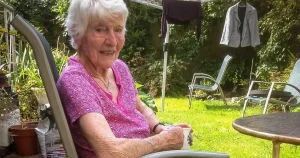


Bern Rogers was 68 when her mother moved in with her. She did not set out to become a full-time carer; she was simply a daughter saying yes. Sheila Wills was in her late eighties and living alone in Norfolk, and people had begun to worry. She had been found wandering outside her house, confused and vulnerable, and neighbours raised concerns about her safety. Bern and her husband Jon offered to have her stay with them in Bristol for a little while, just to get things sorted, and they thought it might last ten days. It lasted nearly three years. Sheila did not want to go home, and she did not want to go into residential care. She wanted Bern. So Bern gave up her own life to keep her mother safe and comfortable, and she did it out of love, not duty alone. She cooked, cleaned, bathed, dressed, fed, consoled and watched over her. She learned to live with dementia and all the fear, anger and confusion it brought. She was there through sleepless nights and difficult mornings, through moments when her mother forgot where she was, and through times when Sheila wept because she knew something in her mind was slipping away. Bern did all of this while her siblings lived far away, while her own marriage was tested, and while the world shut down around them during the first Covid lockdown. Then, after Sheila died, the family turned on her. Bern took £100,000 from her mother’s estate because she genuinely believed it was owed to her for years of unpaid care. Her siblings believed she had stolen it, and they reported her to the police. The money was seized, Bern was charged with fraud and theft, and she spent a long time facing the possibility of prison. In 2022, a jury acquitted her. But by then she was already caught in a nightmare that would continue for six and a half years. “I went from being held up as a saint for looking after mum to suddenly being this terrible criminal,” she said later. “I was just doing what my mum asked me to do. It was them against me, made me feel like a scapegoat.”
To understand why Bern felt so betrayed, you have to understand what caring for Sheila actually meant. Sheila moved from Norfolk to Bern’s home in Bristol in September 2017, after being found wandering outside her house. At first, everyone assumed it was temporary. But within a year she was diagnosed with dementia, and her condition began to deteriorate quickly. Sheila herself made it clear she did not want to live alone. “I don’t want to live on my own. I want to come and live with you,” Bern remembered her mother saying. And so Bern took her in, not knowing how much would be demanded of her. Sheila eventually needed help with everything. She needed help washing, dressing, eating, getting in and out of bed, and using the toilet. She needed support with incontinence and treatment for a painful prolapse. She could not be left alone for even a few minutes because she might become anxious, confused, or frightened. Bern’s husband Jon, a retired GP, described the reality plainly: “We felt unable to leave her on her own. If Bern needed to go to the shops, I would have to stay at home. We couldn’t go out. Even going to the shops was difficult. It was a 24-hour job.” Their lives were put on hold. They stopped visiting friends, stopped going on trips, stopped having any time for themselves. The hardest part was watching the woman Bern had known all her life change before her eyes. “It was very hard,” Bern said. “You think they’re the person they’ve always been and then you realise their brain is being affected by the slightest thing. She would get anxious and upset. She could get angry. It was very frightening for her.” In the final weeks of Sheila’s life, which coincided with the first Covid lockdown, Bern slept on the floor beside her mother’s bed so that Sheila would never wake up alone and disoriented. It was exhausting and heartbreaking, yet Bern insists she would do it all again. “I think we gave her the best life,” she said. “She loved being around the children and grandchildren. I think she was really pleased to be here.”
The question of money had been discussed within the family long before Sheila died. Bern says everyone knew she was providing an enormous amount of care, and everyone agreed she should be compensated in some way. In court, text messages from her five siblings were shown in which they said she should be paid something for what she was doing. But no amount was ever settled on. Bern says that when her mother died in April 2020, her brother—who was the executor of Sheila’s estate—told her to take money from the estate for her care. So she transferred £100,000 from her mother’s account into a separate account. Almost immediately, relations collapsed. The banks recovered the money and returned it to the estate amid concerns about possible fraud. The police were contacted, and Bern was investigated for theft and fraud. She was charged and put on trial at Bristol Crown Court in 2022. The jury found her not guilty, but the criminal case left her shell-shocked. She had been publicly accused of stealing from the woman she had devoted her life to caring for. And at that point, she said, she had not received “a penny” from the estate. She says the estate was worth more than £400,000, including the sale of Sheila’s Norfolk home for around £235,000 after her death. According to Bern, her five siblings received their shares, while she received nothing. So she turned to the civil courts, determined to prove that her mother had promised to pay her and that taking money from the estate was not theft but the repayment of a debt. It was a lonely fight, and it lasted more than six years. “I was just doing what my mum asked me to do,” she repeated. Her siblings, she said, made her feel like a criminal and a scapegoat.
The civil case finally came to the High Court, and in 2025 Bern won. The judge found that she and her mother had formed an informal contract under which Sheila would pay Bern a reasonable sum for the care she provided. Even if there had been no contract, the court ruled, the estate had benefited from Bern’s care through the legal principle of unjust enrichment. In other words, it would not be fair for the estate to keep all the value of Bern’s labour while giving her nothing in return. A further hearing in August settled the amount. Bern had cared for her mother for 850 days, from the time Sheila moved to Bristol until her death. The court calculated that Bern should receive £150 for each day of care, which came to £127,500. This was a landmark decision, and Bern hoped it would help other family carers who found themselves in similar situations. Family caregiving is often treated as a labour of love, something that should be given freely because the person is family. But Bern’s case showed that it has real economic value, and that when a parent asks a child to give up their life and promises payment, that promise should be honoured. The award was not just about money. It was about recognition. Bern had been branded a criminal, fought her way through a criminal trial, and then had to prove her innocence again in a different kind of courtroom. The High Court ruling was a validation that she had not stolen from her mother. She had earned that money. For Bern, the greatest relief was finally being believed. She had been accused of the worst thing a child can do—robbing their own mother—and now a judge had said she was owed far more than she had originally taken.
But the emotional cost cannot be measured in bank accounts. Bern is a grandmother of six, a woman who gave years of her life to keep her mother safe, only to end up in the middle of a family war. She said the criminal trial made her feel like a criminal even though she had done nothing wrong. “I went from being held up as a saint for looking after mum to suddenly being this terrible criminal,” she said again, the words heavy with hurt. “It was them against me, made me feel like a scapegoat.” She did not set out to fight her siblings. She simply wanted what her mother had promised her, and what she had earned. But the dispute destroyed something precious. Family gatherings will never be the same. Trust between brothers and sisters, once broken, is very hard to rebuild. Bern does not regret caring for her mother, though. She says she would do it all again, despite everything that happened afterward. She remembers the good things: her mother laughing with her grandchildren, sitting in the garden, feeling safe and loved. “I think we gave her the best life,” she said. “She loved being around the children and grandchildren. I think she was really pleased to be here.” That is the part of the story that must not be forgotten. Bern was not some greedy daughter who waited for her mother to die and then raided the inheritance. She was a woman who slept on the floor beside her dying mother in the middle of a pandemic, who changed her clothes, bathed her, held her hand and reassured her when dementia made the world terrifying. She did all of that out of love. The money was never the reason she cared. But it was the only thing that could have shown her that her family understood the sacrifice she had made. Her case, she hopes, will give other carers courage to speak up and to be treated fairly when the accounts are settled.
Not everyone sees it that way. Sheila’s estate is administered by Bern’s brother, Andrew Wills, and he offered a very different account. In a statement on behalf of the estate, he said the only agreement the siblings knew about was for their mother to give Bernadette £50 per week for “keep” and to make sure Bernadette was not left out of pocket. “We were not made aware of any other contract between our mother and Bernadette,” he said. “At all times, I have attempted to be independent and to act in the best interests of the estate. The estate has always been willing to pay Bernadette her genuine expenses as well as an additional gratuity in recognition of her efforts for our mother. We have always tried to be fair. Unfortunately, our offers were not accepted by Bernadette who instead issued legal proceedings against the estate.” His words reveal a family split by sharply different memories and expectations. Bern saw a promise made by her mother; her siblings saw only a vague hope. Bern saw a debt; they saw a gift. The courts ultimately sided with Bern, but that cannot undo the years of pain, the bitter messages, the frozen silence at family events, or the loneliness of being the one who was singled out. The six-and-a-half-year battle is over, but the wounds may never fully heal. What happened between Bern and her siblings is a cautionary tale for any family. Love and duty are hard enough to carry on their own, and they become even harder when money is added to the mix. If you are caring for an elderly parent, or if someone in your family is, talk openly about what is expected, write it down, and remember that the person caring for your parent is making sacrifices that may be invisible to you until it is too late. Bern Rogers won her case, but she lost something no court can give back. Her story is a reminder that caring for those we love is both a gift and a burden, and that it deserves to be honoured long before the final bill arrives.