


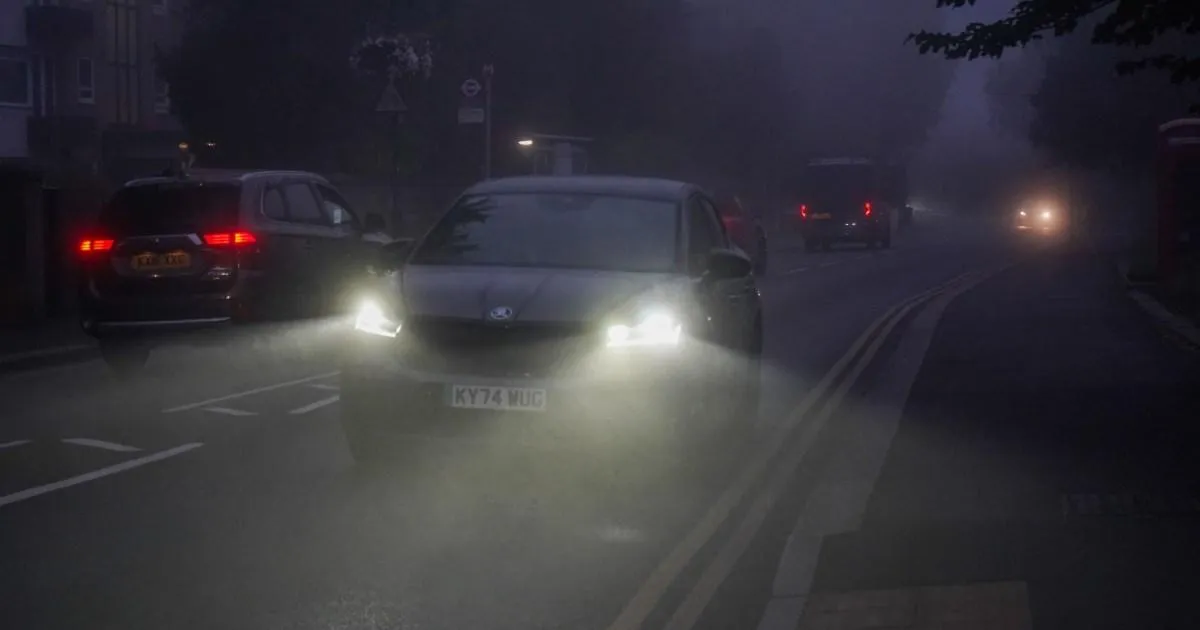
There is something quietly unsettling about waking up to fog. The world becomes smaller, muffled, uncertain. Trees disappear into grey, streetlights glow like distant lanterns, and familiar roads turn into guessing games. This week, across large parts of central and southern England, that eerie stillness has settled in and refused to lift. The Met Office has issued a yellow weather warning as thick fog tightens its grip on morning commutes, reducing visibility in some places to just a couple of feet. For drivers, this means a journey that should feel routine suddenly demands total concentration, with the fear of a hidden car, a wandering pedestrian, or a suddenly appearing junction lurking in every swirl of mist. After the violence of Storms Austen and Boelo, which left the country battered and disrupted only days earlier, the quiet intrusion of fog feels almost ironic. The rain and wind have gone, but the roads are still dangerous. Rather than dramatic flooding or toppled trees, this hazard creeps in silently overnight, turning the morning rush hour into a slow, anxious crawl.
The Met Office has warned that road and rail travel could be disrupted, and flights may be cancelled as a result. The warning, active until 10am, covers a broad sweep of England, including the South East around London, the East of England, the East Midlands, and parts of the West Midlands. It is not just a light mist. In places, visibility has dropped below 100 metres, which is the kind of fog that makes even the most experienced drivers sit up and take notice. Satellite images and maps show a blanket of cloud lingering close to the ground, stretching across counties and creeping along motorways and country lanes alike. The forecaster has explained that the fog will slowly begin to thin, lift, and clear later in the morning, but in some rural spots in eastern England, it may not disappear until the afternoon. That means the most difficult conditions will align with the very worst time to be travelling: the morning rush hour. For parents doing school runs, commuters heading to work, and delivery drivers trying to make up time, the wait for the sun to burn through the haze can feel interminable.
Looking further ahead, the forecast offers a mixed bag. Tomorrow is expected to bring some rain to the northern and western parts of the British Isles, while large areas of the UK should remain dry and settled. That might sound like good news after days of foul weather, but there is another catch. With clear skies and light winds, night-time fog is likely to form in parts of eastern and southern England, and the conditions could return early next week. So just as people begin to relax, the grey veil may descend again. This is the nature of autumn and winter fog: it thrives in the calm that follows a storm, when the air is still and the ground cools rapidly after sunset. For many, it will mean another week of checking the forecast before leaving the house, peering out of the window in the morning, and wondering whether the school run will take twice as long as usual. There is a particular kind of frustration in this weather, because it does not announce itself with thunder or driving rain. It simply arrives, silently, and changes everything.
For anyone who has to drive in foggy conditions, the best advice is to slow down and prepare properly. Fog is most common from October to March, and the experienced motoring organisation the AA has shared a list of practical tips to help people stay safe. The first step is to use dipped headlights, along with wipers and demisters, to give yourself the clearest view possible. Fog lights should be switched on when visibility gets significantly worse, but they need to be turned off again as soon as conditions improve, because leaving them on can dazzle other motorists and actually make the situation more dangerous for everyone. It is also important to be wary of other drivers who may not have the appropriate headlights on. In dense fog, it is easy to assume that the road is empty until a pair of dim shapes suddenly emerges from the grey, often without any indication that they are there. Adjusting speed is vital; slowing down gives the driver more time to react, and the AA recommends allowing a three-second gap between cars rather than the usual two. This extra second might seem small, but it can make all the difference when something appears from nowhere.
There is a human side to these driving tips that is worth remembering. Driving in fog can be genuinely frightening, especially for younger drivers, older drivers, or anyone who does not use the roads every day. The anxiety begins before the car even moves. You step outside into cold, damp air, the house vanishes behind you, and suddenly the familiar street looks alien. The AA’s advice to open a window at junctions where visibility is poor is particularly useful, because sound can be a lifeline in thick fog. Listening for approaching traffic when you cannot see it can help you make safer decisions, and it is a reminder that the best driving is patient, aware, and willing to adapt. No one arrives at their destination meaningfully faster by taking risks in poor visibility. The extra minutes spent crawling through fog are nothing compared to the minutes lost to an accident, a breakdown, or worse. So the humble fog light is not just a piece of equipment. It is a small act of courtesy, a way of telling other road users: I am here, I am paying attention, and I want all of us to get home safely.
In many ways, this week’s fog is a reminder that the British weather is never truly predictable. One week it is storms with names, the next it is a silent, creeping mist that makes the world feel as though it has been wrapped in cotton wool. But the human response is always the same: we adapt, we warn each other, we share tips, and we find a way through. The fog will lift. The sun will eventually burn through the grey, and the familiar landscape will return, vivid and sharp. Until then, it is worth taking a moment to be extra kind to the people around us, whether that means giving the driver in front more space, checking on an elderly neighbour who needs milk, or simply accepting that some mornings will be slower than others. So if you are heading out into the thick of it, take a breath, switch on your headlights, leave a little early, and remember that the fog will not last forever. After all, it cannot compete with the quiet determination of people just trying to get where they need to go.