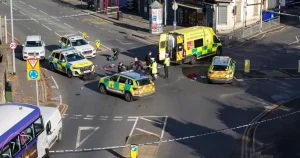

On a cold October morning, the A127 at Dunton, near Basildon in Essex, became the scene of a strange and startling drama. A dozen or more pigs had somehow escaped from wherever they were kept and found themselves on one of the busiest roads in the region, darting between speeding cars, causing drivers to slam on their brakes and bringing traffic to a standstill for nearly two hours. What should have been a typical commute turned into a surreal spectacle, with police called in to manage the chaos and try to keep both the animals and motorists safe. The pigs were terrified, confused, and completely out of their element, surrounded by roaring engines and flashing lights. As officers attempted to herd them away from the carriageway, it quickly became clear that the situation was not going to end peacefully for every animal. With no way to secure the panicked animals and after consulting experts about the danger they posed, police made the difficult decision to shoot five of the pigs at the scene. It was a grim reminder of how quickly a desperate situation can turn tragic. But amid the sadness and confusion, a quieter, more hopeful story was unfolding nearby — one that would eventually give nine of the pigs a second chance at life.
That hope arrived in the form of Martin Morgan, a man who runs Tower Hill Stables in Asheldham alongside Fiona Oakes. Martin had heard about the chaos on the motorway, but at first, he believed there was only one pig to worry about. A pig had taken refuge in a resident’s garden, and it was due to be shot unless someone stepped in. Martin, who has spent thirty years rescuing animals, knew he could not simply walk away. He loaded a van, drove over, and managed to coax the frightened animal into safety. He later named her Abigail. It seemed like a small victory — one life saved from a bullet, one pig given a warm place to stay instead of a cruel end. But as Martin was settling Abigail into her new surroundings, he began to hear more about the other pigs from the A127. These were not just random strays; they were animals with personalities, histories, and worth. And as he learned more, he discovered that eight more pigs were facing the same terrible fate. A farmer had temporarily housed them after they escaped, but with no permanent home found and space needed for his own business, he had arranged for someone to shoot them. Martin was confronted with a choice that would keep him up at night.
What made the situation so difficult for Martin was not the question of whether pigs are valuable — he knew they were — but the practical reality of what saying yes would mean. He tried to be rational. As he later said, pigs are slaughtered every day, and one more group of pigs would not change the world. But this was not an abstract idea. These were pigs he had come to know, pigs with faces and stories, pigs that had already survived one terrifying ordeal only to be handed another death sentence. “It is not rational,” he admitted, “but when you get to know who the pigs are it is impossible to say no.” And so, after a sleepless night of worrying about whether he could afford to care for them, he made the decision to take all eight in. The sanctuary was already struggling to cover its costs, like so many rescue organizations that depend on donations and goodwill. Martin knew that adding nine pigs to the hundreds of animals already depending on him would stretch resources to the breaking point. But he also knew that turning them away would mean condemning them to death for no reason other than inconvenience. He cleared out a shed, made space, and opened his heart a little wider. It was not a perfect solution, but it was a compassionate one.
Word soon spread about the pigs and the rescue, and the public responded in a way that has restored faith in human kindness. An online fundraiser was launched to help cover the cost of caring for the pigs, and donations quickly climbed to nearly £6,000. For a sanctuary that operates month to month on the kindness of strangers, that money made a real difference. It meant feed, bedding, veterinary care, and the simple dignity of a safe life for animals that had almost ended in tragedy. Martin was overwhelmed by the generosity, expressing deep gratitude to everyone who gave, saying the donations were vital for covering feed bills. He pointed out that looking after 400 animals is a tall order, and that since the pandemic, support has dropped off significantly. “We are really relying on donations now,” he said, and those words carried the weight of a man who has dedicated his life to caring for creatures that cannot speak for themselves. The fundraiser was not just about money — it was proof that people still care about the lives of animals, even when those animals are not beloved pets or endangered species. Pigs are intelligent, sensitive creatures, and the outpouring of support showed that their lives matter too. The community that had watched them cause chaos on the motorway now rallied to save them from the slaughterhouse.
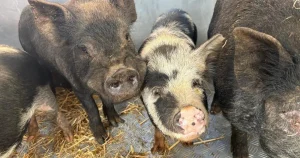
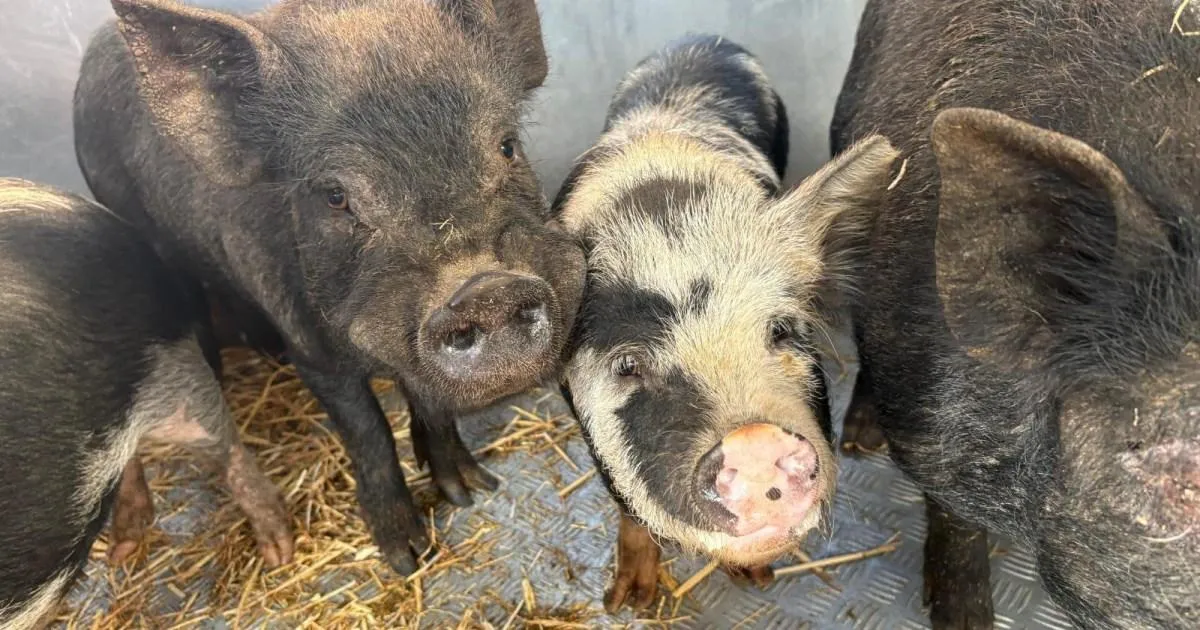
Life at Tower Hill Stables is never quiet, and with the arrival of the nine pigs, it became even busier. The sanctuary is home to around eighty horses, fifty cows, seventy-five goats, and hundreds of other rescued animals, all of whom rely on Martin and Fiona for food, shelter, and medical care. The pigs were given their own shed, a safe haven where they could recover from their ordeal and learn to trust again. Martin and his team carefully separated the animals by sex, an important step in preventing any surprises and ensuring the group could live peacefully together. But there was a tender moment when three of the younger pigs were reunited with what appeared to be their mother. After all the chaos of the motorway, the fear, the gunfire, and the uncertainty, that small family was back together. It was a gentle reminder that animals have bonds and emotions, and that rescue is about more than just physical safety — it is about preserving the connections that make life meaningful. The pigs still have a long road ahead, but they are safe, they are fed, and they are loved. The sanctuary estimates its running costs at £30,000 a month, a staggering amount for a place that survives on donations rather than government funding. To care for the pigs over the next decade, the sanctuary has launched a fresh appeal, hoping that the same generosity that saved them once will continue to sustain them.
As the days have passed, questions remain about where the pigs originally came from. Essex Police previously said that twenty pigs had escaped onto the A127, but their origin is still a mystery. Were they farm animals that broke through a fence? Did someone abandon them? Are there others still missing? The police said they sought advice from the Animal and Plant Health Agency about the risk the animals posed, and the decision to shoot five of them was made with safety as the priority. But for those who love animals, the memory of those five lost lives is bittersweet. The story is not simply a happy ending; it is a reminder that animals are often caught in circumstances beyond their control, and that human decisions can be both cruel and kind. The nine survivors owe their lives to a man who could not say no, to donors who opened their wallets, and to a community that refused to look away. In a world that can feel harsh and indifferent, this small story of rescued pigs stands as a testament to the power of compassion. It asks us to consider what we owe the creatures that share our world, and what kind of society we want to be. For Martin Morgan and the animals of Tower Hill Stables, every donation, every share, and every kind word makes a difference. The pigs are safe today because people chose to act, and their story is far from over.