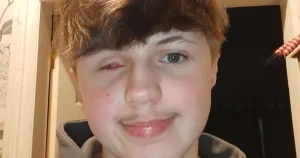

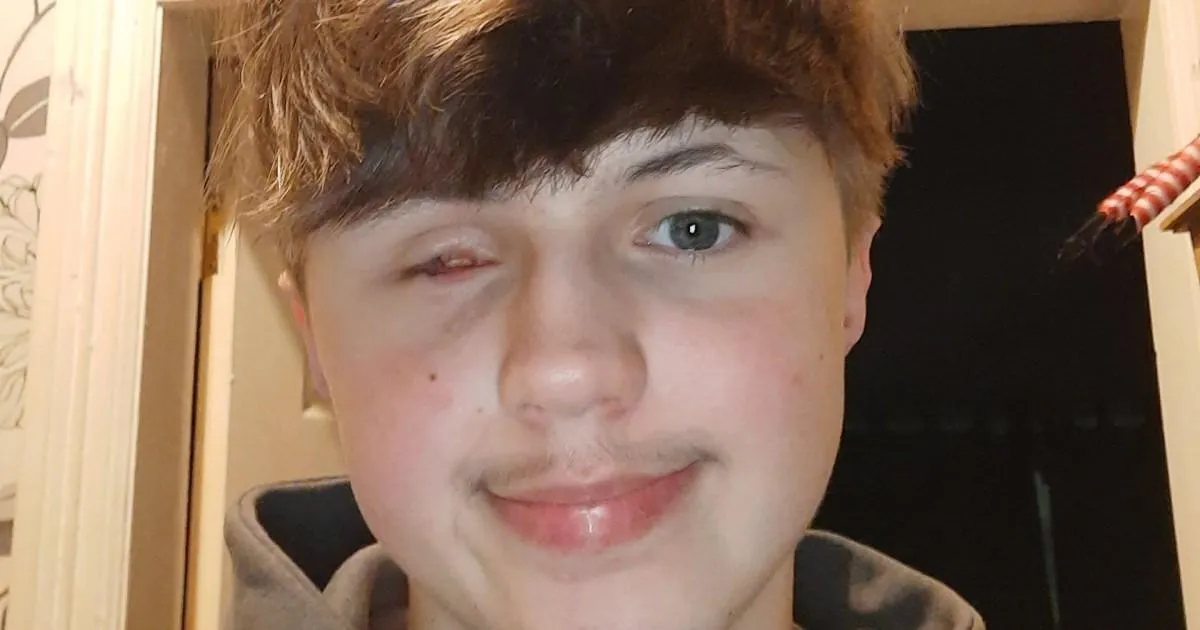
Bonfire Night has long been a fixture of British autumns: the smell of smoke, the crackle of sparklers, families wrapped up against the cold, looking upward as rockets bloom across dark skies. For most, it is a night of harmless thrill. But for Aleks Stasiukiewicz, a teenager from Hartlepool, County Durham, the fifth of November 2024 is not a memory of fireworks exploding in pretty colors; it is the night his world collapsed. Aleks, then 15, had gone to an organized display at a local rugby club with friends. The evening started well, full of laughter and the shared excitement of a community event. After the display ended, Aleks and his friends went to a nearby park. There, they encountered a firework that had failed to go off. Whether out of curiosity or a desire to salvage the fun, Aleks walked over to inspect it, possibly to relight it. In a split second, the device exploded straight in his face. The blast threw him to the ground and left him dazed, in pain, and with catastrophic injuries. His friends were terrified. Someone called 999. Julie, Aleks’s mother, received a phone call from one of those friends. She thought it was a joke. It wasn’t. She raced to the park and found her son already in an ambulance. Then she saw him properly. She would later describe, in harrowing detail, watching his eye leak down the side of his face. For any parent, that image is unspeakable. In that moment, Julie knew that life would never be the same. Aleks was taken to James Cook University Hospital in Middlesbrough, where the true scale of what had happened began to emerge. The accident cost him his left eye, part of his eyelid, a broken front tooth, and skin on his arm and leg burned. He was a child, and suddenly he was facing a permanent, life-altering injury.
At the hospital, medical teams went to work. Aleks was 15, still growing, still at college, with plans and dreams; now his face, and future, were at risk. The staff at James Cook University Hospital, particularly the specialists in oculoplastic and orbital surgery, took over. Aleks underwent surgery the next day. The procedure was delicate and complex: surgeons had to remove tiny fragments of firework debris embedded in his eye socket, clean the wound, and begin the process of reconstruction. Part of his eyelid was gone, which brought not just cosmetic concerns but functional ones; eyelids protect the eye and keep it moist. In this case, there was no eye to protect anymore, but the socket still needed to be shaped and preserved for the future. The medical team inserted a ball-shaped prosthesis, an implant designed to sit in the eye socket and mimic the movement of a real eye. This is not a magic fix. It takes time, care, and follow-up appointments. For a teenager, suddenly having a prosthetic eye is a heavy burden. It changes how he sees himself, how others look at him, and how he moves through the world. Aleks also had to deal with pain, healing burns, a broken tooth, and the psychological shock of the trauma. The hospital staff, Julie said, were incredible. They were not only treating physical wounds; they were trying to give Aleks some form of normality in the aftermath of a tragedy. The skill of the surgeons meant that, even without his left eye, Aleks still has movement within his eye socket. That matters more than many people realize. A static prosthesis can look artificial and alienating; a movable one, even in a socket that has been through such trauma, helps a person feel more like themselves. Julie later said that they felt lucky. It could have been so much worse. But gratitude and grief can coexist. While they were thankful for the skill that saved his life and preserved some function, they have also had to mourn the ordinary teenage experiences Aleks lost: the ease of not being stared at, the confidence of a flawless face, the simple ability to see out of both eyes.
Julie’s account of that night is haunting. She described standing in the ambulance, unable to tear her eyes away from her son. She watched as his eye leaked down the side of his face. That is not a metaphor; it is a clinical, brutal reality of certain facial injuries. For a mother, it is the kind of image that cannot be erased. In the days and weeks after, Julie had to become both caregiver and advocate. She had to navigate the hospital system, understand surgical options, console her son, and manage her own trauma—all while trying to keep their lives together. She spoke about the hospital with deep gratitude, saying they could not thank the team enough. But gratitude does not erase the pain of watching your child suffer. Julie said that Aleks lost a lot, and there will be things he cannot do. She did not list those things. Perhaps they are too painful to enumerate. But one can imagine: sports that require depth perception, certain jobs, driving under certain conditions, the simple act of waking up and immediately seeing with both eyes. The family also knows that the accident could have been fatal. Had the firework struck his brain or his neck, had the velocity been slightly different, the outcome could have been far worse. That thought is both a comfort and a nightmare. It comforts because Aleks is alive. It terrifies because of how close they came to losing him. Julie’s strength is remarkable. She has channeled her pain into advocacy, joining her son in urging others to take firework safety seriously. She wants other parents to avoid the phone call she received. She wants other teenagers to understand that a firework is not a toy. It is an explosive device capable of destroying lives in an instant. Her willingness to speak publicly about such a personal tragedy comes from a desire to protect others. She has already watched her son endure surgeries, hospital stays, and the slow process of adjusting to a new appearance. She knows that no amount of regret can change what happened, but she hopes that by sharing their story, she can prevent another family from living through the same horror.
Aleks himself is now speaking out, and his voice is perhaps the most powerful warning of all. He remembers the evening clearly: the organized display, the crowd, the fun. Then the park, the firework that did not go off, and the decision that changed his life. He went over to relight it. It exploded instantly. He was knocked to the floor, and in the confusion and pain, he must have known immediately that something was terribly wrong. He was 15 years old. In that moment, he lost more than an eye. He lost part of his identity, his sense of invincibility, and the unthinking confidence of youth. Aleks’s message to others is simple and direct: when people say don’t play with fireworks, listen. He acknowledges the temptation. It is easy to think that breaking a rule is harmless, that a quick bit of fun is worth the risk. But he has learned the hard way that fireworks are incredibly dangerous. They are not something to mess around with. They can cause serious, life-changing injuries in a fraction of a second. He says he is now much more cautious when attending firework displays. He never wants to take the risk of something like this happening again. That last sentence is stark. A 17-year-old should not have to speak like a survivor of war. But Aleks has been forced to grow up quickly. He has had to learn how to navigate a world that assumes two eyes, binocular vision, and a face without scars. He has had to answer questions, deal with stares, and accept a new reflection in the mirror. Yet there is resilience in his words. He is not hiding. He is not blaming anyone. He is accepting responsibility for his own decision and trying to turn his tragedy into a lesson for others. That takes courage. His story is not just a warning about fireworks; it is a story about human fragility, the randomness of accidents, and the incredible capacity of a young person to adapt and keep going. He has a long road ahead, but he is walking it with honesty. When he says he wants to make sure this doesn’t happen to anyone else, you believe him.
Gar-Yun Wong, the consultant oculoplastic and orbital surgeon who worked closely with Aleks throughout his recovery, has seen the consequences of firework accidents firsthand. For him, Bonfire Night is always a worrying time. As an eye consultant, he knows that a single night of celebration can fill his department with patients whose lives have been turned upside down. Accidents can happen in an instant, he says, and they can result in life-changing eye injuries or even permanent sight loss. That is not alarmism; it is the hard-earned knowledge of someone who has stood over operating tables trying to piece together the human face after a firework has torn through it. Wong and his team played a crucial role in Aleks’s recovery. The surgery to remove debris from the eye socket and insert the ball-shaped prosthesis required precision and expertise. It is delicate work, performed on a young man who should have been preparing for exams and worrying about football, not about whether his eye socket would heal properly. Wong strongly encourages people to attend organized firework displays and never return to or handle a lit firework. That second instruction sounds obvious, but it is often exactly where accidents happen. A firework that fails to go off is not a dud; it is a live explosive. It may be delayed, partly ignited, or unstable. Approaching it, picking it up, or trying to relight it is incredibly dangerous. Aleks did what many curious teenagers might do. He paid a terrible price. The medical advice is unambiguous: leave fireworks alone. Let the experts handle them. Enjoy the show from a safe distance. The same goes for sparklers, which can burn at temperatures hot enough to melt metal. And for parents, the advice is to talk to your children before Bonfire Night, not after it. Set boundaries. Stress that these are not toys. The consultant’s words echo Aleks’s own message: never return to a lit firework. Never. In a few short seconds, a night of fun can become a lifetime of consequences. The medical team that treated Aleks did everything possible to give him a future, but even their best efforts could not give him back his eye. That is the true cost of a careless moment.
Aleks’s story is not just a headline; it is a reminder of how quickly life can change. A year ago, he was an ordinary teenager looking forward to Bonfire Night. Now he is a 17-year-old with a prosthetic eye, a scarred face, and a message that he never expected to have to share. His mother is no longer just Julie; she is a woman haunted by the image of her son’s eye leaking down his face, and determined to make sure other parents never see that. Together, they are asking the public to be careful, to respect fireworks, to attend organized displays, and to never, ever approach a firework that has failed to go off. This year, as Bonfire Night approaches, their warning carries a weight that no poster campaign can match. It is not easy to relive trauma. It is not easy to stand in front of cameras and talk about the worst moment of your life. But Aleks and Julie are doing it because they understand that being silent will not help anyone. They want to turn their pain into prevention. They want the story of what happened to Aleks to be the reason another teenager doesn’t make the same mistake. There is sorrow in their story, but there is also hope. Aleks is alive. He is recovering. He has movement in his eye socket, a surgical team that cares, and a mother who never left his side. He has learned to be cautious, to appreciate what remains, and to see his own life with more clarity than most people ever gain. That does not make the loss easy. It doesn’t make the mirror any less difficult. But it means that from the explosion, from the blood, from the hospital nights, something important has emerged: an urgent, human reminder that safety is not about being boring. It is about protecting the life you love. Bonfire Night should be about joy, not tragedy. Let Aleks’s face be the reason you step back, the reason you stay away from a dropped firework, the reason you listen to the warnings. It only takes one second to lose an eye. It takes a lifetime to get used to it.