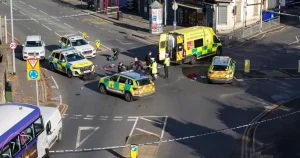

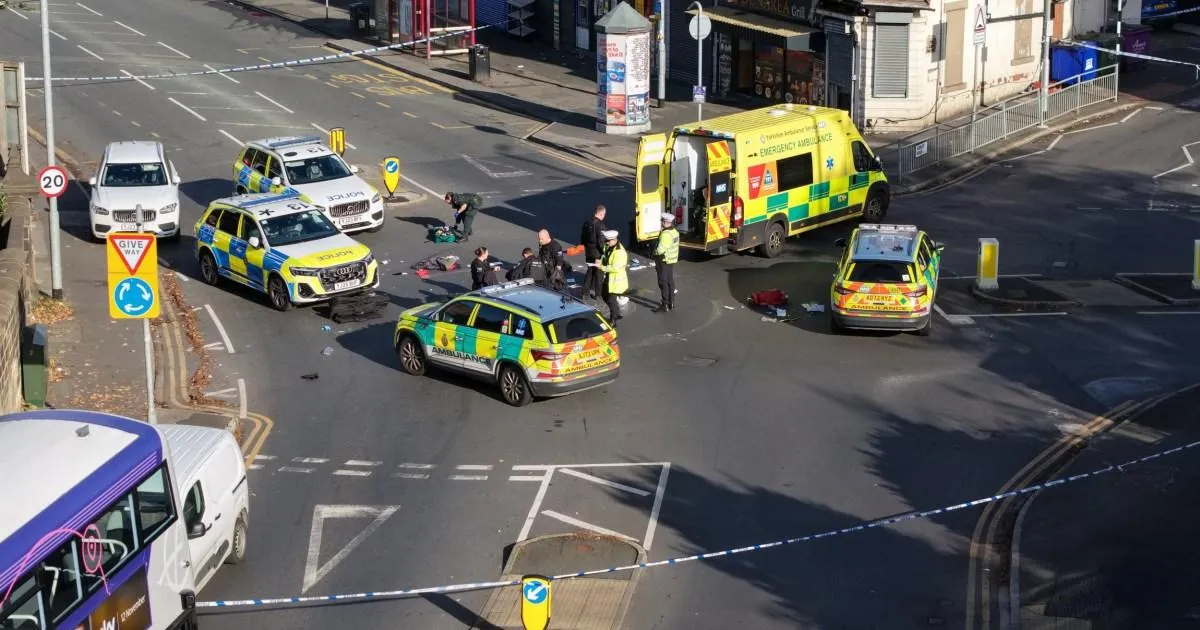
On an ordinary Thursday morning, a 36-year-old woman stepped into a moment she could not have anticipated, and in the space of two minutes, her life was abruptly taken from her. The streets of Leeds city centre were not supposed to become the scene of a fatal collision, but that is exactly what happened after a police pursuit spiralled into tragedy. The woman, whose name has not yet been released, was struck by a black Vauxhall Corsa on Beckett Street at around 9:52am. Officers had only authorized the chase moments earlier, at 9:50am, after the driver of the Corsa failed to stop for police on Harehills Road. What followed was not just a brief chase, but the beginning of a devastating chain of events that would end with a woman in hospital fighting for her life, and later pronounced dead. For her family and friends, this was not a statistic or a news headline; it was the sudden, violent erasure of someone beloved. She was someone’s daughter, perhaps someone’s partner, perhaps someone’s mother or confidante. The ordinary texture of her life—morning routines, plans for the weekend, people she loved—now sits in heartbreaking contrast to the cold reality that she will not be coming home.
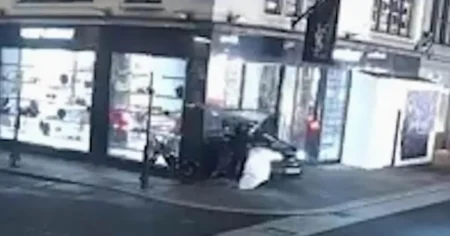
The sequence of events is stark and deeply troubling. On Thursday morning, police officers on Harehills Road attempted to stop a black Vauxhall Corsa. When the driver did not comply, a pursuit was authorized. Two minutes later, the Corsa collided with the 36-year-old pedestrian on Beckett Street. The driver did not stop at the scene to offer help or wait for emergency services. Instead, the vehicle continued on, leaving behind chaos and a critically injured woman. She was rushed to hospital with serious injuries, but medical efforts could not save her, and she was pronounced dead. The Corsa was later discovered abandoned on Nippet Lane, with at least two people having fled the vehicle before authorities could arrive. The car has since been seized, and forensic teams are combing through it for any trace of those inside. The sheer speed of these events—from the failed stop to the collision to the abandonment—paints a picture of frantic escape and, at the same time, a complete disregard for human life. It is hard to imagine the shock and grief of the victim’s loved ones, who now must face a future shaped by a tragedy that occurred in broad daylight on a public street, in a city going about its daily life.
As the community reels, the investigation has already begun in earnest. The Homicide and Major Enquiry Team has taken charge of the case, a clear indication of the seriousness with which authorities are treating the death. Forensic examinations of the abandoned vehicle are underway, and investigators are painstakingly piecing together the exact circumstances that led to the fatal collision. In addition to the criminal investigation, there is an independent element that cannot be ignored: because there was prior police contact before the crash, a mandatory referral has been made to the Independent Office for Police Conduct, the IOPC. This is standard procedure in cases where police actions may have contributed to a death, but its implications are significant. It means that alongside questions about who was driving the Corsa and why they fled, there will also be questions about the pursuit itself. Was it necessary? Could the outcome have been different? These are not easy questions, and they are not meant to be rhetorical. They are part of a system designed to ensure accountability, transparency, and, ultimately, justice. The IOPC referral does not assume wrongdoing, but it does acknowledge that this was no ordinary accident. It was a tragedy that unfolded within the framework of a police operation, and every aspect of that operation must now be scrutinised.
In the meantime, the police are turning to the public for help. They are appealing for witnesses who saw the collision itself, as well as anyone who saw the black Vauxhall Corsa before or after the incident. Dash-cam footage could prove invaluable, capturing the movement of the vehicle, the events of the pursuit, or perhaps even the faces of the occupants. Investigators are urging anyone with information, no matter how minor it may seem, to come forward by contacting police on 101. They understand that people may be hesitant, frightened, or unsure whether what they saw matters. But in a case like this, fragments of observation can become crucial pieces of evidence. Perhaps someone saw the Corsa speeding through a junction, or noticed it abandoned on Nippet Lane, or saw people leaving the vehicle in a hurry. Perhaps someone captured something on a phone or a dashboard camera without fully realising its significance at the time. For the victim’s family, every piece of information brings them one step closer to understanding what happened to their loved one, and one step closer to the hope of accountability. The appeal is not just a procedural formality; it is a call to ordinary citizens to help untangle a tragedy that is far bigger than any one person’s ability to comprehend on their own.
This devastating incident also reopens difficult conversations about police pursuits and public safety. Officers are expected to chase down dangerous drivers, but every pursuit carries the risk of unintended consequences. In this case, the decision to authorize the chase was made quickly, and within two minutes, a pedestrian was dead. Was that risk acceptable? Did the driver’s actions justify the chase? And what protocols, if any, were followed in deciding whether to continue? These are the kinds of questions that will haunt the investigation, and they are also the kinds of questions that matter to the public. People want to feel safe on their streets, and they also want to trust that the police are acting in the best interests of everyone. There is a delicate balance between enforcing the law and protecting innocent life, and when that balance goes wrong, the consequences can be catastrophic. This incident in Leeds is not the first time a police chase has ended in tragedy, and it will not be the last. But each such event leaves behind a family destroyed, a community shaken, and an institutional responsibility to examine what went wrong. It is not just about assigning blame; it is about ensuring that lessons are learned, that policies are refined, and that the same mistakes are not made again. The victim did not choose to be part of this story, and her death demands more than grief. It demands answers.
Ultimately, though, this is not a story about policies or procedures. It is a story about a woman whose life was cut short, and about the people who loved her. Somewhere in Leeds, a family is waking up to a reality they never imagined. A mother or father may be trying to make sense of a phone call that brought news no parent should ever hear. A child may be asking when their mother is coming home, with no way of understanding that she never will. Friends may be gathering, sharing memories, crying, and clinging to the fragments of a person who was here just yesterday. While police work continues and the legal process moves forward, these people are left to navigate an unbearable loss. In time, the victim’s name may be released, and her face may appear in news reports. The world may come to know her story in broad strokes, but the full measure of her life—the sound of her laughter, the warmth of her presence, the dreams she carried—will remain known only to those who were lucky enough to love her. Leeds is a strong and resilient city, but this tragedy has left a wound that will not heal easily. As the investigation unfolds and the justice system does its work, one thing remains true: no car, no chase, no decision can ever bring her back. The best that can be hoped for now is that her death is not treated as merely a statistic, but as the loss of a human being, worthy of dignity, remembrance, and the truth.