


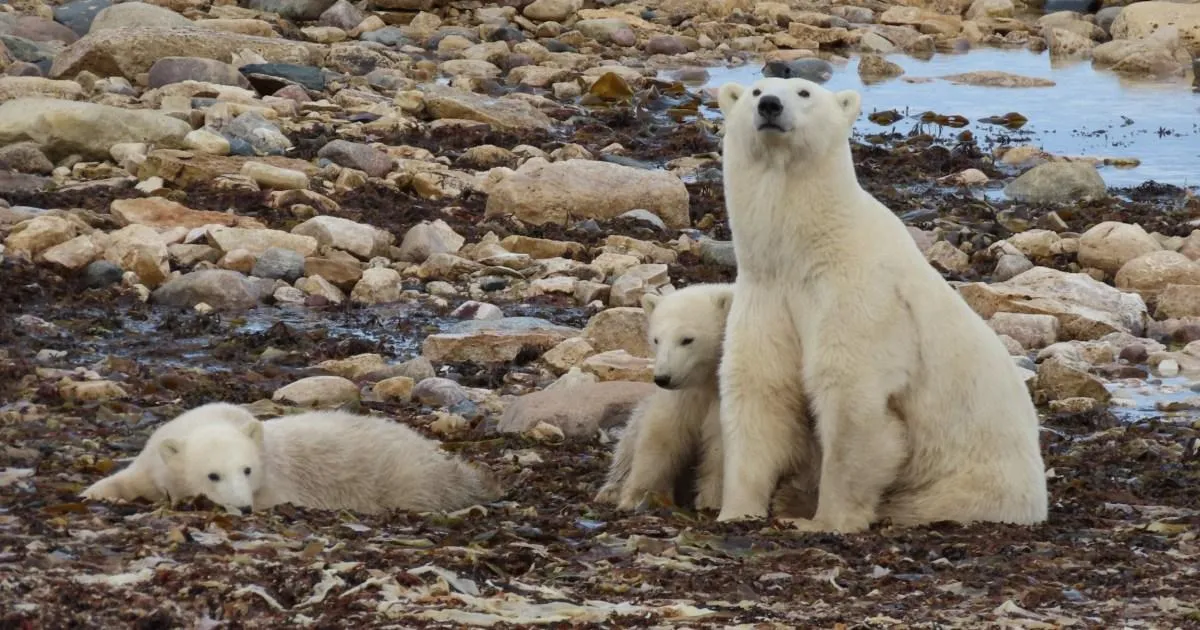
In a small town perched on the edge of Hudson Bay, the ordinary act of stepping outside carries a wild expectation. Churchill, Manitoba, is famous for its polar bears. Every autumn they migrate toward the coast, waiting for the bay to freeze over so they can venture out onto the ice to hunt seals. But as the climate warms, the ice is not forming as early as it once did, and it is melting sooner in the spring. The bears are spending more time on land, often hungry, sometimes curious, and increasingly likely to wander into places where people live, work, and send their children to school. This is why an international team of experts has traveled to Churchill to test a new kind of early warning system: an AI-powered “doorbell camera” called Bear-vision. It is designed to spot an approaching polar bear before it gets too close, then send an instant alert to homes, businesses, and community buildings. Imagine a smart doorbell that recognizes the face of a delivery person, except this one recognizes the unmistakable silhouette of a thousand-pound predator moving across the snowy landscape. For the people of Churchill, it could be a lifesaving addition to daily life. The technology is being developed by Polar Bears International, a conservation group that has spent decades working on ways for humans and bears to coexist safely. With climate change increasing the odds of a dangerous encounter, this camera is more than just a clever gadget. It is a peace offering, a way to protect both human communities and the animals that have become icons of the Arctic wilderness. The goal is not to create fear, but to give people the peace of mind that comes from knowing they will have a little extra time to react when a bear wanders into view.
The concept behind Bear-vision grows out of an earlier system called Bear-dar, which combines radar and cameras to sense motion across the surrounding terrain. Bear-dar can detect moving objects at a distance and then use artificial intelligence to identify what they are. It can tell the difference between a polar bear, a caribou, a person, a dog, or a snowmobile. That kind of precision is crucial in a place where a false alarm can cause panic or lead people to ignore warnings over time. Bear-vision takes that same technology and shrinks it into a smaller, more affordable device, something that could eventually be installed outside a school, a hotel, or a family home. The experts are currently deploying the first Bear-vision system at a waste facility in Churchill, a critical location because garbage attracts bears. The device is being tested to see if it can reliably spot bears approaching, day or night, through snowstorms and darkness, and send a clear alert to the people working nearby. It is an experiment in practicality: Can a camera and an algorithm give remote northern communities an early warning system that actually works, without costing a fortune? The researchers believe so. They imagine a future where residents receive real-time alerts on their phones, much like a weather warning, telling them that a bear has been spotted near a specific part of town. Instead of relying on someone happening to look out a window or hearing dogs bark, the technology acts as an extra set of eyes, always watching the horizon so that people can go about their daily lives with a little more confidence. It does not replace the need for human caution, but it adds a layer of protection that could make all the difference.
To appreciate why Churchill has become the testing ground for these tools, you have to understand the rhythm of the season. Churchill sits on the western shore of Hudson Bay, and every autumn polar bears gather nearby, waiting for the saltwater to freeze so they can head out onto the ice to hunt seals. This annual gathering draws thousands of tourists, who come to see the bears from large tundra vehicles, making Churchill one of the few places in the world where polar bears are a reliable part of the local economy and identity. But the timing of the ice is shifting. Polar Bears International says that because of climate-driven ice loss, the bears are now stuck waiting on land for about a month longer than their grandparents did. That is a startling change in the span of a single generation. The longer they wait, the hungrier they become, and the more likely they are to wander into town in search of food. This is why the annual Polar Bear Week, hosted by Polar Bears International, kicks off on Sunday, coinciding with the bears’ return to the coast. It is both a celebration and a reminder of the work that needs to be done. Krista Wright, the executive director of Polar Bears International, has spoken warmly about the relationship between the organization and the community. “We’re grateful to the Churchill community, who we’ve been honoured to work with over the decades on human-polar bear co-existence,” she said, “ensuring that conservation benefits not just wildlife but the community too.” Her words reflect a growing understanding that conservation is not only about protecting animals in remote places; it is about helping people and wildlife share the same land. In Churchill, that means children learn at an early age to be aware of their surroundings. It means residents know not to leave trash outside, and visitors know to follow the rules. Coexistence is not an abstract idea there. It is a way of life that is becoming more difficult as the changing climate puts pressure on both animals and people.
Nowhere has that pressure been more visible than at the town’s waste facility. In 2024, a fire destroyed the site, leaving piles of rubbish exposed to the elements and to wildlife. Polar bears, always on the lookout for an easy meal, began pawing through the garbage to find food. This created a double danger: the bears could ingest toxic materials and become ill, and they would also learn to associate the town with food, a lesson that is nearly impossible to unteach once a wild animal learns it. A bear that becomes conditioned to garbage is a bear that will keep coming back, and that is a recipe for tragedy. The team at Polar Bears International responded by installing new electric fences and deploying its Bear-dar technology to monitor the area. The new Bear-vision cameras are being tested there as well, with the goal of keeping polar bears away from the facility and alerting workers the moment a bear approaches. The experts have also traveled from Churchill to tour a similar waste management facility in Greenland, hoping to learn how other northern communities handle the challenge of managing garbage in polar bear country. It is not glamorous work. It involves trash, fences, sensors, and the unglamorous but essential business of cleaning up human messes. But this is where conservation really happens. If you can keep a bear from learning to eat garbage, you can keep that bear alive and keep the community safe at the same time. The problem of waste is a human problem that has become a bear problem, and solving it requires not just high-tech tools but also a good deal of common sense. Securing the rubbish, monitoring the perimeter, and removing the temptations that bring bears close to town are all part of a broader strategy to reduce conflict before it ever begins.
Bear-vision is not the only novel idea being tested. Researchers are exploring a whole toolkit of non-lethal ways to move bears away from communities without harming them. Polar Bears International has joined forces with Brigham Young University and Churchill’s Polar Bear Alert Programme to test drones as an affordable, gentle way to encourage bears to leave. The idea is that a drone can fly toward a bear, perhaps making a noise or flashing a light, and persuade it to turn around without any physical contact. That is far safer than shooting a bear with a gun or chasing it with a vehicle, and it is much more humane than killing a bear that is simply doing what its instincts tell it to do. The same research effort is also testing ultrasonic sounds, conductive materials, and a new odour-based bear spray formula. The spray might be more effective than traditional pepper spray because it is designed to be specially tuned to a polar bear’s sensitive nose, a smell that sends a clear message without causing lasting harm. Imagine a repellent that works by making a place smell frightening to a bear, but is completely harmless to people and the animal itself. It is clever chemistry and thoughtful engineering. What all these methods have in common is a commitment to smart, compassionate problem-solving. No one wants to hurt a polar bear, even when a bear threatens human safety. The challenge is to convince the bear that people and the places they live are not worth investigating. A drone buzzing in the distance, a strange sound, an unpleasant smell—these are gentle but firm signals. They respect the bear’s life while protecting the community. This is the new face of wildlife management, less about traps and guns and more about signals and boundaries. It is still a work in progress, and not every idea will work in every situation, but the spirit of the research is deeply hopeful.
The work being done in Churchill offers a blueprint for the rest of the world, not just for polar bear country but for every place where people and wild animals are learning to share an increasingly crowded planet. As climate change continues to reshape habitats and migration patterns, the sharp lines between human and animal territory will blur even further. Polar bears are not the only species that will need this kind of assistance. Mountain lions, wolves, elephants, and countless other animals are already facing similar challenges as they move into human-dominated landscapes in search of food, water, and shelter. If we can learn to coexist with polar bears in Churchill, perhaps we can learn to coexist with other wild neighbours elsewhere. The word “coexistence” may sound abstract, but in Churchill it is deeply practical. It means making sure garbage is stored securely so hungry bears do not learn bad habits. It means teaching children to walk to school in groups and to always be aware of their surroundings. It means giving tourists the chance to see a magnificent bear from a safe distance, not through a window of fear but with a sense of wonder and respect. It also means using technology wisely, as a support for community rather than a replacement for it. Polar Bears International and its partners understand that conservation is about relationships: between people and the land, between people and animals, and among the people who share a place. The residents of Churchill have taught the world a great deal, and they continue to lead by example. They are not trying to turn the Arctic into a theme park or a fortress. They are trying to live with dignity in a place that is both beautiful and dangerous. And in doing so, they are showing us that with a bit of creativity, a bit of humility, and a lot of courage, we can protect the great white bears and the human communities that call their homeland nearby. That is a message worth remembering during Polar Bear Week and long after the ice returns.