

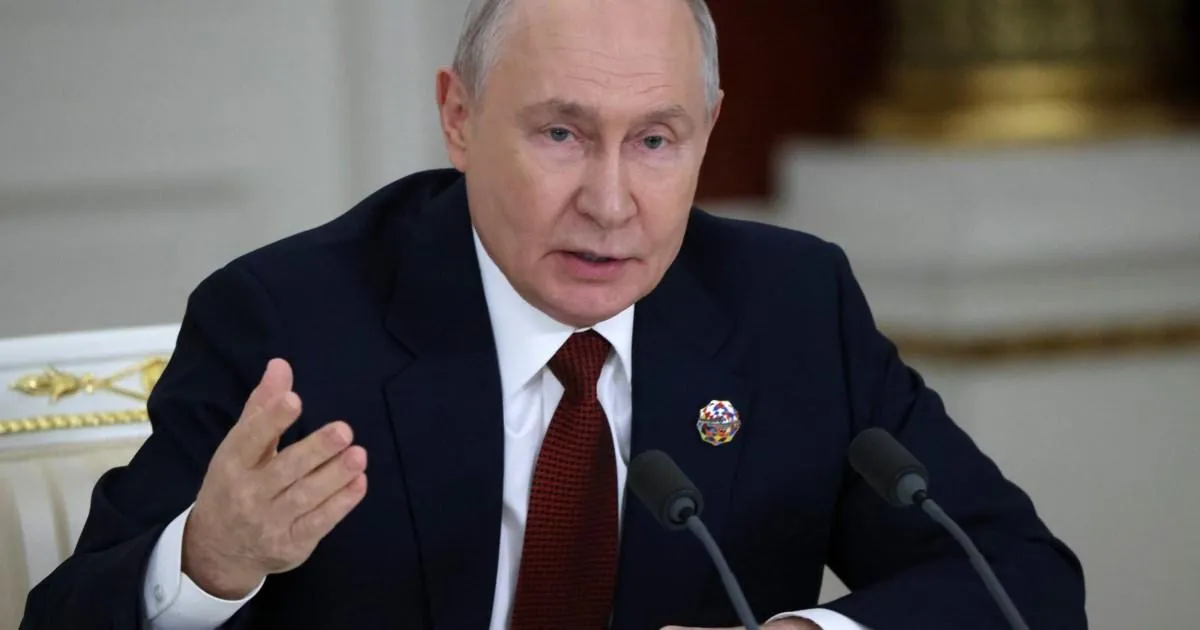
Vladimir Putin has once again put the world on notice, and this time his words landed with the weight of a man who knows exactly how much fear he can generate. Speaking after a phone call with the leaders of Finland and Norway, the Russian president issued a stark warning to the West: Russia is prepared for war with Europe, but it does not want one. It was the kind of statement that makes headlines and sends ripples through chancelleries across the continent, because it manages to be both reassuring and terrifying at the same time. On the one hand, Putin insisted that Moscow has no interest in conflict. On the other, he made it unmistakably clear that if the West keeps pushing, Russia will not back down. “We are ready for war with Europe, but we don’t want it,” he said. “As for them – if anyone desires such a thing, let them prepare.” His remarks came in response to Western nations that have been making preparations for a possible conflict by 2030. In Putin’s telling, the West has been conjuring a threat that does not yet exist while failing to achieve its own goals. He dismissed the idea that Russia could be strategically defeated, saying the West’s ambitions had already collapsed under their own weight. “It is highly unlikely that this will be possible by 2030,” he said, before adding a warning that cut through all the geopolitical posturing: “If things go too far, there will be no winners at all.”
The warning is not entirely new. Earlier this month, Putin made similar remarks, insisting that Russia had no plans to attack European countries but would respond to any aggression with the full force of its arsenal. What has changed is the tone, the timing, and the diplomatic choreography around it. There is a growing sense that Europe is sleepwalking into a new era of confrontation, with NATO countries talking openly about the need to prepare for war, conducting military drills in the Baltic Sea, and seizing Russian vessels. From the Kremlin’s perspective, these are not defensive measures; they are provocations. Putin seized on them as evidence that the West is escalating tensions even as it claims to want peace. The result is a dangerous feedback loop. Every military exercise on one side is seen as preparation for attack on the other, and every warning becomes a reason to prepare even harder. The fear is no longer just theoretical. In recent weeks, a series of drone strikes in the Black Sea off the coasts of NATO members Romania and Bulgaria has heightened anxieties that Russia is testing the alliance’s resolve. These incidents, coming after a long string of airspace incursions, have raised troubling questions about whether the war in Ukraine is spilling beyond its borders. For ordinary people in the region, the sounds of drones and the sight of military aircraft are no longer abstract images from a distant conflict. They are reminders that war, once unleashed, does not always stay where it was intended to.
In the midst of this tension, something unusual happened. The leaders of Finland and Norway picked up the phone and called Vladimir Putin. For years, Western leaders have largely shunned direct contact with the Kremlin, treating the Russian president as a pariah after the full-scale invasion of Ukraine. But Finnish President Alexander Stubb and Norwegian Prime Minister Jonas Gahr Støre decided that the usual approach was no longer enough. They spoke with Putin for about ninety minutes, and then they called Ukrainian President Volodymyr Zelenskiy. The conversation was described as frank and substantive, which is diplomatic language for a difficult but meaningful exchange. The two Scandinavian leaders made no apologies for reaching out to Putin. They are neighbors of Russia, and they carry the weight of that proximity in ways that leaders further west do not. “The outcome of this war will have a direct impact on our and the broader European security,” Stubb said. “Ending the war requires direct discussions.” It was a quiet but significant break with the longstanding practice of isolating Putin, and it reflected a growing recognition that the war cannot be ended by refusing to talk. The call also came at a particularly delicate moment, with the United States shifting its stance under President Donald Trump and relations between Washington and Kyiv reaching their lowest point in eighteen months. By stepping in, Finland and Norway were trying to open a channel that others had allowed to go cold.
The immediate results of that call are difficult to measure, but the signals from the Kremlin were not encouraging. The official Russian readout of the conversation made no mention of any softening in Putin’s position. Instead, it stressed that a just and lasting peace could only be achieved if the legitimate interests of the Russian Federation were fully and unconditionally taken into account. That is the kind of wording that gives diplomats headaches, because it can mean almost anything the Kremlin wants it to mean. It could be an opening for negotiations, or it could be a precondition designed to make negotiations impossible. The readout also accused the European Union and NATO of pursuing confrontational policies that were prolonging the hostilities. In other words, from Moscow’s perspective, the war continues because the West wants it to continue. That framing is unlikely to win over many allies in Europe, but it does reveal something important about how the Kremlin sees the conflict. For Putin, the war is not just about Ukraine. It is about Russia’s place in the world, its security interests, and its demand to be treated as a great power. Any peace plan that does not account for those interests, in full and without conditions, is not a peace plan at all. This is the wall that diplomats keep running into, and it is why the planned discussions in Abu Dhabi, involving Russian, Ukrainian, and American officials, are so important. Those talks, expected next month, would be the first of their kind since February. They may not produce a breakthrough, but they would represent the first real attempt in months to find a diplomatic path out of a war that has killed tens of thousands, displaced millions, and reshaped the security map of Europe.
The human dimension of all this can be easy to lose sight of when the discussion is dominated by missile systems, drone incursions, and military readiness. But behind every statement from the Kremlin and every declaration from NATO is a reality of human suffering. There are families in Ukraine who have lost their homes, their loved ones, and their futures. There are soldiers on both sides who have been sent to the front lines by leaders who will never have to experience the mud and the fear and the noise of war. There are ordinary Russians who have been told that their country is fighting for its very survival, and ordinary Europeans who are being asked to prepare for a conflict they never wanted and do not fully understand. The mental shift is profound. People in Finland and Norway, countries with long borders with Russia, have had to confront a reality that their parents and grandparents knew only in stories. The idea of a war with Europe is no longer a hypothetical scenario in a think tank report. It is something that leaders are actually preparing for, with timetables and budgets and contingency plans. Putin’s warning that “there will be no winners at all” if things go too far is not just a rhetorical flourish. It is a recognition that a war between major powers would be catastrophic in ways that are almost impossible to imagine. And yet, the very fact that he is making these statements, while the West is making its own preparations, means the unthinkable is being normalized.
What makes this moment so unsettling is that no one seems to have an exit plan. The war in Ukraine has ground on for years, with no end in sight. Peace talks are announced with great fanfare and then collapse under the weight of mutual suspicion. Economic sanctions have not changed Russia’s calculus. Military aid has not given Ukraine a decisive advantage. The call from Finland and Norway to Putin was a reminder that dialogue matters, even when it is uncomfortable, because the alternative is a future in which countries speak to each other only through the barrel of a gun. But so far, the dialogue has not produced a shift in positions. Russia continues to demand that its interests be treated as sacrosanct. Ukraine continues to demand the restoration of its territory. The West continues to debate how much support to give. And the clock keeps ticking toward a decade in which the unthinkable has already become possible. Putin says he does not want a war with Europe. Perhaps that is true. But the machinery of conflict is moving, driven by fear, pride, and the momentum of crisis. The question for the rest of the world is whether leaders will find a way to step back before the warnings become real, before the rhetoric becomes reality, before the phrase “no winners” becomes an epitaph. Because in the end, war is not just something that happens between governments. It happens to people. It is the father who does not come home, the city that is reduced to rubble, the childhood interrupted forever. And no matter how many times leaders say they are ready for it, no one who has ever lived through it would ask for it again. The world is holding its breath, waiting to see whether this is the moment where reason prevails or the moment where everything falls apart.