
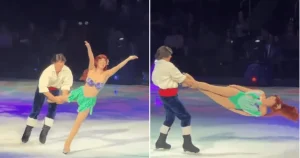

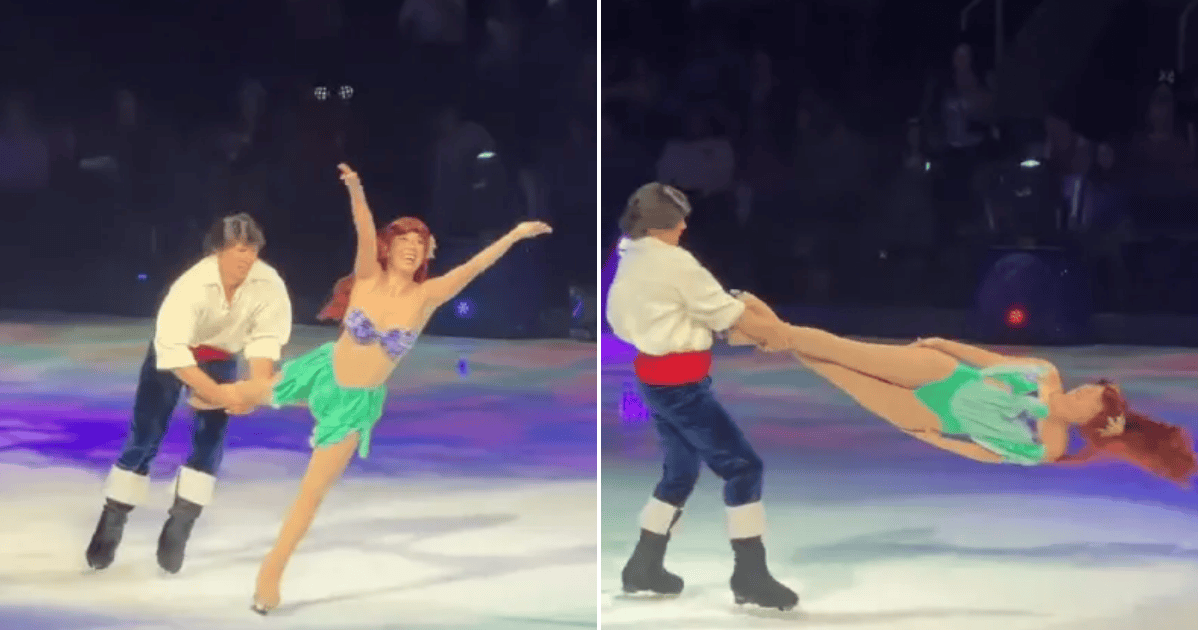
It was supposed to be a moment of fairy-tale magic, the kind that makes Disney On Ice such a beloved family experience. A skater dressed as Ariel, the adventurous Little Mermaid, and her Prince Eric were performing a dramatic spin lift in front of a roaring crowd. She was hoisted into the air by one leg, twirling above the ice like a character come to life, and the audience was cheering. But in a heartbeat, the picture-perfect moment collapsed. The skater lost control of the rotation, and both performers came crashing down onto the hard rink. The thud was audible, and the gasp from the spectators was immediate and collective. The woman, who had been so effortlessly airborne just seconds before, lay on the ice with her arms wrapped around her head, clearly shaken and hurting. Her partner scrambled to her side, staying close until she could manage to sit up. Then, gently, he helped her back to her feet and together they skated off, pausing only to wave to the audience as if to reassure everyone that they were all right. The footage, shared on TikTok by a user named PlanoPlaysGames, quickly went viral, leaving viewers across the internet holding their breath.
What made the accident so alarming was the terrifying nature of the move itself. In the world of ice skating, this particular lift is sometimes known as a “headbanger,” because when performed at full speed, the skater being spun is swept just inches above the ice, her head and body rotating dangerously close to the frozen surface. It is a crowd-pleasing, high-risk maneuver that demands immense strength, split-second timing, and complete trust between partners. Here, that trust was tested in the cruellest way. As the male skater spun his partner by her leg, something went wrong—a loss of grip, a shift in balance, a moment of fatigue or misalignment. The physics that had been keeping her safely in orbit suddenly turned against them, and gravity yanked both performers down. For the audience, it was a startling reminder that the polished, seamless performances they watch in awe are the result of human bodies doing extraordinarily difficult things, and that even elite professionals are never entirely safe. The woman’s immediate reaction, curling into herself and holding her head, was a heartbreaking sign that she knew how close she had come to serious injury. Her partner’s quick response, staying by her side, checking on her, and waiting until she was ready to stand, spoke volumes about the bond and care that exists between skating partners.
When the clip made its way across social media, the response was a mix of shock, worry, and admiration. TikTok users flooded the comments with concern, with one writing, “He almost bashed her head on the ice omg,” while another replied simply, “He did.” Others commented, “That actually looked BAD,” and noted that the fact the performer was able to skate away did not mean she was fine. There was also a wave of praise for the sheer professional composure she showed after such a heavy fall. She did not stay crumpled on the ice in defeat; she took a moment to gather herself, allowed her partner to support her, and then made the choice to rise and finish the exit as gracefully as she could. This is the reality of live performance: the show must go on, even when your body is crying out for you to stop. Yet beneath the bravery and the reflexive wave to the audience, there lies an important truth that many of us forget. Skaters, stunt performers, and theatrical artists do not leave their vulnerability at the door when they step onto the stage. They push their physical limits in front of thousands of people, night after night, and when accidents happen, the pain is real. The fact that we cannot see the bruise or feel the throbbing ache does not make it any less present.
This incident also echoes a more serious accident that occurred in the very same production world just over a year ago. In February 2024, Disney On Ice performer Anastasia Olson was badly injured during a show at the Target Center in Minneapolis. Olson, who was portraying Belle from Beauty and the Beast, was in the middle of a lift routine shortly after the show began when she fell. Audience member Beka, who witnessed the accident, told local news outlet KARE 11 that the lift “appeared shaky” before Olson came down. The show, remarkably, continued on, and Olson was taken to a hospital, where her condition was initially listed as serious. For days, fans and fellow performers waited for updates, sending prayers and messages of support. By Valentine’s Day, her condition had improved, and Olson eventually shared a series of photographs of herself in full Belle costume on Instagram, alongside a deeply emotional message. “I’m overwhelmed with emotions and love from everyone over the last week,” she wrote, adding that the love and prayers of so many people had carried her through a terrifying and painful experience. To concerned parents who feared for her, she offered warm reassurance: “Belle is ok and recovering.”
Olson’s recovery was not just a personal triumph, but a testament to the resilience that defines so many performers. In an industry where physical grace is everything, an injury can feel like a betrayal of the body, an interruption of one’s identity and purpose. Yet Olson refused to let the accident define her. She worked hard to heal, reconnected with the character she loved, and eventually returned to the ice. By October 2025, she was once again wearing Belle’s golden gown in a Disney On Ice tour, proving that setbacks, no matter how scary, can be surmountable. Her story has become a source of inspiration for many, including those who saw the recent TikTok video of Ariel’s fall. It offers a quiet but powerful reminder that the performers who delight our children are not superhuman. They are people with dreams, fears, and fragile bodies, and every time they take the ice, they risk more than most of us ever realize. The applause they receive is not just for their artistry, but for their courage, their dedication, and their willingness to put on a show even when they know that something could go wrong.
Ultimately, these moments of crisis reveal the delicate balance between the spectacle and the human beings who create it. When we watch Disney On Ice, we are transported into a world of enchantment, where princesses and princes glide effortlessly across the rink and every gesture feels choreographed to perfection. We rarely think about the hours of training, the physical toll, the broken bones and torn muscles that lurk beneath the glittering costumes. But occasionally, a video like this pierces the illusion. A skater falls, the music stumbles, and we are suddenly reminded that the people on the ice are not animated characters but flesh-and-blood performers who feel pain and fear and doubt just like anyone else. That reminder, uncomfortable as it may be, is also profoundly humanizing. It invites us to watch with more empathy, to cheer a little louder when they rise after a fall, and to understand that each performance is a gift made possible by incredible bravery. The best thing we can do, as audiences, is honor that effort—not by turning away from the hard moments, but by holding the performers in our thoughts, sending them kindness, and remembering that behind every perfect spin, there is a person doing something extraordinary simply for our joy.