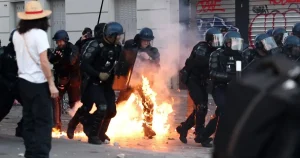


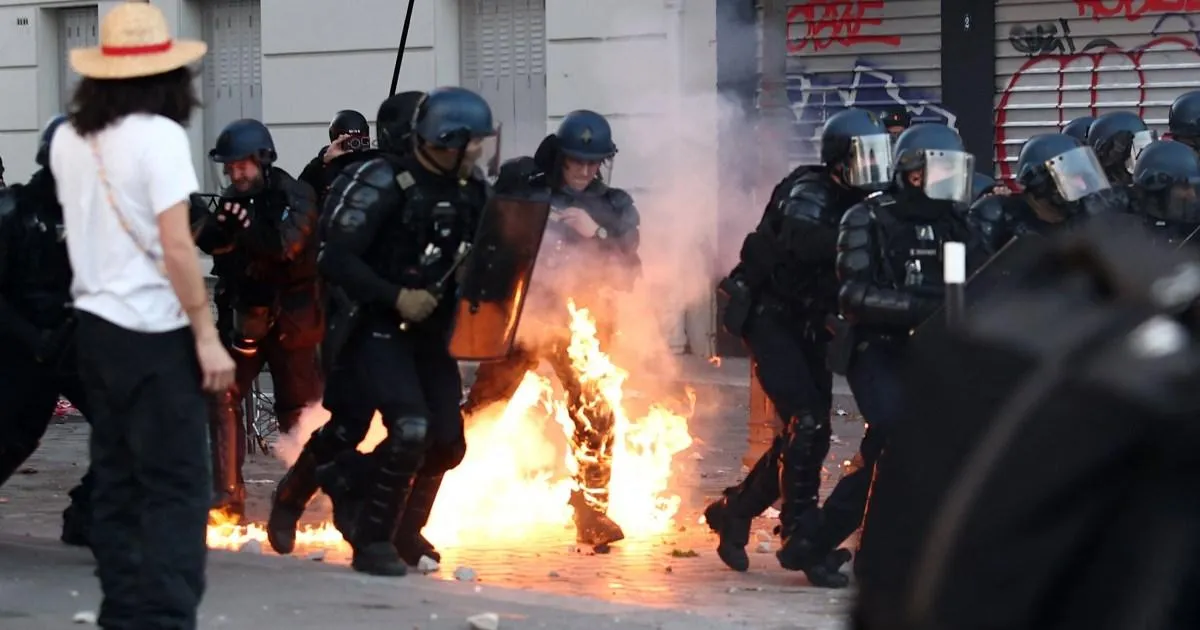
It is almost impossible to imagine what goes through a person’s mind when their body catches fire in the middle of a crowded street. But one French police officer has tried to put that experience into words after being hit by a Molotov cocktail during the latest wave of protests in Paris. Speaking anonymously to French news outlet RTL, the gendarme described an “immediate, intense” burning sensation that did not stop, a pain that grew as the flames ate through his protective equipment and reached his skin. “We have time to feel it coming on, we have time to feel that the equipment is starting to be affected and to feel that the flesh is starting to sting,” he said. The attack happened on the margins of a larger peaceful demonstration over the cost of living, and the moment was caught on video. The footage shows riot police holding up their shields near the Porte de Bagnolet and Porte de Charenton Metro stations when one object arcs through the air, lands at the officer’s feet and sends a fireball up his body. For him, the worst part was the helplessness. The flammable liquid was so greasy, he explained, that he could feel it travelling over his skin, unable to stop it, wondering when it would finally stop burning. That visceral testimony has turned a statistic into a face, a human being with fears and hopes. The French interior minister, Laurent Nuñez, called the incident an attempted murder, and for anyone watching the images, it is not hard to see why. The officer was lucky enough to avoid serious injuries that would keep him off work, but the memory of that sensation, the smell of smoke and the feeling of his own flesh beginning to burn, is not something that will simply disappear.
The attack came during the third consecutive weekend of unrest across France, a country already on edge after weeks of demonstrations that began with school students demanding better classroom conditions. What started as a specific complaint about crowded classrooms, crumbling buildings and a lack of teachers quickly expanded into a wider cry of anger over the rising cost of everyday life. In cities and towns, people took to the streets because they are struggling to pay bills, put food on the table and keep a roof over their heads. In Paris, smoke and fireworks filled the air as demonstrations once again descended into chaos. Police in black riot gear formed lines, protesters threw projectiles, and ordinary passersby stopped to watch from doorways and street corners. The line between peaceful and violent has become dangerously thin, and every weekend more people are being caught up in it. For those who threw Molotov cocktails, perhaps they too are scared and desperate, but no political grievance justifies trying to burn someone alive. The interior minister’s phrase “attempted murder” resonates because of the intention behind it: to hurt, to maim, to terrorize. There are many unknown officers, their faces hidden behind helmets and shields, standing between order and disorder. When a fireball races up their legs, it is not abstract. They are brothers, fathers, sons and daughters. They go home smelling of smoke and trying to explain to loved ones why they chose this job. The images from Paris underline a wider tragedy: a country where frustration has curdled into violence, where anger over the cost-of-living crisis is real, but where police officers have become targets of hatred instead of public servants.
When the officer spoke to RTL, he chose to remain anonymous. That anonymity says something in itself. He is not seeking fame or sympathy; he is simply one of many women and men who have to wake up every morning and put on a uniform in a country where that uniform can make you a target. His account was remarkable for its matter-of-factness. The burning sensation was immediate and intense. He could feel his equipment failing, the heat seeping through layers meant to protect him. The substance was greasy, so it kept burning and spreading. “I felt it spreading on my skin, wondering when it would stop,” he said. That simple sentence carries an ocean of fear. He said he did not end up with serious injuries that blocked him from getting back to work, but getting back to work does not mean being okay. A person who has been set on fire lives with that memory forever. The smell, the sound, the flash, the sudden awareness of mortality. He may return to the streets, stand behind a shield and face another crowd. But there will be a flicker of vigilance, a tightened grip on the handle, a quicker instinct to turn away when something flies through the air. In human terms, we often measure trauma by visible scars, but some wounds are invisible. The officer’s willingness to speak, even anonymously, gives the public a window into what it is like to be on the receiving end of a weapon intended to cause agonizing death. A Molotov cocktail is not a protest sign; it is a firebomb. It is a weapon used in warfare. When it is thrown at someone in uniform, it crosses every line. His survival is a relief, but his ordeal is not over.
The unrest is not confined to France. Across Europe, the same anxieties are erupting. In the weeks since the initial marches in Paris spiraled out of control, protests have spread to Italy, Belgium, Albania and now Germany. In German cities, a youth campaign group called Gen Z Regelt — which translates to “Gen Z Reigns” — has mobilised young people around demands that sound less like ideology and more like basic survival: more funding for schools, better mental health care, action on the cost-of-living crisis and opposition to compulsory military service. These are not fringe complaints. They are the concerns of a generation that has inherited a world of expensive housing, uncertain jobs, ecological crises and political gridlock. They feel forgotten. In Frankfurt, Berlin, Hamburg and Cologne, demonstrations began peacefully but, as in France, some participants were determined to turn them violent. Fireworks were set off, masks were worn, and police clashed with groups. In Frankfurt, police closed off the main shopping street as disturbances broke out. The police force Polizei Hessen later appealed to the public for photos and videos of violence that included property damage, thefts and serious physical attacks on police officers. There was looting and vandalism. In Cologne, police cancelled a Gen Z Regelt march after spotting participants wearing masks and letting off fireworks, allowing it to go ahead only as a stationary rally. One image that ricocheted around social media — a man in a Batman costume standing among protesters — captured the strange, carnival-like atmosphere that can emerge in these moments. But for all its surrealism, the underlying message remains urgent. These are not all mindless criminals. Many are young people who believe the system will not listen unless they make noise. The tragedy is that in making noise, they have given authorities a reason to see them as enemies rather than citizens with legitimate grievances.
German politicians responded with words that blended condemnation with resolve. Boris Rhein, the state premier of Hesse, said: “Anyone who behaves like the attackers in Frankfurt’s city centre places themselves outside our society. We will carefully assess the aggressors, perpetrator groups and the course of events, and draw our conclusions.” His tone echoed the French interior minister’s description of the Molotov cocktail attack as attempted murder. Authorities are clearly frustrated that a minority of violent people have hijacked legitimate protests, endangering the lives of police and civilians alike. The appeal from Polizei Hessen for photos and videos of the violence showed a modern law enforcement dilemma: in an age of smartphones, the public is both witness and jury, and authorities depend on ordinary citizens to help identify troublemakers. But there is also something uncomfortable about watching a state that has the power to enforce order asking for help. It reveals how fragile social contracts have become. When protesters and police face each other across barricades, trust dissolves. Police see every masked figure as a potential attacker; many protesters see every officer as an agent of repression. In the middle are the vast majority of people who simply want lower bills, better public services and a chance to live. They are the school students who first marched in France for better conditions, the young Germans who ask for mental health care, the families struggling to buy groceries. Their voices risk being drowned out by tear gas and fire. Officials are right to call violence unacceptable, but they must also hear the desperation underneath it. The road back to peace will require more than arrests and condemnations. It will require meaningful answers to the cost-of-living crisis, investment in public infrastructure and a political culture that treats young people’s fears as urgent rather than trivial. Otherwise, the Molotov cocktails and fireworks will keep coming.
What does it mean to humanize a story like this? It means remembering that every person on the street is more than a symbol. The gendarme who was set alight is not merely an official in a uniform; he is a person who felt his flesh sting, who wondered if the fire would ever stop, who will carry that moment for the rest of his life. The protesters are not merely rioters; many are students, workers, mothers and fathers who have seen their real incomes shrink and their futures clouded. There is a human story in every statistic, in every arrest, in every broken window and every burning car. The cost-of-living crisis is not abstract. It is the parent choosing between heating and eating, the young person delaying a family because rent is too high, the teacher paying for classroom supplies out of her own pocket. When school students first marched in France for better conditions, they expressed a simple and legitimate desire: to be educated in an environment that shows the state cares. When that cry expanded into anger over the cost of everyday life, it drew in millions who recognized the same injustice. But the turn to violence is a betrayal of that message. Molotov cocktails, fireworks, looting and attacks on police do not fix schools or lower prices; they create more pain, more division and more reason for hard-hearted responses. The officer’s testimony should compel us to see the danger of treating fellow citizens as enemies. At the same time, political leaders should see that a generation is crying out. The challenge is to keep the door to democracy open — protests, strikes, votes, debates — while shutting the door on violence. For the officer, getting back to work is a measure of resilience, but no one should have to accept being set on fire as part of the job. For the young protesters, “Gen Z Reigns” is a slogan, but it also holds a promise: they will inherit the country, so they should be listened to before desperation turns into destruction. Perhaps the most human thing we can do is to acknowledge both realities: the genuine pain of those who march and the genuine pain of those who protect. Then, slowly, rebuild trust. That is the hardest work. It is also the only work that matters.