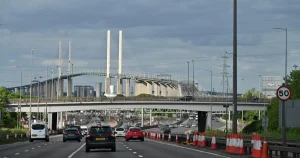


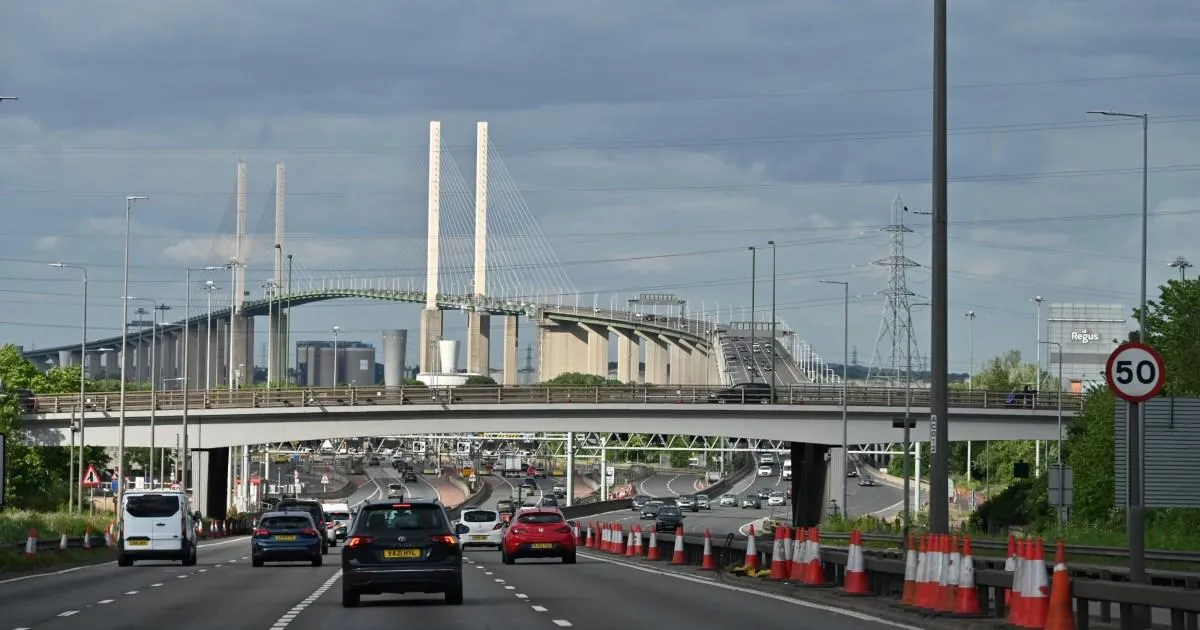
The morning had been ordinary enough, the usual hum of commuter traffic building along the M25 as thousands of drivers made their way between Essex and Kent. But just before midday, the rhythm broke. The iconic Queen Elizabeth II bridge at the Dartford Crossing, a structure that carries more than 180,000 vehicles on its busiest days, was suddenly closed. A police incident had unfolded on the bridge, triggered by concerns for a man’s welfare. Word spread slowly through the network of radios and smartphone apps, and then the reality sank in: the main artery connecting the southeast had been cut off. The M25, already notorious for its congestion, began to snarl and seize. Drivers who had left home with packed schedules and high hopes found themselves creeping to a halt, their vehicles becoming tiny steel islands in a sea of brake lights. The sky above remained grey and indifferent, while the famous bridge stood silent, its traffic frozen in place, a symbol of how quickly modern life can be upended by a single moment of human crisis.
Essex Police later confirmed that officers were dispatched to the bridge after receiving calls about a man in distress. The operation was swift and careful, a delicate negotiation between human fragility and the unforgiving steel and asphalt around it. For those sitting in their cars, however, the wait was agonizing. The closure stretched on, with National Highways initially offering no timescales for reopening. The incident, they stated, was of a nature that made prediction impossible. Meanwhile, the first drivers to be caught in the chaos began to feel the panic of missed appointments, late pick-ups, and ruined plans. One frustrated motorist took to social media, venting not just about the delay, but about the financial sting of the Dart Charge, which had recently increased to £3.50. “I hope Dart Charge will be issuing refunds,” they wrote, “I have now missed my plans and I’m sat here in standstill.” The tweet captured a moment of collective exasperation, a small voice in the digital wilderness speaking for the hundreds of thousands of others trapped in the amber glow of tail lights.
The scene on the ground was one of mounting desperation. The bridge was not the only casualty of the police operation. To the north, one of the two Dartford Crossing tunnels, the eastbore, was also forced to close, leaving only the west bore tunnel available for northbound traffic. This tunnel, with a height restriction of 4.8 metres (15 feet 9 inches), could not accommodate taller vehicles, which were directed to take a lengthy detour around the clockwise M25. The result was a logistical nightmare. HGVs, coaches, and lorries discovered their planned routes were suddenly impassable, and they had to contend with the very traffic they would now be adding to. For ordinary car drivers, the queue crawled through the remaining tunnel, each vehicle inching forward with the agonizing slowness of a snail crossing a motorway. The air inside cars grew thick with frustration and sighs. Some had turned off their engines to save fuel, but that only made the stillness more oppressive. The minutes stretched into an hour, and still there was no sign of movement.
The human cost of the gridlock was written across the faces of the drivers, though most remained hidden behind windscreens. A woman travelling northbound told reporters she had been “sitting here standstill for an hour,” her words a testament to the sheer inertia that had claimed the road. Her plans were now in tatters, and she was left with nothing but the hum of idling engines and the distant wail of sirens that seemed to grow no closer. On social media, the complaints multiplied, a chorus of frustration that ranged from the philosophical to the sarcastic. Some drivers posted pictures of the endless lines of traffic, the red and white lights stretching to the horizon like a Christmas tree that had lost its joy. Others begged for information, any information, about when they might finally move again. The bridge, which had been a symbol of connection and progress, had become a prison of sorts, a place where time itself seemed to have stalled, waiting for the single act of human kindness that would resolve the crisis at its heart.
The congestion spiralled far beyond the crossing itself. Traffic snarled back for miles on the M25 towards both Kent and Essex, creating a ripple effect that touched surrounding roads and motorways. On the A13, cars were stationary all the way to the Lakeside Shopping Centre in Thurrock, a sprawling retail destination that was suddenly unreachable for many. Similarly, the approach to junction 3 with the M20 was gridlocked, leaving drivers with few options but to wait or abandon their journeys altogether. The Dartford Crossing, which ordinarily handles a staggering volume of vehicles each day—sometimes exceeding 180,000—was now reduced to a trickle. The two tunnels, originally built in the 1960s, and the bridge that came later, had been designed to keep London moving. But on this day, they were a testament to the fragility of infrastructure under pressure. For anyone who had ever taken the crossing for granted, the closure was a brutal reminder of how much the region depends on this single thread of tarmac and steel. The costs of the delay, both in time and money, began to mount, with businesses losing productivity and families missing important moments.
Finally, after what felt like an eternity to those caught in the jam, Essex Police confirmed that the man had been safely brought to care, and the bridge was reopened. The news spread like a slow wave, but the relief was muted. For those still stuck in the miles of backlog, the reopening was only the beginning of a long, slow unwinding. Traffic began to move, but it did so hesitantly, like a river that had frozen and was now melting in the spring. The queue took hours to clear, and many drivers found that even after the bridge was open, they were still trapped in the congestion that had built up behind them. The incident, which had begun as a human crisis, had become a city-wide event, a shared experience of frustration and helplessness. In the end, the bridge reopened, and life slowly returned to normal, but the memory of the day lingered. For the man at the centre of the incident, there was a chance for a new beginning; for the drivers, there was only the hope that such a disruption would not happen again. And yet, in the unpredictable world of the M25, that hope was as fragile as the peace that had been restored. The Dartford Crossing would carry its millions again, but it would always remain a place where a single moment could bring the entire southeast to a standstill—a reminder that the roads we travel are not just concrete and steel, but living threads that connect our lives in ways we too often forget until they are severed.