


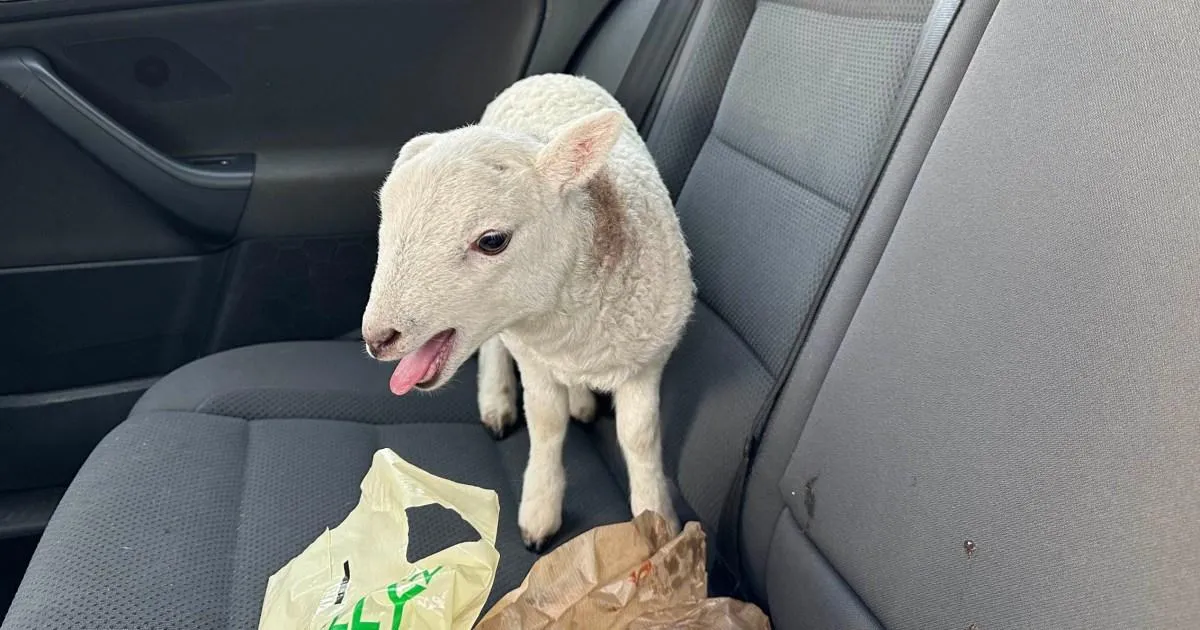
On a grey spring morning in late April 2023, a routine traffic stop on the M74 near Glasgow turned into one of the strangest scenes any police officer could expect to encounter. A Volkswagen Golf was pulled over, and as officers approached, there was nothing to suggest that this would be anything more than a minor roadside check. But a police dog was brought in, and its instincts led officers to search beneath the front passenger seat. There, hidden in bags, they found heroin and cocaine worth around £14,000. It was a serious drugs bust, the kind that usually ends with handcuffs and a grim trip to the station. Yet what made this case unforgettable was not the drugs themselves, but what was sitting in the back seat: a lamb, calmly munching on a bag of chips. The animal, later identified as a lamb named Pablo, appeared utterly unbothered by the chaos unfolding around it. In that single moment, the worlds of serious crime and rural innocence collided in the most absurd way imaginable. The passengers were John McNeil, 56, and the driver, Lindsey Sangster. The lamb, it turned out, had been named after Pablo Escobar, the infamous Colombian drug lord, an irony so heavy that it almost felt deliberate. But the scene was real, and it would soon become the centrepiece of a courtroom drama that had everyone struggling to keep a straight face.
When police asked where the lamb had come from, the explanations became even more bizarre. According to an officer, McNeil claimed that Sangster was a “trainee shepherdess,” a description that seemed to have no basis in reality. Sergeant Nick Twigg later told the court that there was little evidence to support that particular claim. The lamb, he noted, was at the time eating a bag of chips left on the back seat, which hardly suggested a professional shepherd’s careful transport of livestock. The pair later offered a more detailed story, saying they had rescued Pablo after finding him in a dangerous position in the middle of the road. They said they had been on their way home to Ayrshire after a trip to Edinburgh when they came across the animal. McNeil, who said he had previously worked with his father, a retired agricultural contractor, told jurors that Pablo appeared dehydrated and had not been fed for several hours. They claimed they planned to return the lamb to its owner after noticing identification markings on its ears. But the court heard that Pablo actually belonged to North Lanrigg Farm in Motherwell, owned by farmer Kirsty Mair. A charge of resetting the animal was later dropped by the Crown during the trial because there had been no reported theft at the time. Still, the image of a drug suspect trying to pass off a lamb as a roadside rescue project, while the animal happily ate chips in the back of a car filled with cocaine and heroin, became the defining absurdity of the entire case.
The drugs themselves were no laughing matter. Police recovered £4,640 worth of cocaine and £10,050 worth of heroin from underneath the passenger seat. Prosecutors argued that the quantity was far too large for personal use and clearly indicated an intention to supply. In September, at Glasgow Sheriff Court, both McNeil and Sangster were found guilty of possessing heroin and diamorphine with intent to supply. Both denied knowing anything about the drugs, but the evidence was difficult to ignore. Sangster, the driver, had also been under the influence of drugs when she was behind the wheel, and she had already pleaded guilty to separate offences related to that. She was disqualified from driving for 18 months and ordered to carry out 100 hours of unpaid work. But when it came time for sentencing, she failed to appear in court, and a warrant was issued for her arrest. McNeil, from Fairlie in North Ayrshire, faced the music. Sheriff Tony Kelly ordered him to complete 300 hours of unpaid work and to wear an electronic tag for six months. He avoided jail, but his freedom was now tightly monitored. The sentence reflected a belief that he was not a kingpin, but he was certainly not an innocent bystander either. The courtroom must have felt heavy with the weight of poor decisions, bad luck, and a lamb that had somehow become a silent witness to it all.
Behind the absurdity, there is a human story worth pausing over. McNeil was not a young man with a reckless streak; he was 56 years old, someone who spoke about his father, a retired agricultural contractor, and who seemed to know something about livestock. When he described Pablo as dehydrated and hungry, he spoke with a certain familiarity, the kind of knowledge that comes from growing up around farms. It is entirely possible that he and Sangster did find the lamb on the road and genuinely wanted to help it. People do strange things in moments of panic, and the presence of drugs in the car does not automatically mean they had no compassion for an animal in trouble. But it also does not excuse what they were carrying. The human heart is not a simple thing. A person can care for a helpless creature and still make terrible choices. A person can tell a ridiculous lie about a trainee shepherdess and still be terrified, trying to protect themselves and someone else. The court was not swayed by the tenderness of the lamb story, but the fact that the pair bothered to rescue Pablo at all adds a layer of complexity to their characters. It is easier to judge them as criminals, but harder to dismiss them as monsters. They were ordinary people caught in an extraordinary situation, and the lamb made them look both foolish and, in a strange way, more human.
As for Pablo, the lamb at the centre of this bizarre tale, his story ended far more happily than that of the two humans. After being taken to a farm in Ayrshire, he was kept for between 48 and 72 hours before eventually being returned to his rightful owner. Farmer Kirsty Mair confirmed that Pablo was in good health and seemed content, happy with his new pet lamb pals. It is a comforting ending to an otherwise troubling story. The lamb, named after one of history’s most notorious criminals, had no idea what had happened. He had simply enjoyed a bag of chips, been passed around, and eventually found his way home. In a way, Pablo became the unlikely hero of the tale, an innocent creature who brought a moment of lightness to a dark and serious case. His presence reminded everyone that life is not always neat or logical. Sometimes a police dog sniffs out heroin, and a lamb sits in the back seat chewing on junk food. Sometimes the most serious moments are accompanied by the most ridiculous details. The charge of resetting the animal was dropped, and no one was ever accused of stealing Pablo. He was simply a lamb who had wandered into the wrong car, or perhaps the right car at the wrong time, and ended up as a footnote in a drugs trial that would have otherwise been entirely unremarkable.
In the end, this case is a parable about human fallibility and the strange paths life can take. A routine traffic stop uncovered a significant quantity of drugs, but it also uncovered a story that made people laugh, shake their heads, and wonder. McNeil and Sangster were not sentenced to prison, but they were ordered to pay back their debt to society through unpaid work and restrictions on their freedom. The electronic tag on McNeil’s ankle would be a constant reminder of the choices that led him there. Sangster, meanwhile, had a warrant hanging over her head, a fugitive from her own mistakes. The story went viral not because of the drugs, but because of the lamb, and because of the absurd explanation about a trainee shepherdess. It is a reminder that people are not one-dimensional. They can be guilty of serious offences and still show a flicker of kindness to an animal. They can lie badly and still reveal something true about their fear and confusion. The M74 stop became a snapshot of human nature at its most contradictory. And perhaps the lesson is this: no matter how carefully we try to hide our mistakes, a police dog can find them, and a hungry lamb can expose them to the world. For Pablo, the ending was joyful. For McNeil and Sangster, the road ahead would be longer and harder. But all of them, in their own way, became part of a story that no one could have invented, a story that reminds us how strange, messy, and unexpectedly tender life can be.