


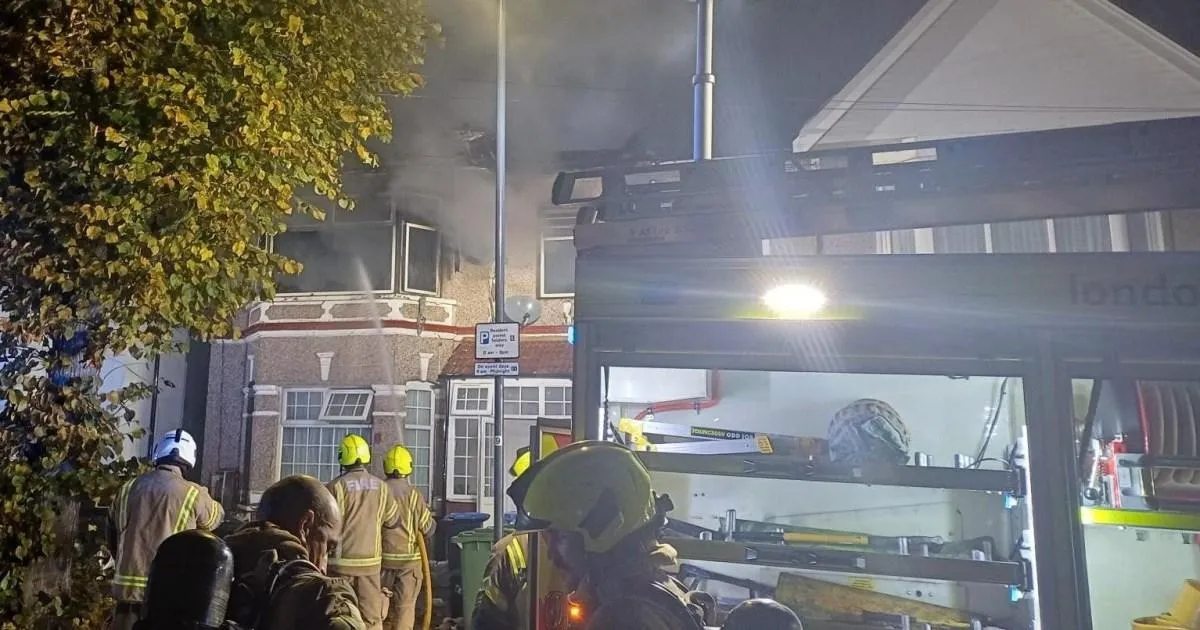
Sunday evening in Eagle Road, Wembley, was supposed to be quiet. The famous arch of Wembley Stadium stood in the distance, and the street of neat semi-detached houses was settling into another unremarkable night. Then, without warning, the peace was torn apart. A fire broke out in the upper part of one house, and within minutes flames were shooting into the air while thick, dark smoke rolled across north-west London. The London Fire Brigade received the first of nine emergency calls at 6.26pm. Six fire engines and around 40 firefighters were sent from Wembley, Park Royal, Northolt and surrounding stations. But for one family inside the building, help could not arrive quickly enough. Anas Ali and three members of his household were in their downstairs flat when the fire began above them. They did not have the luxury of watching it grow. Smoke appeared suddenly in their room, and in that instant the evening changed forever. They understood that they had only seconds to act. They ran for the door and poured out onto the street, and by the time they looked back, their home was already being swallowed by flames. It was not a dramatic rescue; it was pure survival, a desperate race against heat and smoke that they won by the narrowest margin. The house was consumed around them, and all they could do was stand outside and watch as the life they had built began to burn.
Anas later tried to describe the speed of it, and his words were as raw as the fire itself. “There was suddenly smoke in the room and we realised there was a fire. We ran for our lives,” he said. “We had to get out; we realised when we only had seconds.” Those seconds matter. Four years earlier, the family had moved into the flat and made it a home. They had learned the sounds of the street, filled the rooms with everyday belongings, and built a life around ordinary routines. In one breath, all of that was placed in danger; in another breath, they were standing on the pavement, watching fire crews pour water onto the upper floor. The flames were enormous, licking at the roof and sending sparks into the darkening sky. Witnesses described a terrifying spectacle, flames high enough to be seen from blocks away, and the smoke blackened everything above the house. For nearly two hours, the firefighters fought the blaze. They trained hoses from the street, raised ladders to reach the roof, and worked without pause even as the house crackled and steamed. The family could only stare, helpless, as the home they had known for more than four years became unrecognizable. By the time the fire was extinguished at 8.24pm, the first floor and roof had been destroyed. The building was no longer a home; it was the remains of one, and the people who had lived inside were left standing in the cold with nothing but the clothes they were wearing.
The morning after brought a different kind of devastation. The sirens were gone, the fire engines had left, and the smoke had faded to a lingering burnt smell that clung to the street. Eagle Road was cordoned off, and a police car remained outside the ruined house. The family returned to the scene, not to stand in the way but simply to be near the place where their lives had been changed. They carried suitcases—not packed for a trip, but containing the few possessions that had been recovered from the wreckage. It is difficult to imagine what those suitcases held. Maybe clothes, maybe documents, maybe small things that survived because they happened to be in the wrong or right place. But they were not enough to rebuild a home. One family member tried to put the feeling into words and said: “It’s heartbreaking. We escaped with our lives, which we are thankful to God for, but we have nowhere to go.” That sentence captures the impossible contradiction of surviving a fire: gratitude and grief in the same heartbeat. They were alive, unharmed, holding each other. But they were also homeless, displaced, and facing the exhausting task of starting again with almost nothing. The comfort of being alive did not erase the reality that every familiar corner of their lives had been turned to ash. The ordinary became precious only after it was gone, and now they were left with suitcases and uncertainty.
The people who watched the fire from the street will not forget it quickly. Diwas Chand was one of them, and his description was simple and direct. “It was a very big, scary fire. The flames were very high. So many firefighters came,” he said. He added that it was “lucky” everyone had escaped. That luck should not be confused with chance; it was the result of quick reactions, open doors, and perhaps a calm that came from somewhere deep. But it was, by all accounts, a near thing. Had the family been upstairs, had the smoke reached them while they slept, had any one of a hundred details been different, the ending could have been terrible. In the chaos of that evening, neighbours and passers-by did what people do in an emergency: they gathered, they watched, they called for help, they wrapped arms around one another. Some probably held their breath until the last person was accounted for. Some may have offered the family water, phone chargers, a place to sit. The firefighters, meanwhile, moved through the smoke and heat with purpose, carrying out a job that most of us could never face. They did not just fight flames; they gave a frightened community the assurance that someone was in control. When it was over, no one had been injured, and that fact felt almost miraculous. The families who lived upstairs and downstairs had all made it out, but the damage was not just physical; it was emotional, and the shock would settle in slowly.
The full scale of the incident was confirmed by London Fire Brigade in a statement that mixed precise facts with the weight of what had happened. “Six fire engines and around 40 firefighters tackled a fire at a semi-detached house on Eagle Road in Wembley,” it read. “The first floor and roof were destroyed by the fire. There are no reports of any injuries.” The statement also revealed how the emergency was called in: control officers took the first of nine calls at 6.26pm and mobilised crews from Wembley, Park Royal, Northolt and surrounding fire stations. The fire was eventually extinguished by 8.24pm. Those two hours were filled with noise, heat and uncertainty. Nine calls meant nine people—or more—who saw the flames and felt the need to do something. The family who lived in the upper flat also escaped safely, and they told reporters they did not know what had caused the fire. That remains the hardest question. As the investigation continues, everyone connected to the house is left in a strange middle ground: safe, but not settled; relieved, but not resolved. The building is sealed off, waiting to be examined, while the people who lived there wait to understand how their lives were so suddenly derailed. The statement from the brigade was calm and professional, but behind it were the sounds of the evening: screams, sirens, the roar of flames, the sigh of relief when the last person was counted.
Wembley is a place associated with celebration, with cups and anthems, with thousands of people streaming toward a stadium to watch something unforgettable. Just a short distance from that excitement, on an ordinary residential street, a family learned how quickly life can turn. The contrast is sobering. While the famous arch stood in the distance, a house was being destroyed; while the city went about its Sunday evening, an entire household was reduced to a handful of recovered items and a suitcase full of uncertainty. The family has no home to return to, no clarity about what happened, and a long road ahead. They need shelter, support, and time. But they also have something that cannot be burned: each other. They escaped together, and their survival is not lost on them. “We escaped with our lives, which we are thankful to God for, but we have nowhere to go,” one of them said. It is a statement of fact, a prayer, and a plea all at once. In the days and weeks to come, the community around Eagle Road may drift back to its usual routine, but the memory of this fire will not disappear so easily. Neighbours will keep an eye on the boarded-up house. Local people may reach out, donate, offer comfort. Fire investigations will provide answers, but they cannot provide closure; only time and rebuilding can do that. Yet if there is a human thread in this story, it is that no one was lost. The home may be gone, but the family remains, standing together on the pavement, already beginning the slow and painful task of starting over.