


On a damp, grey afternoon in Hanwell, a quiet corner of west London that usually goes about its business far from the world’s attention, there is a strange feeling of déjà vu. Across the Atlantic, Americans were heading to the polls for the midterm elections, and Donald Trump’s name was once again dominating headlines. But here, along the banks of the historic Grand Union Canal, residents were preparing for a battle of their own—one that carries an unlikely echo of the former president’s glittering Manhattan empire. The cause of the conflict is a proposed development on Trumpers Way, a street whose name alone invites comparisons to Trump Tower, and a scheme that locals say would tower over their peaceful waterside neighbourhood in a way that feels more Fifth Avenue than west London. Three residential blocks are planned: one reaching fifteen storeys, with two others at ten storeys each, containing 287 homes and three industrial spaces. For the people who live in the surrounding streets, the comparison to Trump Tower is not just a joke about a name—it is a warning about scale, ambition, and the feeling that outside forces are shaping their community without truly listening to them.
The details of the proposal are enough to make even the most pro-development resident pause. The site on Trumpers Way was originally earmarked for industrial use, and for years it has sat as a working-class corner of the borough, home to HGVs, warehouses, and the kind of functional clutter that keeps London moving but rarely gets a second glance. Now, the developer, Fancourt, wants to transform that industrial land into a dense residential hub. The three towers would rise above the canal, and alongside the new homes, there would be space for industrial units, but the sheer mass of the project has alarmed the community. This is not the first time such plans have been floated. In 2020, a smaller scheme for 213 homes was approved, and the developer has now returned with a larger vision, claiming that it is simply responding to the growing need for housing in Ealing. A consultation leaflet describes the plan as “refreshing” to better meet local needs, pointing to increasing demand for affordable homes. But for residents, the difference between 213 and 287 homes is not just a number—it is a matter of light, space, traffic, and the character of a place they call home.
The objections are heartfelt and practical. Councillor Clare Welsby, who has become a vocal opponent of the scheme, insists she is not against new housing in principle, but she is adamant that this is the wrong location. She points to the area’s heavy industrial traffic, the constant flow of HGVs, and the lack of reliable public transport in the immediate vicinity. “It doesn’t make sense to build a huge residential development,” she says, and her words resonate with people who live on nearby streets like Humes Avenue. For Danielle, a mother of two, the threat is personal and immediate. She stands in her garden and imagines the day when a fifteen-storey block blocks the sunlight that currently pours into her family’s home. “The light in my garden will be blocked,” she says, and the simple sentence carries a world of loss. Parking, she adds, is already a nightmare, and the thought of hundreds of new residents arriving without adequate transport links feels like a recipe for chaos. The community is not anti-housing, she stresses—they are anti-overdevelopment, anti-poor planning, and anti being ignored.
The concerns go beyond parking and shadows. Residents argue that local schools are already at capacity, that GP surgeries are overburdened, and that the infrastructure simply cannot absorb an influx of hundreds of new people. There is also a growing fear about flooding, with drainage and sewage pipes in the area already struggling to cope during heavy rain. For Ronald Lipscombe, a 71-year-old who has lived in the neighbourhood for decades, the issue is about preserving something precious. He walks his dog in Elthorne Park, a beautiful green space directly opposite the development site, and he cannot bear the thought of it being overshadowed and spoiled by towers that have no respect for the environment around them. “I understand people need homes,” he says, “but it is the scale of this development that is the problem.” Louise Cramer, 51, echoes his frustration. “It’s no place for a huge development,” she insists. “We want more consultation, and we will say no unless this is scaled back.” Their words are not the angry outbursts of NIMBYism; they are the measured, worried voices of people who feel their community is being asked to absorb more than it can handle, without being given a proper seat at the table.
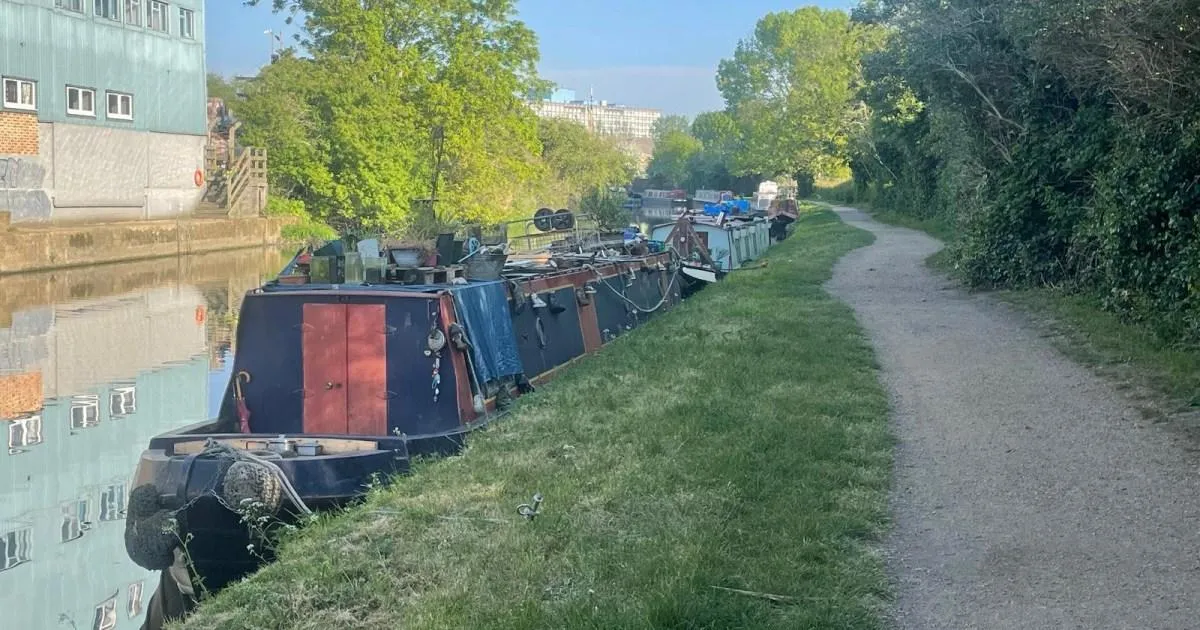
Perhaps the most poignant opposition comes from those who live on the water itself. Along the Grand Union Canal, where swans glide across the surface and reeds rustle in the breeze, a small community of boat owners has found a refuge from the noise and pressure of London life. One moorer, who asked not to be named, described the canal as a peaceful spot, a place to escape the rat race and reconnect with nature. The thought of being overlooked by a huge Ealing version of Trump Tower fills them with a sense of grief. “It will be heartbreaking,” they say, “and I for one might move away.” That quiet sentence speaks to the real human cost of development—not just in bricks and mortar, but in the loss of peace, beauty, and belonging. The campaigners have organised under the slogan “Hands off Hanwell, Stop Trumpers Towers,” and they have spent years locked in a battle with the developers. On Tuesday, as American voters cast their ballots, they met again to hatch last-ditch plans to oppose the scheme, drawing a surreal parallel between the political dramas unfolding in Washington and the grassroots fight taking place in a west London canal-side neighbourhood. The irony is not lost on them: Trump may be fighting for his political future, but they are fighting for their home.
Yet the developers see things very differently. Fancourt insists that the plan is not only necessary but noble, pointing to a target of 70% affordable housing across the three towers, with up to 208 homes available for social rent. A spokesperson argues that they have worked closely with Ealing Council officers to refine the proposals, building on the existing planning permission while remaining within the previously approved maximum height. “We believe this is exactly the type of development that can help meet Ealing’s housing needs,” they say, adding that it is those on housing waiting lists and in temporary accommodation who stand to lose out if opportunities like this are not taken seriously. It is a powerful counterargument, and one that cannot be easily dismissed. But for the residents of Hanwell, the promise of affordable homes is not enough to outweigh the reality of their daily lives. They want to know who will fill those homes, how they will travel, where their children will go to school, and what will happen to the light, the wildlife, and the character of their neighbourhood. The final council meeting is expected later this month, and both sides are bracing for a decision that will shape the future of this small corner of London for generations. Whether the towers rise or the campaigners succeed, one thing is certain: this is not just a planning dispute, but a deeply human story about the meaning of home, the cost of progress, and the lengths people will go to protect the place they love.