

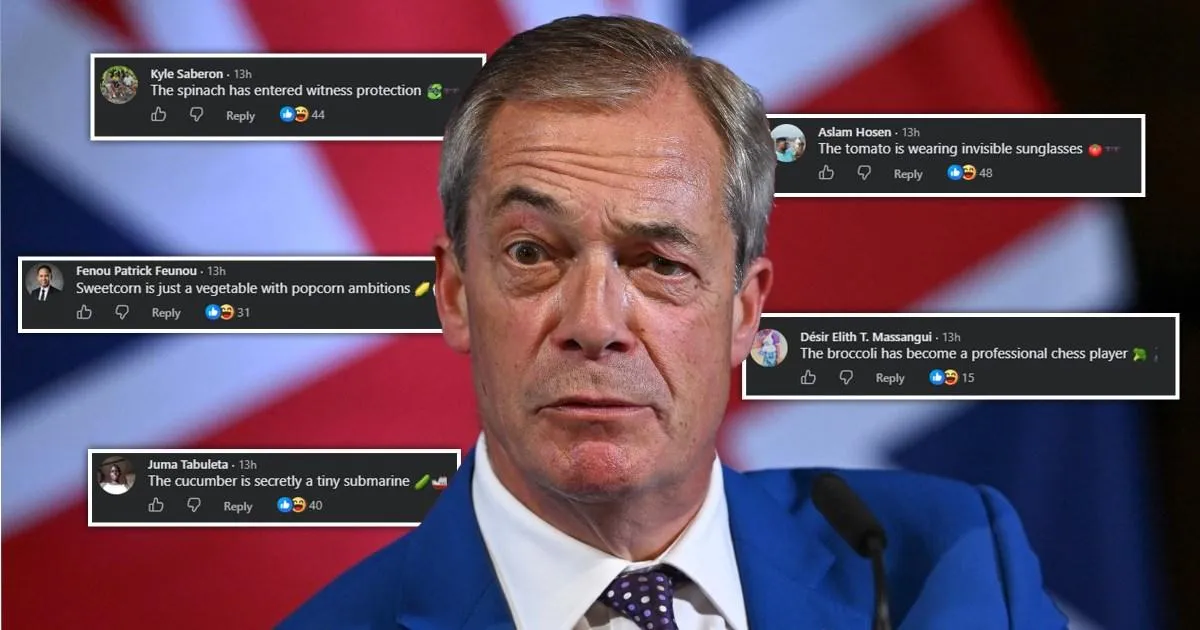
If you have ever spent time on Nigel Farage’s Facebook page, you might expect to find a particular kind of chaos: supporters cheering, opponents arguing, and the occasional absurd insult. But over the past few days, something far stranger has been unfolding in the comments section. It is not the kind of political debate that normally dominates the Reform leader’s social media. Instead, beneath a post where Farage argues against Andy Burnham’s suggestion that Britain should formally apologise for its role in the transatlantic slave trade, a different conversation has broken out. It involves vegetables. Lots of vegetables. One account, calling itself Hope for Rushmoor, wrote: “The sweetcorn has escaped captivity and is now living among the peas.” Another person, Julie Cavanagh, added: “There’s a pepper staring at me from the shadows under the stairs.” Then came Dela Dell with: “Potatoes are the kings of underground fashion.” Dozens of other comments follow the same pattern. Each one features some form of vegetable. Each one is cryptic, slightly unsettling, and strangely poetic. And each one ends with two emojis, as if to punctuate a secret message that nobody else fully understands. The overall effect is less like the comments section of a prominent political figure and more like a waking dream, or the output of a chatbot that has read too many surrealist poems and then decided to go shopping for groceries. It is weird enough to make you double-check whether you have accidentally stumbled onto a parody account. But no, it is right there on Farage’s official page, attached to a serious post about historical injustice and reparations. The contrast between the heavy subject matter and the absurd vegetable declarations is so jarring that it almost feels deliberate. And that, of course, raises a question: what on earth is going on? The answer, according to security researchers and amused observers, is not as straightforward as it might seem. But before we get to that, it is worth understanding exactly how bizarre this all looks in practice. And it is not just a handful of odd messages—there are dozens of them, spread across multiple posts, all following the same strange formula.
This odd incident was first flagged by a popular blog called Man Behaving Dadly, which suggested that Farage’s “social media bots” had somehow short-circuited. That idea quickly caught on. In the comments sections of the very same posts, people started gleefully speculating that a clever hacker had broken into the systems behind an army of bots—bots that would normally be doing the tedious work of backing the Clacton MP’s message—and replaced their programming with something far more ridiculous. The theory is an appealing one. It fits with a wider suspicion that many political figures rely on automated accounts to boost their engagement and drown out criticism. It also offers a satisfying mental image: a team of digital foot soldiers, originally designed to post loyal talking points, suddenly malfunctioning and declaring that parsnips have formed a secret government. But is that really what has happened? The truth, as with so many strange things on the internet, is probably more complicated. The vegetable comments did not appear only under Farage’s post about slavery apologies. Similar surreal statements have been spotted under posts from other prominent Reform figures, including Robert Jenrick and Zia Yusuf. That could suggest a coordinated campaign rather than a one-off glitch. Or it could suggest that something in the Reform universe has become infected with a very peculiar strain of absurdity. Either way, the phenomenon has become an unlikely source of entertainment for people who might otherwise spend their time arguing about immigration, trade, and the future of British politics. Instead of the usual shouting matches, you get philosophical cabbage and cauliflower knitting clubs. The comments are not exactly hostile; they are just nonsense, and somehow that makes them even more effective. It is hard to say which is more disorienting. For a movement that often presents itself as the voice of common sense, the sudden outbreak of vegetable-themed surrealism feels like a strange new frontier.
To make sense of it all, let’s bring in an expert. Pieter Artnz, senior threat intelligence researcher at cybersecurity firm Malwarebytes, has spent a lot of time thinking about how bots and trolls operate online. When asked about the bizarre comments, he set out four potential explanations. The first is that someone is deliberately running a script from multiple accounts in a coordinated attempt to distract or be funny. In other words, an agent might be flooding the thread with absurd comments on purpose, either for the fun of it or to make Farage’s page look ridiculous. The second possibility is that the flood is human-led but not automated. This could involve “copy-and-paste” activity, where remote workers in other countries are paid small amounts of money to simulate the behaviour of a legion of bots. It sounds strange, but it is a known practice: low-paid online workers are sometimes asked to post the same content across multiple accounts, creating the illusion of widespread grassroots support or, in this case, widespread absurdity. The third option is that a group of volunteers has decided, entirely of its own accord, to join in and make Farage look daft. This would not be a commercial operation or a coordinated astroturf campaign, but simply a bunch of people who saw a funny thing happening and wanted to be part of it. The fourth and final explanation is that the whole thing is a genuine malfunction. Farage’s posting system, or whatever tool he uses to manage his social media presence, might have gone wrong. It could be “publishing the wrong comment list” or “using an incorrect generation instruction,” perhaps triggered by a word in the original post. In other words, an AI or automated system might have meant to produce supportive political comments and instead started talking about vegetables. That would be a very modern kind of failure, but not an impossible one. Each explanation has its own implications. If it is a deliberate prank, someone is spending a lot of effort to make a political figure look silly. If it is a malfunction, then Farage has bigger problems than he might realise. If it is a paid operation, then we have stumbled onto a shadowy corner of the digital economy where absurdity itself is a commodity.
Of those four options, Pieter said he would guess the first is most likely. “Someone is committing resources, but that doesn’t tell us who benefits or whether there is a paying client,” he explained. “A commercial posting service, a prankster, or someone deliberately trying to make the page look bot-infested could all produce this result.” That is a careful, professional way of saying: someone is definitely doing something, but we don’t know who, why, or whether they are being paid for it. It is the kind of answer that makes you realise how murky the world of online influence can be. There are people whose entire job is to make things look organic. There are companies that sell “engagement” by the thousand, using armies of fake accounts to create the impression that a politician or product is popular. There are also pranksters who do this sort of thing for no reason other than the joy of chaos. And there are political opponents who might want to embarrass Farage by exposing the fact that his social media presence is propped up by bots in the first place. The vegetable comments could be a clever way of doing that. If the bots were supposed to be silently amplifying Farage’s message, and someone managed to hijack them, then every absurd vegetable post becomes a tiny piece of evidence that the whole operation is fake. It is a form of digital sabotage that is both hilarious and deeply uncomfortable for the person on the receiving end. After all, if you are a political leader who claims to represent ordinary people, the last thing you want is for your page to be filled with obvious nonsense that looks like the work of broken machines. It undermines the authenticity of everything else you post. It makes people question whether the support you claim to have is real. And it turns your serious policy announcements into a backdrop for jokes about root vegetables. Even if the original post was perfectly sensible, it is now impossible to read it without thinking about sweetcorn living among the peas. The message has been effectively drowned out, and the person responsible—whoever they are—has achieved the oldest trick in political communication: making the other side look foolish.
The case for a “shared posting operation” becomes even stronger, Pieter suggested, if the accounts of other public figures are targeted with similarly head-scratching posts. And sure enough, a quick skim of the comments sections belonging to other Reform figures reveals the same kind of strange content. Under posts from Robert Jenrick and Zia Yusuf, you can find references to cauliflower knitting clubs, philosophical cabbages, and helicopters for carrots. This is not a one-off accident. It is a pattern. Someone, somewhere, appears to be running a vegetable-themed campaign across multiple political pages. The question is whether this is an attack on Reform specifically, or just a coincidence of people having fun in different places. The fact that all the examples come from Reform politicians makes it hard to believe that it is pure chance. Either someone has decided that Reform politicians are the best target for a bizarre bot attack, or the party’s voters have discovered, en masse, a penchant for surrealist vignettes. Both possibilities are strange, but they are not equally strange. The idea that a group of Reform supporters has spontaneously started writing poetry about vegetables in the comments section of their favourite politicians seems unlikely. The idea that an external actor is using automated tools to post these messages seems more plausible. But even then, there are layers of uncertainty. It could be a foreign influence operation designed to destabilise British politics. It could be a domestic prankster with a good sense of humour and too much time on their hands. It could be a company that provides “bot services” to multiple clients, and whose systems have somehow been compromised. It could even be an experiment by a researcher who wants to demonstrate how easy it is to manipulate political conversations online. The truth is that we may never know for certain. What we do know is that the comments are there, they are very funny, and they have completely overshadowed the original arguments that Farage was trying to make. In that sense, whoever is behind it has already won. The vegetables have done their job, whether that job was deliberate, accidental, or just a strange case of collective online madness.
So what should we make of all this? The simplest response is to laugh and move on. There is something deeply silly about a political leader’s Facebook page being hijacked by vegetable-themed nonsense, and sometimes silliness is exactly what we need. But there is also a more serious lesson lurking beneath the surface. The internet is full of accounts that are not what they seem. The comments section of any prominent politician is likely to contain a mix of real people, paid trolls, automated bots, and mischievous pranksters. Sometimes, as with the vegetable posts, the line between all of these becomes impossible to draw. We want to believe that there is a simple explanation—a hacker, a glitch, a coordinated campaign—but the reality is often more chaotic. The same infrastructure that allows political leaders to communicate directly with millions of people also allows anonymous actors to manipulate, mock, and undermine them. And when something inexplicable appears, it can be almost impossible to tell whether it is a deliberate attack, a technical failure, or just a group of strangers having fun. In this case, the ambiguity is part of the joke. The vegetable comments are so absurd that they invite speculation, and every theory only adds to the comedy. Farage, for his part, is probably just as confused as the rest of us. His post about slavery apologies was serious. His page’s comments section is now a vegetable-themed fever dream. And there is no obvious way to make sense of it. So we will leave it up to you to decide which explanation is more likely. Are Reform politicians the targets of a bizarre bot attack? Or have their supporters suddenly developed a deep love of surrealist vegetable poetry? Either way, the whole episode is a reminder that, in the strange world of social media, truth is often stranger than fiction. And sometimes the best response is simply to appreciate the absurdity, share a confused emoji, and wonder what the potatoes are going to do next. After all, in a political landscape that can feel depressingly predictable, a sudden outbreak of vegetable-based surrealism is at least something to smile about.