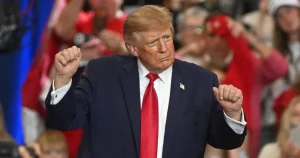


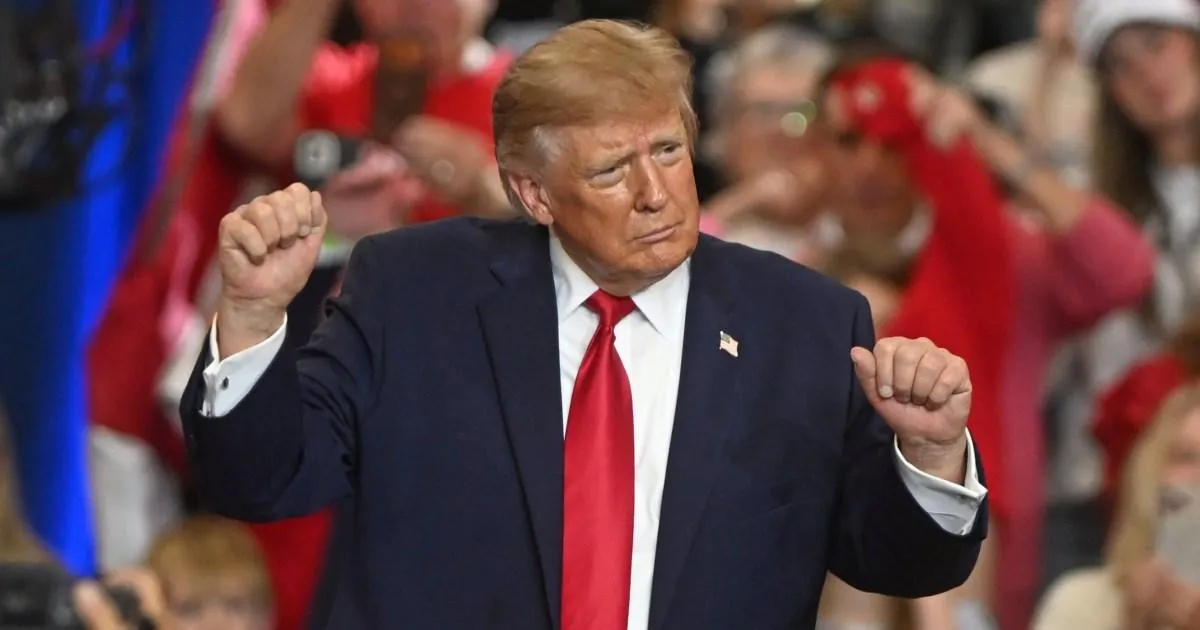
There is a moment in every public spectacle when laughter gives way to unease, when a joke stops feeling like a joke and starts feeling like a symptom. That moment happened for many Americans during a recent rally in South Carolina, when President Donald Trump tried to name former South Carolina Governor Nikki Haley and instead produced a strange, guttural sound: “EUGH.” It was not a slip of the tongue in the traditional sense. It was as if the name never arrived at the finish line. If you found yourself confused, you were not alone. The confusion was not just about that one bizarre phrase, or about the way Trump then described military strikes on alleged drug-smuggling boats with cartoonish “pew, pew, pew” sound effects. The confusion runs deeper. It is the growing sense that something is off, that the man who once projected raw, relentless energy on the political stage is now losing his footing in a far more fundamental way than a stumble on a ramp. Trump has always been a rambler, someone who spoke in tangents, exaggerated, repeated himself, and veered off script. But the past weeks have produced a flood of moments that are not merely rhetorical eccentricities. They are sentences that collapse halfway through, names that come out as sounds, thoughts that drift away and never return. It reads like a random series of words, but it is real, and that is precisely what makes it so alarming.
Barely a day goes by without another fresh stumble from the President, and the examples are piling up like unread newspapers on a porch. Earlier this month, he was seen waving and saluting at what appeared to be absolutely no one in the distance as he boarded a helicopter, a moment that would be amusing if it did not feel so lonely and disoriented. During a series of campaign trail appearances, he delivered a closing argument that somehow included a detailed analysis of Ohio Senator Jon Husted’s buttocks, declaring that the senator’s rear end was “like a big piece of muscle,” before clarifying that it was not like a big piece of muscle, but literally a big piece of muscle, because, in his words, “that is what an ass is.” He then paid a similar bum-based compliment to Nicki Minaj, a pop star whose name has no obvious connection to a political speech about the future of the country. In a rambling critique of California Governor Gavin Newsom’s dyslexia, Trump called him “dumb” and unfit to be president, but then accidentally referred to him as “the president of the United States, Gavin Newscum,” a verbal slip that undercut the entire point and handed his opponents a gift wrapped in irony. Last week in South Carolina, his get-out-the-vote pitch dissolved into something about “a thing called November,” as if the month of the election itself had become a vague concept. In Tennessee, he floated renaming either the Atlantic or Pacific Ocean to “Trump Ocean,” a proposal that sounded less like a policy idea and more like the wishful fantasy of a child who has not yet learned the difference between self-promotion and reality. Still sore about not receiving the Nobel Peace Prize, he announced that “they gave the Pulitzer Prize to a young lady,” apparently confusing the Nobel with the Pulitzer and referring to Navi Pillay, an 85-year-old South African judge who actually won the Nobel, not a young lady and not a Pulitzer. And in Texas, mid-rant about something involving food, he groaned, “I love the meat… ahhh!” while miming a mouthful of sausage, adding yet another strange moment to a growing pile of strange moments. Any one of these incidents could be dismissed as a bad night or a tired voice. Taken together, they paint a picture of a man whose grip on language, memory, and reality is loosening in public, in real time, and in front of a nation that cannot look away.
What makes this so uncomfortable is not just the behavior itself, but the fact that Americans have been here before, and the memory is raw. When clips of Joe Biden’s verbal stumbles and moments of confusion started piling up during the 2024 election cycle, the instinct among many Democrats, journalists, and voters was to close ranks, to explain away what their own eyes were showing them. There was a sense of loyalty and a fear of what the alternative would mean. I was part of that instinct, and I defended Biden until the bitter end. Voters were told not to believe their eyes, that the clips were selectively edited, that he was sharp behind closed doors, that age was just a number. And then it cost the party and the country, big time. The lesson was painful and expensive, and yet it appears to be repeating itself on the other side of the aisle. Republicans are now making the same mistake, insisting that Trump is fine, that his rambling is strategic, that his strange sounds are just part of his unique speaking style. But voters are not buying it, and they are not buying it in large numbers. One poll earlier this year found that 61% of Americans think Trump has become increasingly erratic with age, and that number includes almost a third of Republicans. By summer, half of Americans rated his mental sharpness as poor. The White House, meanwhile, insists that Trump remains “the sharpest and most accessible President in American history,” and his physician last year declared him in “exceptional health” in a one-page summary so vague it was almost insulting to anyone seeking honest information. The disconnect between what officials say and what people see is becoming a chasm. Voters are not being won over by spin or flashy editing. They trust their own eyes, and they have been burned before by closing them.
The cruelest twist in all of this is that Trump wrote the rulebook now being thrown back at him. For years, he made age and cognitive fitness a centerpiece of his political attacks, weaponizing the perceived frailty of his opponents with a ruthlessness that now looks like projection. In 2016, he told the world that Hillary Clinton lacked the “mental and physical stamina” to be president, and he mocked her after she stumbled at a 9/11 memorial event, even though she was attending while suffering from pneumonia and even though she is 16 months older than him. In 2014, he criticized Barack Obama for the way he came down the stairs of Air Force One, calling it “so inelegant and unpresidential. Do not fall!” Last year, he said of Biden, “Every day, the guy’s falling down stairs.” It was a relentless, almost obsessive focus on the physical and mental slips of others, always in the service of presenting himself as the strong, vigorous alternative. But now the tables have turned. Last year, it was Trump gripping the handrail as he descended stairs, and he conceded, “I have to be careful, because one day I’m gonna probably fall.” To be fair, he has never been keen on stairs. When he took Theresa May’s hand on a White House ramp in 2017, Downing Street officials reportedly put it down to a fear of stairs and slopes. May, in her characteristically diplomatic way, described it as a “moment of assistance.” There is no shame in an 80-year-old taking the stairs slowly, or in holding a handrail, or in accepting help. Aging is not a moral failing, and it is not a crime. The shame is in spending a decade sneering at everyone else who struggled with those exact same things, weaponizing their age and ability while secretly carrying the same vulnerabilities. The hypocrisy is breathtaking, but what is more troubling is the possibility that Trump genuinely does not see it, or cannot see it, because his own self-perception has become untethered from reality. He has spent his entire political career defining strength as something he alone possesses, and now he appears to be looking in a mirror and seeing the same illusion that he sold to others.
The political stakes of all this are enormous, and they are arriving at a dangerous time. America does not have a release valve for a president who declines in office. There is no mechanism to recall a sitting president, and the fixed terms of the presidency mean that the country is locked into whatever comes next for years, regardless of what voters see with their own eyes. In under a week, Americans will head to the polls in what is widely described as one of the most seismic midterm elections in the country’s history, a referendum on the administration’s first two years. Trump has told voters to pretend he is on the ballot, even though he is not, and his approval ratings have hit an all-time low. His party should be glad he is not on the ballot, because he does not look okay. Trump has always been about strength and winning, but primarily for himself. When he ran against Jeb Bush, the worst insult he could conjure was “low energy,” a phrase that defined his opponent as weak, listless, and unfit. He has always understood, at a visceral level, what the public perceives as presidential power: confidence, sharpness, vigor, command. If that is what he thinks a loser looks like, then one has to wonder what he thinks he looks like to the voters right now. Whatever he sees in his own mind, it is not what the rest of the country sees. It is not a winner. It is an old man struggling to find words, saluting empty air, confusing oceans and prizes and names, and asking people to laugh along with sounds that are not jokes but distress signals.
At some point, this stops being a story about politics and becomes a story about a human being, and about a country that has to decide what it is willing to accept in its leaders. There is a persistent myth that age and power somehow shield people from the ordinary vulnerabilities of life, that the presidency itself is a source of vitality and mental clarity. But time does not care about titles. It does not care about approval ratings or electoral calendars. It does not care that Trump once mocked others for stumbling, or that he once made a career out of projecting strength. It comes for everyone, and it comes in ways that cannot be hidden behind vague doctor’s notes or defiant claims of sharpness. The tragedy is not that Trump is aging; everyone ages. The tragedy is that he built his entire persona on the idea that aging was a weakness to be ridiculed, and now he is living proof that no amount of bluster can stop it. The voters who supported him are not stupid for noticing. They are not traitors for being concerned. They are simply people who have seen this movie before, and they know how it ends when reality is denied for too long. The instinct to protect one’s own side is powerful, and the fear of what the other side might do can make people cling to an untenable reality. But the cost is too high. Republicans are now making the same mistake Democrats made with Biden, and if history is any guide, they will pay a price far larger than they expect. The country cannot afford to keep pretending that what is in front of us is not there. We need to be able to say, out loud and without shame, that something is wrong, not to mock a man for growing old, but to care enough about the country to acknowledge that its president is no longer the person he was. That is not a betrayal. That is the most basic form of citizenship. The confusion that so many people feel is not a sign of weakness. It is a sign of honesty. And in a world where political spin has made honesty feel radical, perhaps that is the best place to start.