

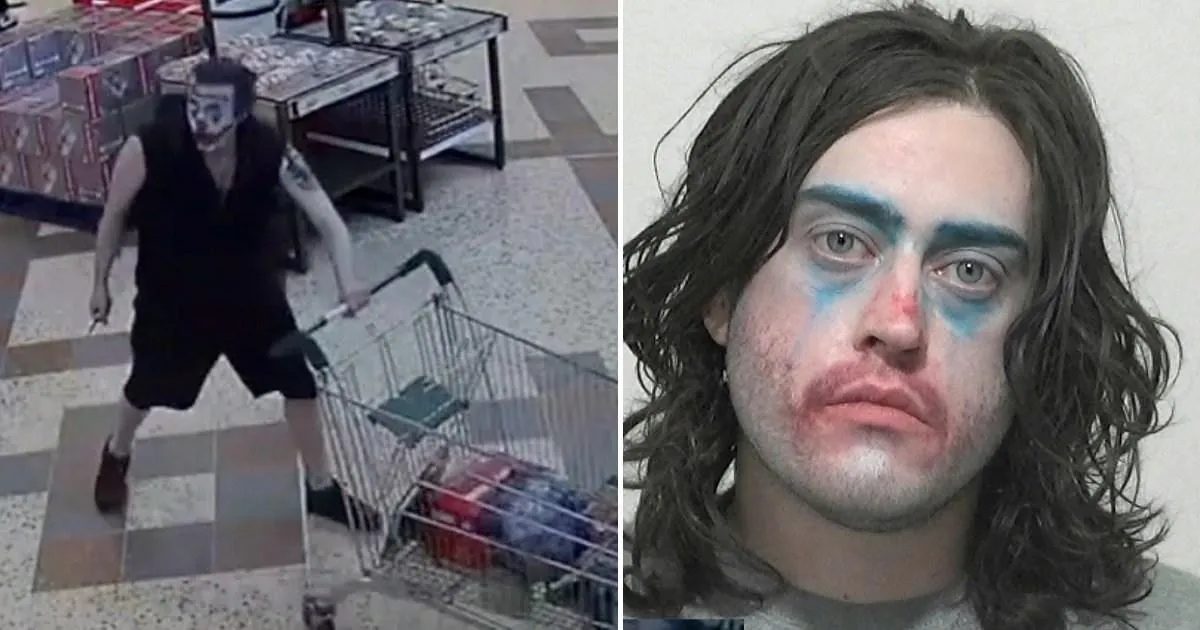
On an ordinary July afternoon, the familiar hum of a Morrisons supermarket in Jarrow, Tyneside, was shattered by a scene that belonged more to a crime thriller than to a weekly shopping trip. Peter Braithwaite, a 31-year-old man, walked through the entrance of the store at The Viking Centre with a trolley, but something was deeply wrong. His face was painted like the Joker, the grinning, chaos-loving villain from Batman, and he was carrying a knife. The disguise was not for a costume party or a promotional stunt; it was a chilling mask for a robbery. CCTV footage later showed him moving through the aisles, pushing a trolley filled with food, while holding what appeared to be a blade in full view of other shoppers. What should have been a routine errand—grabbing groceries, queuing at the checkout, heading home—became a nightmare for everyone present. Staff and customers alike found themselves in the presence of a man whose appearance seemed designed to terrify, and the fear was immediate and visceral. The supermarket, usually a place of fluorescent lights, stacked shelves, and mundane decisions about dinner, turned into a stage for violence and intimidation. Braithwaite did not sneak or hide; he marched, his painted face a grotesque mask, his trolley a declaration of intent. The afternoon of July 8 would leave deep emotional scars on those who encountered him, and the image of that grinning face, combined with the threat of a knife, would linger long after the police arrived. For the people inside, this was not a scene from a film. It was real, and it was terrifying. The ordinary became sinister in a matter of moments, and the safety of a local supermarket was replaced by the cold reality of an armed robbery. Braithwaite’s choice of the Joker—a character defined by anarchy and violence—was not lost on anyone. It made the encounter even more disturbing, as if he had deliberately chosen a persona to amplify the horror. The day began like any other, but by the time it ended, the lives of several supermarket employees had been changed forever, and a man who had terrorized them was on his way to custody.
The robbery unfolded with a strange mix of theatricality and menace. Braithwaite loaded his trolley with food and attempted to leave the supermarket without paying. When female staff members approached him, he did not respond with an explanation or an apology. Instead, he winked at them and said, “speak to your manager,” as though he were playing a role in some twisted performance. The wink, in hindsight, was perhaps the most unsettling detail—a gesture that suggested he was enjoying the fear he was causing. The situation escalated quickly when a male security guard approached and members of the team held onto the trolley, refusing to let him walk out with stolen goods. It was then that Braithwaite produced a knife, described in court as a six-inch blade, and began threatening the staff. According to prosecutor Kevin Wardlaw, he made chilling comments such as “do you want to get stabbed” and “do you want to die” while pointing the weapon at the workers who were backing away in terror. The words were not empty threats; they were spoken by a man holding a knife, his face painted like a comic-book villain, and the staff had no way of knowing how far he was willing to go. The confrontation was chaotic and terrifying, a blur of adrenaline and fear. For the employees, the moment must have felt endless—a standoff in which their safety, and possibly their lives, hung in the balance. Braithwaite’s demeanor, with his bulging eyes and painted grin, made him appear almost inhuman, a figure from a nightmare rather than a person. The staff did what they could to protect themselves and others, but the memory of that knife, and those words, would not easily fade. The incident was not a simple shoplifting gone wrong; it was a violent robbery that left people feeling vulnerable and afraid. The courtroom would later hear details of the threats, but no legal description could fully capture the terror of being on the receiving end of that blade. The security guard and the female employees who confronted Braithwaite showed remarkable courage in the moment, but courage does not erase trauma. The encounter ended with Braithwaite leaving the store, but the psychological damage was just beginning.
The aftermath of the robbery was felt most acutely by the staff, who were left to process a trauma that would not easily heal. One female worker, in her victim impact statement, described the lasting effects of the ordeal. She said she now suffers from anxiety and stress, and that she keeps reliving the moment she approached Braithwaite. “He looked so frightening, his eyes were bulging. I believed I was going to be stabbed,” she recalled. Her words paint a vivid picture of the terror that gripped her in that instant—a moment when she was face-to-face with a man who seemed capable of anything. She also expressed concern for the children who were in the shop at the time, saying, “I felt threatened and I’m sure they did too.” The presence of young shoppers added another layer of horror to the incident. A supermarket, a place where parents bring their children to buy cereal and snacks, became a scene of danger. The employee’s anxiety did not end when Braithwaite was arrested. It followed her home, disturbed her sleep, and made her wary of situations that once felt safe. The psychological impact of an armed robbery is often invisible but profound. It can manifest as hypervigilance, nightmares, and a persistent sense of unease. For this woman, the memory of Braithwaite’s bulging eyes and painted face was seared into her mind. She could not simply move on; she had to rebuild her sense of security from the ground up. The other staff members were also affected, though their stories may not have been told in court. Each person who witnessed the robbery, who heard the threats, or who saw the knife, carried a piece of that trauma with them. The supermarket, once a familiar workplace, now held a memory of violence. The team had done their best to stop Braithwaite, holding onto the trolley and standing up to him, but their bravery came at a cost. The human cost of crime is often measured in injuries and stolen goods, but the deepest wounds are often invisible. The fear, the anxiety, and the lingering sense of vulnerability are part of the sentence that victims carry long after the courtroom proceedings have ended. This woman’s testimony was not just a legal formality; it was a cry of pain from someone whose life was upended by a few minutes of terror. Her words reminded the court that behind every crime statistic is a person who must live with the consequences.
Police acted quickly after the robbery, tracing Braithwaite to his nearby home, where they found him along with the knife and the stolen shopping. The evidence was clear, and the case moved toward prosecution. A neighbor who confronted Braithwaite after the incident said he did not speak but “stared wide-eyed”—a detail that echoed the description given by the terrified female staff member. The image of Braithwaite, silent and wide-eyed, suggests a man in a state of altered consciousness, perhaps disconnected from the reality of what he had just done. The arrest brought a measure of relief to the victims, but it also raised difficult questions about how and why this robbery had happened. Braithwaite’s appearance, his behavior, and his choice of disguise all pointed to something deeper than a simple desire for free groceries. As the legal process unfolded, the court began to piece together a fuller picture of the man behind the Joker paint. The prosecution presented the facts of the robbery, including the threats and the knife, but the defense offered a different lens through which to view the events. Braithwaite, they said, suffers from schizophrenia, a serious mental illness that was linked to the offending. He had been in a “bad place at the time,” according to his defense team, and his actions were not those of a calculating criminal but of a man in the grip of a mental health crisis. This did not excuse the harm he had caused, but it helped explain it. The court heard that Braithwaite was now remorseful and understood the impact of his actions, a crucial step toward accountability. The neighbor’s observation of his wide-eyed stare, combined with the diagnosis of schizophrenia, painted a portrait of a man who was deeply unwell, perhaps detached from the severity of his actions. The stolen shopping, the knife, and the Joker face paint were not just evidence of a crime; they were fragments of a life that had gone terribly wrong. The legal system’s task was to balance justice for the victims with compassion for the defendant’s mental state, a delicate and often painful process. For the staff who had feared for their lives, the arrest was a necessary step, but it could not undo the trauma. For Braithwaite, it was the beginning of a reckoning with both the law and his own demons.
In court, the complexities of the case came into focus. Braithwaite pleaded guilty to robbery, accepting responsibility for his actions. His defense team emphasized his mental health struggles, explaining that schizophrenia was linked to the offending. They described him as being in a “bad place at the time,” a phrase that hints at the chaos and despair that may have led to the bizarre and terrifying robbery. However, Recorder Jamie Hill KC, the judge presiding over the case, acknowledged Braithwaite’s mental health issues but also noted that on the day of the robbery, he was “acting to a large extent while high on drink and drugs.” This was a crucial distinction. It meant that the robbery was not solely the product of mental illness; it was also fueled by substance use, which likely impaired his judgment and intensified his behavior. The combination of schizophrenia, alcohol, and drugs created a perfect storm of instability, leading to a situation where Braithwaite painted his face like the Joker, armed himself with a knife, and terrorized a supermarket full of people. The judge’s comments suggest that while mental health was a significant factor, it did not fully absolve Braithwaite of responsibility. He had chosen to consume intoxicating substances, and those choices had consequences. The defense insisted that Braithwaite was remorseful, and that he now understood the impact of his actions. Remorse is an important element in the criminal justice system, as it indicates a recognition of harm and a potential for rehabilitation. But remorse cannot erase the fear that the victims experienced, nor can it repair the psychological damage they suffered. The courtroom was faced with a difficult balancing act: acknowledging the defendant’s humanity and mental health struggles while also validating the pain of the victims. The Joker face paint, which had seemed so menacing during the robbery, now seemed like a symbol of a life unraveling. Braithwaite was not a comic-book villain; he was a man with a serious mental illness, struggling with addiction, who had committed a terrifying crime. The judge’s decision to consider both mental health and substance use reflected the messy reality of human behavior, where multiple factors often converge to produce tragedy. For Braithwaite, the path forward would involve not only serving his sentence but also addressing the underlying issues that had contributed to his downfall. For the victims, the hope was that the sentence would bring a sense of justice and closure, allowing them to begin the slow process of healing.
Ultimately, Recorder Jamie Hill KC handed Braithwaite a 40-month prison sentence. The punishment reflected the seriousness of the crime—a knife-point robbery in a public place, with threats to kill—while also taking into account his guilty plea and mental health issues. For the staff at Morrisons, the sentence may have felt like a measure of justice, but it could not fully capture the terror they had endured. The female worker who had spoken so movingly about her anxiety and stress would continue to live with the aftermath, even as Braithwaite began his time in prison. The case is a reminder of the profound impact that a single act of violence can have on a community. A supermarket, a place of routine and familiarity, became a scene of fear. The Joker, a fictional character created to entertain, was twisted into a symbol of real-world terror. And a man with schizophrenia, struggling with addiction, became both a perpetrator and a victim of his own circumstances. There are no easy answers in a case like this. The justice system must punish wrongdoing, but it must also recognize the complex factors that lead people to commit crimes. Braithwaite’s story is not just about a robbery; it is about mental illness, substance abuse, and the fragile line between stability and chaos. It is about the courage of supermarket staff who stood up to a knife-wielding man, and the invisible wounds they carry. It is about a community shaken by an event that seemed to come out of nowhere. As Braithwaite serves his sentence, one can only hope that he receives the mental health treatment and support he needs, so that he does not emerge from prison as the same person who walked into that Morrisons with a painted face and a knife. And one can only hope that the victims, too, find a way to heal, to reclaim the sense of safety that was stolen from them on that July afternoon. The story of Peter Braithwaite is a human one, in all its darkness and complexity. It reminds us that crime is never just a set of facts; it is a collision of lives, each with its own struggles and scars. The supermarket in Jarrow has moved on, the shelves restocked, the aisles filled with shoppers again. But for those who were there, the memory of the Joker’s face and the glint of a blade will never fully fade. Justice has been served, but the healing, for everyone involved, is a longer and quieter journey.