


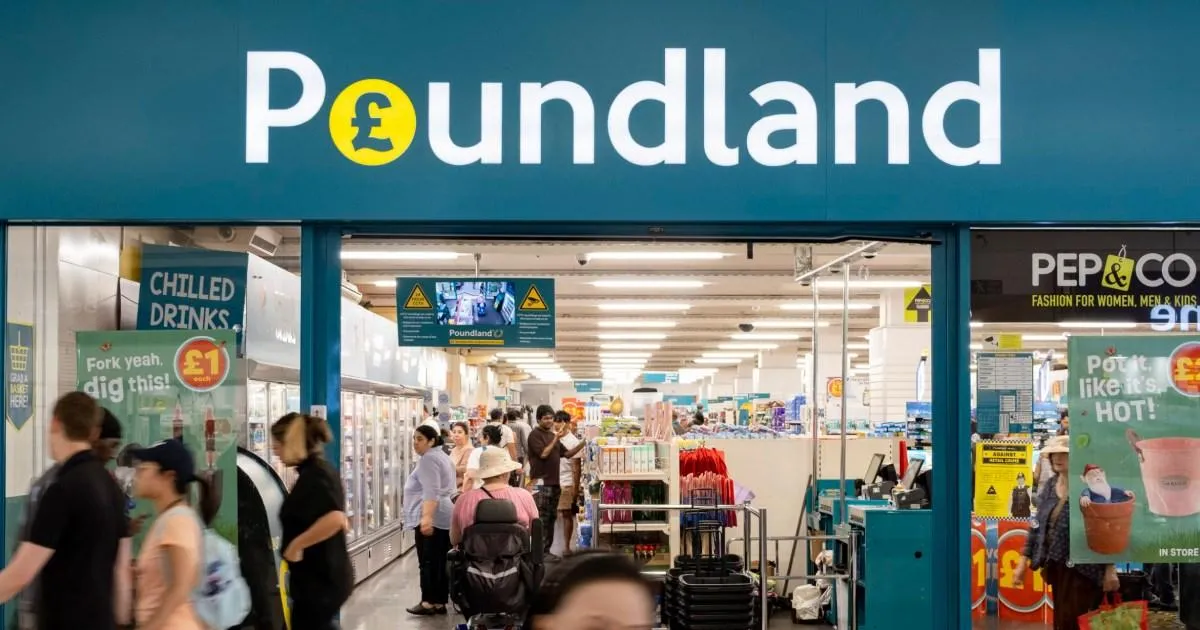
Poundland has long been the kind of shop that quietly holds a community together. For families on tight budgets, it is not just a place to pick up a cheap packet of batteries or a birthday card; it is where the weekly shop becomes manageable, where a child can choose a treat without tears, and where pensioners can stretch their money just a little further. That makes the news now emerging all the more unsettling. According to reports, Poundland could collapse within days, with more than 10,000 employees and around 600 stores across Britain and Ireland left facing an uncertain future. The discount chain has become one of the country’s best-known retail names, but it is now at the centre of a behind-the-scenes corporate battle that could end in insolvency. The drama has been building for months. In the summer of 2025, Gordon Brothers took control of Poundland from its previous owner, Pepco Group, and since then the chain has been trying to find a way through a difficult period of rising inflation, changing shopping habits and a product range that no longer seemed to hit the mark. Now the situation has reached a critical point. Three directors were appointed to the board to oversee an emergency sale, but they are said to be at odds with the majority owner because of its refusal to accept an offer that would keep the business operating. The offer, from Martin Property Group, is not one that would break the company up for parts. It is a bid to buy Poundland as a going concern, meaning the stores, the jobs and the distribution networks could survive. But hopes of a rescue are hanging by a thread, and the threat of insolvency is looming, perhaps even within hours of the Chancellor’s Budget. For those who work at Poundland, this is more than a story about corporate finance; it is about wages, mortgages, school uniforms and the simple dignity of knowing tomorrow is secure.
At the heart of the standoff are three directors: Andrew Kirkpatrick, a former adviser to Steinhoff International when it owned Poundland; Stephen Welch, who is overseeing efforts to revive fintech firm FNZ; and Dominic Young, a former director of the company that owns The Spectator. Their names may not mean much to shoppers, but their decisions could have a massive impact. They were brought in to oversee an emergency sale process, yet they have reportedly raised serious concerns about what they see as a push towards insolvency. The dispute centres on the offer from Martin Property Group. According to people familiar with the talks, this bid would allow Poundland to continue trading as a single, functioning business rather than being carved up and sold off in pieces. It would also apparently include keeping a distribution centre in Makerfield, a town in the Greater Manchester area with strong political ties to Andy Burnham. That detail matters, because it shows the offer is not just about preserving a brand; it is about protecting physical jobs and infrastructure in a region where good employment is precious. Despite this, Gordon Brothers, the majority owner, has reportedly refused to accept the offer. The three directors have become so worried that they are expected to quit, a move that would almost certainly throw the future of the company into even more doubt. Their concern, according to insiders, is that Gordon Brothers is steering Poundland towards a collapse that could have been avoided. The refusal to accept a going-concern bid is puzzling to many close to the situation. If the company is allowed to fall into insolvency, the consequences will be severe: thousands of staff left stunned, suppliers unpaid, and shoppers across the country losing a dependable and affordable retail option. There is still a glimmer of hope. Sources suggest a revised offer could emerge within the next 48 hours, and talks are reportedly still alive, but the window is narrowing. The next few days will be critical. If no deal is reached, Poundland’s fate could be sealed, and the human cost of a boardroom disagreement will be borne by ordinary workers and their families.
To understand how Poundland reached this point, it is worth looking at the broader picture. The retailer has been struggling for some time, squeezed by rising inflation and by changes to its product range that left some loyal customers confused or disappointed. Discount retail is a fiercely competitive sector, and even a well-known name can lose its way if it is slow to adapt. Gordon Brothers took control of the chain in the summer of 2025, after Pepco Group sold it. At first, there was hope that the ownership change would bring fresh direction and investment. Instead, the sale process has dragged on, with Alvarez & Marsal, the professional services firm, overseeing the auction since the summer. Poundland’s management team had identified Martin Property Group as its preferred partner, and they apparently believed a deal could be done. But Gordon Brothers, perhaps wanting a more profitable outcome or a different structure, appointed the three directors to keep an eye on the sale. That decision has backfired. Rather than smoothing the path to a rescue, it has created a bitter dispute at the top. Previous rounds of store closures have already taken their toll, but Poundland remains one of the UK’s biggest general merchandise retailers, with a presence in Ireland as well as Britain. It is not a small, struggling chain with a few shops; it is a massive operation with a central role in the lives of millions of customers. Its collapse would leave gaps on high streets and retail parks, and it would send shockwaves through the industry. The fact that several other retailers, including Poundstretcher, B&M, Iceland and The Range, have reportedly expressed interest in taking over some of Poundland’s stores shows that there is value in the business. But a partial takeover of stores is very different from saving the whole operation. It might protect a few buildings, but it would not protect all the jobs. It would certainly not protect the brand as a national institution. That is why the dispute over Martin Property Group’s going-concern offer matters so much. It is not just a business transaction; it is a test of whether a company that serves so many people can be saved in a way that keeps its soul intact. In the next few days, that question may be answered, one way or another. For the 10,000 people who clock in at Poundland every day, and for the communities that rely on it, the answer cannot come soon enough.
If Poundland does collapse, it would be one of the biggest retail failures in recent years. That is not hyperbole; it is a realistic assessment of the scale, reach and importance of the chain. Retail collapses are always painful, but they are especially raw when they happen to a company that has become part of everyday life. Poundland is the kind of shop where people go in for one thing and leave with a handful of bargains. It is where parents buy party bags and school socks, where students stock their halls of residence, where anyone can buy a spade, a sandwich and a scented candle under one roof. The chain employs more than 10,000 people, and those jobs mean something. They are not faceless numbers on a spreadsheet. They are the checkout operators who remember regulars, the warehouse workers who keep shelves stocked, the managers who train young people for their first job, and the delivery drivers who connect stores to the distribution network. Losing a large employer can damage a town for years. It hits local shops, because workers with no income spend less. It hits landlords, because stores sit empty. It hits mental health, because uncertainty is exhausting and demoralising. The interest from competing retailers such as Poundstretcher, B&M, Iceland and The Range in acquiring some of Poundland’s stores is a small comfort, but it is a double-edged sword. On the one hand, it means some branches may be rescued and repurposed. On the other hand, it means the business is being eyed like a carcass, with predators waiting to take the best cuts. The boardroom battle has made the situation even more unstable. When the directors appointed to protect the process fear that the process is being steered towards insolvency, when the majority owner rejects a bid that would preserve jobs, and when employees have to read about their own future in the news, the sense of powerlessness becomes overwhelming. The irony is that a discount retailer, which has always prided itself on offering value to people who need it most, is now caught up in the kind of high-stakes corporate drama usually reserved for banks and tech giants. Its customers do not care about the intricate details of going-concern bids and insolvency proceedings. They care about whether the lights will still be on next week, whether their wages will still be paid, and whether they will have a job to go to when they turn up for their next shift. Those questions should never depend on one side refusing to negotiate. Yet here we are.
There is, however, no reason to give up hope just yet. Sources have indicated that a revised offer could still emerge within the next 48 hours, and the fact that talks are continuing suggests that someone, somewhere, still believes a rescue is possible. The three directors who are expected to quit have not publicly confirmed their resignations, and perhaps their threat is a way of forcing the majority owner to reconsider. The Martin Property Group has shown a willingness to buy Poundland as a going concern, and it has even indicated that it would keep the distribution centre in Makerfield. That is not a trivial promise. A distribution centre is the beating heart of a retail operation; it is where goods flow in and out, where hundreds of people work, and where the logistics that stock every store are managed. Keeping it open would be a sign that the buyer is serious about maintaining Poundland as a fully functioning company, not just a name to be licensed or a list of leases to be sold. The political dimension adds another layer. The fact that Makerfield is in the Greater Manchester area, associated with Andy Burnham, means the fate of that site could become a talking point in local politics. Burnham has long been a champion of the region and has spoken passionately about protecting jobs and communities. If Poundland collapses and the distribution centre closes, it will be a blow not only to employees but also to the wider regional economy. No one wants to see that happen, least of all the people whose livelihoods depend on it. The next few hours, then, are crucial. If a revised offer is accepted, Poundland could survive, albeit with a new owner and perhaps a long road of restructuring ahead. If not, insolvency could be triggered, and the process of shutting down or selling off the business would begin. That would be a tragedy, not just because of the scale but because it seems so avoidable. The company has a viable offer on the table, a management team that supported it, and a retail format that still has plenty of life in it. What it lacks is a consensus among the people with power. In any rescue story, there comes a moment when the adults in the room have to set aside pride and grudges and do what is best for the whole. That moment is now. With the Chancellor’s Budget looming, and with the clock ticking down, the decisions made in the next 48 hours will determine whether Poundland is remembered as a British success story that fought back, or as another casualty of the high street crisis. The people watching those decisions are not just investors and bankers; they are the employees at their tills, the families at their kitchen tables, and the customers looking in the window, hoping the store opens tomorrow.
In the end, the story of Poundland is not really about bonds and acquisitions; it is about people. It is about the teenager stacking shelves for their first wage, the single mother working night shifts to make ends meet, the retired couple who rely on the local branch for a reasonably priced loaf of bread. It is about the sense of security that comes from knowing a large, stable employer exists in your town. When a company like this is at risk, the words “restructuring” and “insolvency” can feel cold and remote, but the consequences are warm and personal. Everyone loses when jobs disappear and a familiar shop closes for good. The coming 48 hours will be decisive. If a revised offer is accepted, Poundland can begin the slow process of rebuilding, with a new owner and perhaps a clearer sense of what it needs to be. If it is not, the business could be thrust into insolvency, with administrators called in and the company’s assets sold off. The sale of stores to rivals like B&M, Iceland or The Range might keep some sites open, but it would not keep the brand alive, and it would not protect all the workers. A going-concern purchase is the only option that offers a genuine future for the company as a whole. The fact that the directors appointed to oversee the sale are worried enough to resign suggests that the situation is as grave as it appears. But it also suggests that there are people inside the process who are trying to do the right thing, and who are prepared to make a stand when they see something wrong. That is a reason to have a little faith in human nature. For the 10,000 employees, for the customers who have filled their baskets with bargains for decades, and for the communities where Poundland has been a constant presence, the next few days are a nail-biting wait. We can only hope that the pressure to protect jobs will triumph over the short-term logic of the balance sheet. High streets across Britain are already struggling enough without losing another familiar face. Poundland deserves a chance to keep serving the people who rely on it, and the people who work there deserve better than to be treated as collateral damage in a corporate dispute. Let us hope that calm heads and common sense prevail, and that when the news finally breaks, it is a rescue rather than a eulogy.