


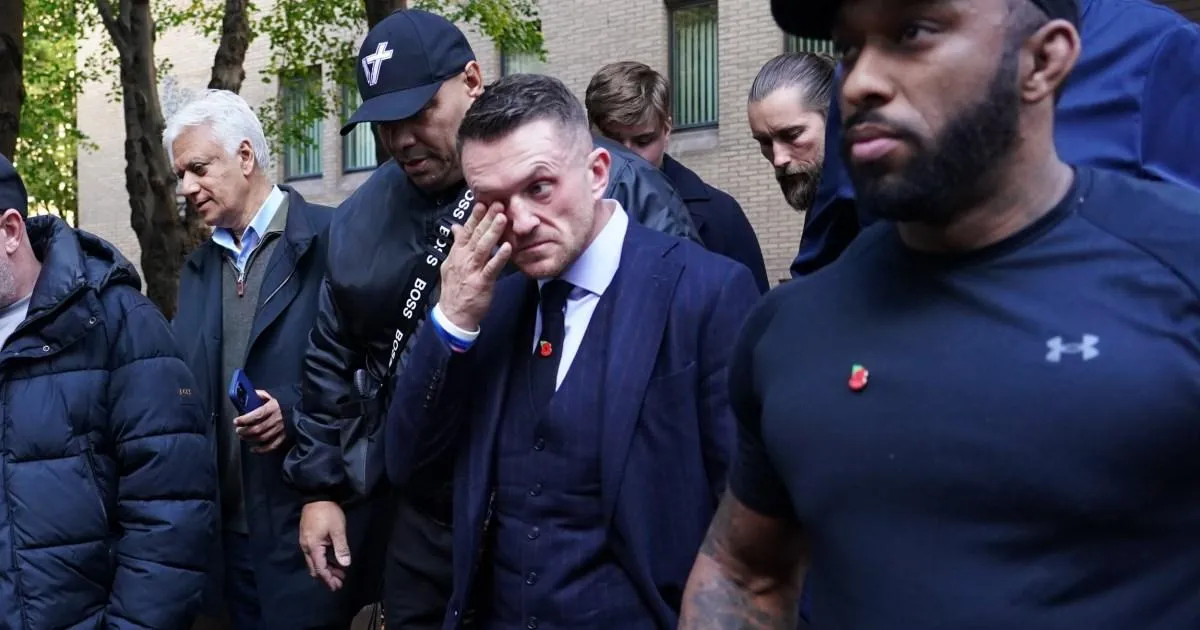
The air in Southwark Crown Court was thick with tension as the foreman of the jury rose to deliver the verdict. For more than eleven hours, across two days, twelve ordinary people had sifted through evidence that painted a portrait of a man whose online rage had spilled into the real lives of journalists. When the words “guilty” were read out, Tommy Robinson—the name used by Stephen Yaxley-Lennon, though he told the court to call him Stephen Lennon—stood perfectly still. He did not flinch. He did not turn to the gallery where his supporters had gathered. Instead, he absorbed the judgment in silence, while around him the courtroom exhaled. A few supporters let out sighs of disappointment, low and heavy, as if the air had been knocked out of them. The jurors had deliberated for eleven hours and twenty-five minutes, eventually returning a majority decision of ten to two. The verdict was on two charges of harassment causing fear of violence, offences levelled against freelance journalist Andrew Young and Daily Mail editor Jacob Dirnhuber. The maximum sentence for such a conviction is ten years in prison—or fourteen if the offence is considered racially or religiously aggravated—and Robinson now waits, on bail, until December 16, when a judge will decide how many of those years he will lose. It was a remarkable fall for a man who has spent two decades positioning himself as a warrior against the establishment, a self-styled defender of free speech who now stood convicted of using fear as a weapon. The trial had not been about his politics, though his politics loomed over every exhibit. It was about what happened when a public figure with a massive following decided to turn his attention to specific human beings, and then refused to stop.
The story began in the summer of 2024, in the aftermath of a tragedy that shook Britain. Three young girls were murdered in Southport, and the country was convulsed by grief and anger. Riots erupted in towns and cities, and social media became a battlefield of blame and accusation. Tommy Robinson was not in Britain at the time. He was on holiday in Cyprus, far from the violence, and from his sunbed he began posting about the unfolding unrest. The Daily Mail sent Andrew Young and a photographer to the island to report on the story, and their subsequent article described Robinson as “stoking riots from his sunbed”—a phrase that clearly enraged him. It is important to understand the context: Robinson was not merely a man who felt unfairly criticised. He was a figure with enormous reach on X, a platform where his words could be amplified to hundreds of thousands of followers in minutes. After the article appeared, he used that reach deliberately. He posted criticisms of Young and Dirnhuber by name, drawing a direct line from their journalism to the danger he claimed they had created. But the prosecution argued—and the jury agreed—that his actions went far beyond criticism. Robinson did not simply complain about the article. He set out to make the journalists pay, and he did so in a way that was designed to make them afraid. The “sunbed” detail stuck in the mind, because it exposed the contradiction at the heart of his anger: he was comfortably abroad, thousands of miles away from the riots he was commenting on, yet he sought to punish the men who had simply reported on his actions. The trial would later hear that Robinson hired private investigators, that he obtained home addresses, and that he turned the private lives of journalists into public spectacles. But it all began with those posts from a holiday island, where a man in sunglasses and swimwear began a campaign of intimidation that would ultimately land him in the dock.
The escalation was methodical. According to the prosecution, Robinson hired private investigators to locate the home addresses of his victims, and also of Ted Verity, the editor-in-chief of the Daily Mail. This was not the spontaneous outburst of an angry man; it was a deliberate, funded operation. Once he had the addresses, Robinson used his social media accounts to publish what amounted to an invitation for others to join the hunt. Photographs of Jacob Dirnhuber outside his own home were posted online, a chilling message that said: I know where you live. Images of Andrew Young’s family, cropped and decontextualised, were shared with Robinson’s followers. The effect was to expose not just the journalists but their wives and children to the gaze of a mob. The harassment did not stop at public posts. Robinson sent direct messages to Dirnhuber, and on August 5, 2024, he made a telephone call to Young that the prosecution described as “increasingly menacing.” The call ended with Robinson telling the freelance journalist: “I’m coming to get you.” Those words, simple and terrifying, stripped away any pretence of political debate. They were the language of a threat, the kind of thing one person says to another when they want them to be afraid to leave their house. And the jury heard that Robinson left a voicemail for Ted Verity as well: “I’ve already located every f** one of you.” The phrase echoed through the courtroom. It was not just a boast; it was a statement of intent, a demonstration of power. The message was clear: no one who crossed Tommy Robinson was safe, not in their homes, not in their families, not in their daily lives. The private investigators, the cropped photographs, the direct messages—they all formed a pattern of behaviour that the jurors would later describe as crossing the line from legitimate criticism into criminal harassment. For the journalists involved, the fear was not abstract. It was the fear of opening your front door, of walking your children to school, of wondering which stranger on the street had seen your face online and had been told, by a man with a million followers, that you were the enemy.
The human cost of that campaign was considerable. Andrew Young was assigned a close protection officer by the Daily Mail after photographs of his wife and children were posted on Robinson’s X account. He could not simply go home and forget about the case; he had to live with the knowledge that his family’s images had been circulated to a wide audience, some of whom might be inclined to act. Jacob Dirnhuber was forced to move house. His home, once a private sanctuary, had become a place of exposure, and the decision to uproot his family was not made lightly. Another Daily Mail correspondent, George Odling, also felt compelled to leave his family home after becoming concerned about the publicity surrounding his colleagues. The ripple effect of Robinson’s actions extended far beyond the two men named in the charges. A newsroom, once a place of shared purpose, became a place of heightened anxiety, with journalists checking their mirrors and locking their doors. Robinson, in his defence, claimed that it was he who was the victim. He wept in the witness box on Thursday as he spoke about his relationship with his children, describing his fear that the Daily Mail’s article had put his family in danger. There was something deeply uncomfortable about seeing a man who had built his career on confrontation reduced to tears, but the jury was not swayed. They heard the evidence of the victims, and they heard the messages Robinson had sent, and they concluded that his tears did not erase his actions. It is a sad irony that Robinson spoke so emotionally about his own children while showing so little regard for the children of the journalists he targeted. The cropped images of Young’s family were not an accident. They were chosen and posted with purpose, and they were part of a strategy that the prosecution said was designed to intimidate. In the end, the jury’s verdict was a rejection of that strategy, a statement that the law protects journalists as much as anyone else, and that no amount of weeping can undo the terror caused by a message that says, “I’m coming to get you.”
After the verdict, the Crown Prosecution Service made its position clear. Frank Ferguson, head of the CPS’s Special Crime and Counter Terrorism Division, said the evidence showed that Robinson had “weaponised social media” in his targeting of the victims. “He also published images relating not only to them, but also their families,” Ferguson said. “The jury heard from the victims and witnesses in this case, ultimately deciding that this behaviour crossed the line into criminality.” Ferguson’s words carried a weight beyond the specifics of the case. “Nobody should be made to fear violence because of the work they do,” he said. “Journalists play an important role in a democratic society and should be able to carry out their professional duties without being subjected to harassment.” That statement, delivered in the formal language of legal institutions, nonetheless captured something essential about why this case mattered. Journalism is not a crime, and reporters are not fair game for those who disagree with them. The verdict was a reminder that the line between robust criticism and harassment is not just a matter of taste; it is a matter of law. Robinson, meanwhile, had already thanked Elon Musk for funding his legal fees, a detail that underscored the strange new world in which such trials now take place. A man who had railed against the elite had found a billionaire to back his fight, and he had used that support to mount a defence that ultimately failed. As he left the court, he was granted bail, meaning he will remain free until December 16, when the judge will pass sentence. The prospect of prison now looms over him, a very real consequence of a case that began with a holiday, a story, and a series of posts that spiralled out of control. For the journalists he targeted, the verdict brought a measure of vindication, though it cannot erase the months of fear and disruption they endured.
Ultimately, this is a story about power and vulnerability. Tommy Robinson has spent years presenting himself as a man of the people, a truth-teller willing to say what others would not. But in the quiet of a courtroom, stripped of his platform and his bravado, he stood accused of something far less heroic: using his influence to make ordinary people afraid. The jury’s verdict sends a message that resonates beyond this single case. In an age of social media, where a post can reach millions in seconds, the ability to harass has become terrifyingly easy. Doxxing, private investigators, online mobs—these are not abstract threats. They are tools that can be used to destroy lives, and they are increasingly common. This trial was a rare moment in which those tools were placed under a microscope, and the person holding them was held accountable. But the story does not end with the verdict. Robinson’s supporters, who sighed in the gallery, will likely see him as a martyr, and he may well appeal. The political currents that allowed him to rise have not disappeared, and the internet remains a place where anger can be monetised and weaponised. Yet something important has changed. The men and women who covered this story, and who continue to report on difficult subjects, now know that the law can protect them. The jury’s decision was not just about two journalists and a far-right activist; it was about whether a democratic society can function when journalists are too frightened to do their jobs. The answer, at least in this courtroom, was yes. As Robinson left to await his sentence, the sun was setting on a case that had exposed the ugly underbelly of online outrage. For the journalists, for their families, and for anyone who believes that a free press matters, the verdict was a small but significant victory—a reminder that words have consequences, and that no one, no matter how loud or powerful, is above the law.