


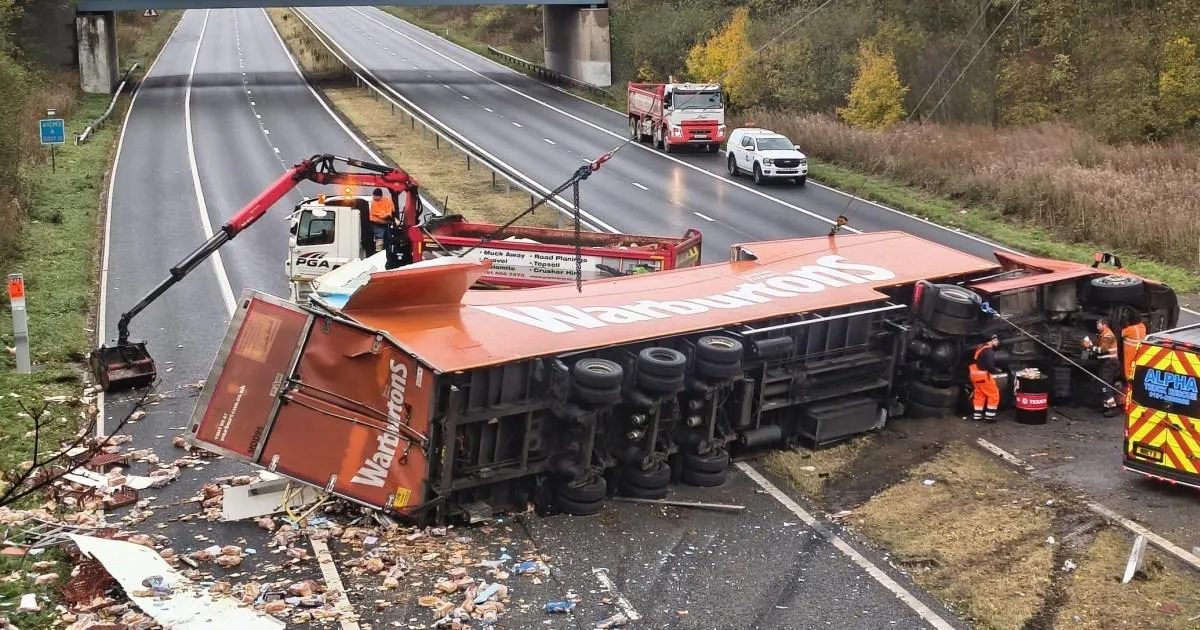
There is something surreal about the morning commute when the road ahead is suddenly covered in fresh bread. That was the sight facing drivers on the A1(M) near Bowburn, just outside Durham, after a Warburtons lorry smashed through the central reservation and spilled its cargo across both carriageways. What had started as an ordinary delivery run became an extraordinary scene: a large orange HGV lying on its side, supermarket crates torn open, and thousands of white loaves scattered over the tarmac like some strange harvest left behind by a storm. The motorway was closed in both directions as emergency services descended on the carriageway, and motorists were held back not by the usual barriers or police tape alone, but by an unlikely obstruction that had turned a major road into a giant, accidental bakery display. The images from the scene were striking: scores of loaves, still wrapped and eerily identical, stretched across the asphalt, some piled in crates and others resting on the central reservation, while the overturned lorry dominated the middle of the road like a sleeping metal giant. For anyone driving past, it must have been hard to believe their eyes. This was not a fuel spill or a broken-down car; this was breakfast, or at least the ingredients for it, suddenly abandoned in the middle of England’s road network.
The incident unfolded in the early morning, when road conditions were still dark and most people were only beginning to think about their day. Durham Constabulary said they were called just after 5.10am following reports that a lorry had overturned on the A1(M) just after the Bowburn junction. The lorry had apparently crashed through the central reservation, and the collision caused the vehicle to tip fully onto its side, shedding its load across both carriageways. At that point, the road was closed at Bowburn junction, and the disruption would last for hours. The driver of the lorry was injured in the crash and taken to hospital for treatment, though the exact nature of the injuries was not detailed. It is a sobering reminder that behind the strangely photogenic pile of bread, there was a human being whose routine job had suddenly turned into a serious accident. For the driver, this was not a funny roadside oddity; it was a terrifying moment, a crash, and a trip to hospital. The force required to send a heavy goods vehicle through the central reservation and onto its side is substantial, and the fact that the driver was hurt shows how dangerous these incidents can be, even when the cargo is as common and harmless as bread.
The scale of the clean-up operation was significant. A massive crane was brought to the scene to lift the lorry back onto its wheels, and the baked goods were eventually scraped off the tarmac by recovery crews. National Highways confirmed that the HGV had been righted by a crane, but warned that a large debris field needed to be cleared and barrier repairs had to take place. The damage was not just the bread scattered across the road; the crash had torn up the central reservation and left the motorway infrastructure in need of repair. Because of the scale of the damage, a stretch of the motorway remained closed into the afternoon, and traffic delays were forming in both directions. Motorists were urged by Durham Constabulary to use alternative routes, but that is easier said than done when a busy stretch of motorway is sealed off during rush hour. For commuters, the closure meant long detours, missed appointments, late arrivals, and a general sense of frustration. For the road crews, it meant hours of physical work in the open air, dealing with the wreckage, the debris, and the thousand loaves of bread that had no business being on a motorway. The image of a crane lifting an overturned lorry while workers sweep up white bread is one that will stay with the people who saw it, and with anyone who reads about it.
For those caught in the delays, the situation was both maddening and, in a strange way, memorable. A traffic jam is rarely accompanied by the smell of fresh bread mingling with diesel and rubber, and it is even rarer to see supermarket crates lying on the hard shoulder with their contents spilling into the road. There is an almost comic quality to the idea that a Warburtons lorry, loaded with white toast bread, could bring a motorway to a standstill. But the comedy only goes so far. The driver was injured, the damage to the road was serious, and the knock-on effects were felt by countless people who had simply been trying to get to work. The incident also highlights how much we take for granted the lorries that travel our roads every night and every morning, carrying the food that appears on supermarket shelves. When everything works, we never think about how the bread got there. When a lorry overturns and loaves end up on the tarmac, we are suddenly confronted with the fragility of the entire supply chain. It is a reminder that behind every simple product is a complex system of vehicles, drivers, warehouses, and schedules, and that system can be disrupted in an instant by a split second of lost control.
It is also worth remembering that this was not the first time a road has been closed by an unexpected spillage. The UK roads have seen their fair share of unusual cargo over the years, ranging from fuel to everyday essentials. Last month, a lorry spilled 300 litres of diesel on the M3 in Hampshire, closing the busy road at peak rush hour and forcing drivers to wait while the fuel was cleaned up and the surface made safe. In 2022, an HGV driver underestimated the height of their vehicle and hit a bridge in Lewisham, south London, causing toilet roll to clog up the road in a scene that was equal parts absurd and disruptive. These incidents, like the bread spill on the A1(M), are often met with a mix of disbelief and amusement, but they also serve as reminders of the everyday hazards of road transport. Diesel can make a road dangerously slippery; toilet roll can create a mess that takes hours to clear; and a load of bread can attract birds and make the carriageway look like a scene from a food-based disaster movie. The cargo may vary, but the impact is always the same: closed roads, stranded drivers, and overstretched emergency services dealing with something that nobody expected.
Eventually, the lorry was lifted, the bread was cleared, and the road repairs began. But the memory of that morning, and the image of a motorway carpeted with white loaves, will last a little longer. It is tempting to laugh at the absurdity of the situation, and there is no harm in a little humour when nobody has lost their life. But the most important part of the story is the human one: a lorry driver who went to work expecting an ordinary day and ended up in hospital. Every loaf that missed the supermarket shelf was a reminder that real people are behind the deliveries we depend on, and that their work is not always easy or safe. The clean-up crews who spent hours scraping bread off the tarmac, the police officers who managed the road closure, the National Highways engineers who fixed the barriers, and the commuters who sat in traffic all had their day disrupted by this single incident. In the end, the A1(M) reopened, the wreckage was removed, and the bread was swept away, destined for neither the toaster nor the bin but simply for memory. The next time a fresh loaf appears on a supermarket shelf, it might be worth thinking about the long journey it made to get there, and the fact that sometimes, on a cold, dark morning, that journey ends in the most unlikely place of all: the middle of a motorway, scattered across the road like a thousand pieces of unintended art.