


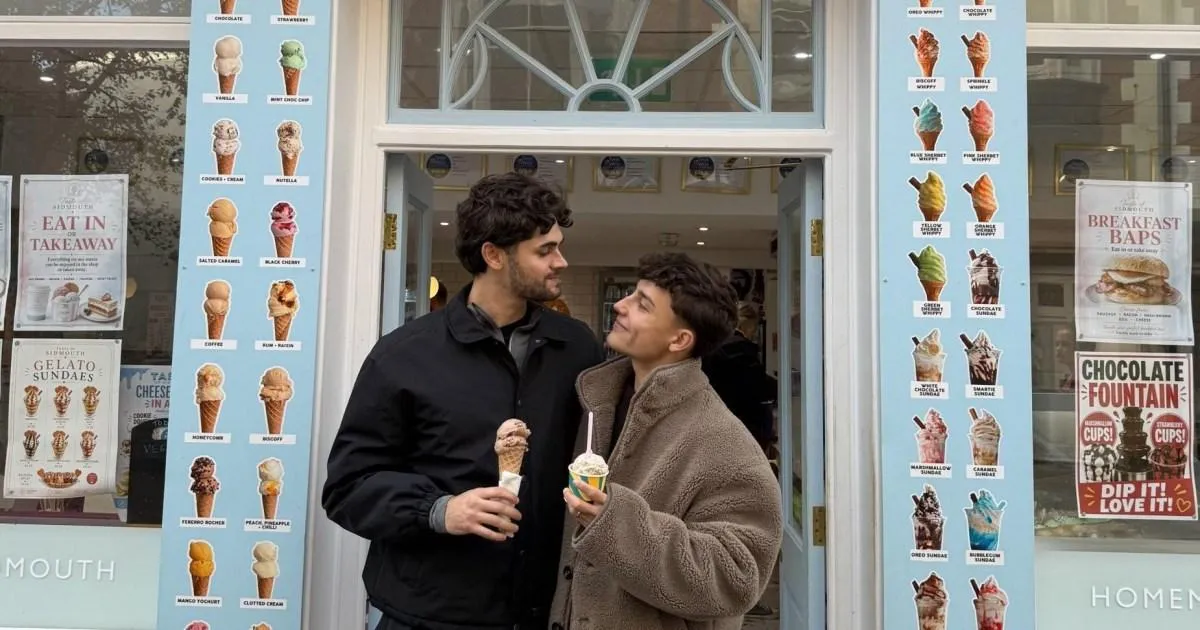
1. There are moments that should be simple: a couple walks into a small ice cream shop on a warm afternoon, smiles at the people behind the counter, orders a couple of scoops of homemade gelato, and pauses for a photograph that is meant to capture nothing more than a pleasant outing. That is how it began for Nick and Ant, a married couple from London who had come to visit Taste of Sidmouth, a beloved independent gelateria in the seaside town of Sidmouth, Devon. They were not there to make a statement. They were not looking for attention. They were simply two people enjoying a treat, happy to support a small family business and happy to pose with a Ferrero Rocher gelato and a strawberry scoop for a photo the shop owners were excited to share. The owners, in turn, were delighted. The couple were kind, warm and generous with their time, and the whole encounter felt like exactly the kind of feel-good story that local businesses love to celebrate. So the shop posted the photo on Facebook, with a cheerful message about their visitors and their homemade ice cream. Within hours, that cheerful moment had curdled into something ugly. The post was flooded with homophobic abuse. Strangers, hiding behind screens, attacked the couple’s relationship simply because they were two men in love. The shop owners watched in disbelief as a photo that was meant to spread joy became a lightning rod for hatred. And yet, even as the comments piled up, a quiet determination began to take shape: this small ice cream shop would not let the bigots have the last word.
2. Cathy Inglis, the owner of Taste of Sidmouth, was the first to speak out, and her words carried the raw, weary frustration of someone who had seen something beautiful turned into something bitter. “Apparently, in 2026, we still have people who think it’s acceptable to make nasty, homophobic remarks simply because two men are in a relationship,” she said. “Are we really still doing this? Seriously?” It was a question that did not need an answer, because the answer was already written in the ugly comments she had spent hours reading and deleting. Cathy described how the two men had walked into her shop, supported a small family business, been incredibly kind, and given the staff a moment they were genuinely excited to share. And somehow, that had attracted negativity. The absurdity of it hung in the air. Two strangers had done nothing except exist, order ice cream, and smile for a photograph, and that was enough to provoke a torrent of hatred. Cathy did not mince words. She said she had found herself reading comments that left her genuinely shocked, angry and incredibly disappointed. She reminded the trolls that they did not have to know who somebody was, follow them, or even be interested in the post. “But being a decent human being? That really shouldn’t be too much to ask.” It was a simple, devastating rebuke, the kind of statement that should not need to be made but somehow still does. The shop also took practical action, removing the worst comments from its page, but the damage had been done. The internet had proven, once again, that it can turn a lovely afternoon into a public battleground in a matter of minutes.
3. Then came the other response, the one that would ultimately define the story. Sophie, the manager and Cathy’s daughter, stepped forward with a voice that was softer but just as fierce. She said the response to their posts over the previous twelve hours had been absolutely overwhelming. The love, the support, the messages, and the hundreds of people standing up for kindness had left her feeling incredibly emotional. But one thing had touched her more than anything else: the number of people thanking them for speaking out. And that, she said, was what she wanted to talk about. Because to her, speaking out against homophobia should not be extraordinary. It should be normal. It should be the bare minimum. In that simple observation lay a profound truth about the world we live in. When a small business posts a photo of a gay couple and receives abuse, the fact that the business responds with courage and love can feel like a rare and beautiful thing. But Sophie was right to resist that framing. Defending two men who were simply enjoying ice cream should not be an act of heroism. It should be the standard, the baseline, the thing any decent person does without thinking. She credited her mother with instilling the values behind the business, describing Cathy as someone who had always encouraged her family to be accepting, outspoken and protective of others. It was a glimpse into the heart of the family-run shop, a place where kindness was not a marketing strategy but a way of life, passed down from mother to daughter, from owner to staff, and ultimately to the customers who walked through the door.
4. Taste of Sidmouth is not just any ice cream shop. It has been voted best ice cream in the south west, and it proudly decorates its premises with rainbow flags for Pride Month every June. This is a place that has woven inclusivity into its identity, not as a trend but as a belief. The shop is the kind of small business that people in the community rely on for more than just a sweet treat; it is a familiar, welcoming spot where everyone is supposed to feel safe. That made the homophobic comments feel like an invasion, not just of Nick and Ant’s privacy, but of the shop’s entire ethos. The owners had opened their doors to the couple with genuine pleasure, excited to share their visit with the world, and the world had responded with abuse. Yet the family behind the shop refused to shrink. Instead of apologising for the post or quietly deleting it to avoid controversy, they doubled down. They made it clear that the hateful comments were not a reflection of the couple, but of the people who wrote them. They also made it clear that the shop would not be intimidated into silence. In the face of ugliness, they chose grace. In the face of hatred, they chose love. And in the face of a world that sometimes seems determined to make LGBTQ+ people feel unwelcome, they chose to plant a rainbow flag even deeper into the ground. For a small business that relies on customers and community goodwill, taking such a firm public stand is not always easy. There is always the fear of backlash, of losing customers, of becoming a target. But the owners decided that some things are worth more than profit. They decided that being a safe space, a place for everyone, was worth defending.
5. Their pledge was simple and unbreakable. Taste of Sidmouth would continue calling out homophobia, celebrating Pride Month, and supporting the LGBTQ+ community. They would not let a handful of hateful comments scare them into silence. And they had a direct message for Nick and Ant, the two men at the centre of the storm. “If you happen to see this, please know that you are SO welcome in our shop, and we were absolutely delighted to meet you both,” the business wrote. “Taste of Sidmouth is a place for EVERYONE. Always has been. Always will be.” Those last words carried a weight that went beyond the moment. They were a promise that the shop’s doors would always be open, its welcome always genuine, and its values always intact. For Nick and Ant, who had innocently arrived for ice cream and found themselves at the centre of an online storm, that message must have meant more than any of the abuse they had seen. It is one thing to know that a business supports the LGBTQ+ community in theory. It is another thing entirely to have that support shouted from the rooftops after you have been attacked. The couple, who are described as London-based married LGBTQ+ influencers, did not respond publicly to the abuse, at least not in the initial reports, but they did not need to. The community around them had risen up, and the shop that had welcomed them had refused to abandon them. In a world where online hate can feel overwhelming, that kind of solidarity is a lifeline. It says: you are not alone. You were never alone. And the people who tried to hurt you have failed.
6. The story of Taste of Sidmouth is about more than one awful comment section. It is a mirror held up to society, reflecting both the hatred that still exists and the love that rises to meet it. The fact that, in 2026, two men can be attacked simply for being married is a painful reminder of how much work remains to be done. But the fact that a small ice cream shop in Devon can quickly find itself supported by hundreds of people standing up for kindness is a reminder that progress is real, too. The internet is a strange place. It gives a voice to the worst of us, allowing strangers to spew venom without consequence. But it also gives a voice to the best of us, allowing communities to rally around those who have been hurt. In this case, the good outweighed the bad. The love was louder than the hatred. The shop’s refusal to back down, and its insistence on celebrating Pride Month and welcoming everyone, became a beacon of hope. It showed that ordinary people, running ordinary businesses, can make an extraordinary difference simply by refusing to accept intolerance. The owners did not have to speak out. They could have deleted the comments, ignored the backlash, and moved on. But they chose to fight, not with anger, but with conviction. They chose to use their platform, small as it was, to say something that still needs to be said: that love is love, that everyone deserves respect, and that a place serving ice cream can also serve as a reminder of what kindness looks like. For Cathy, for Sophie, for the staff, and for everyone who sent a message of support, the lesson is clear. The haters will always be there, but they do not get to decide what this story means. The owners do. And they have decided that it means this: two men walked into an ice cream shop, were treated with warmth and dignity, and when strangers tried to tear them down, an entire community stood up and said, not here, not now, not ever. That is the story worth remembering.