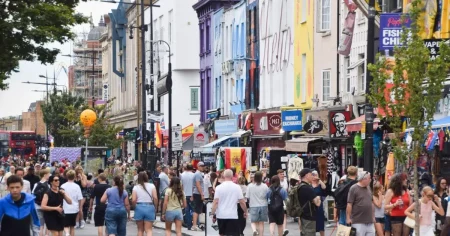



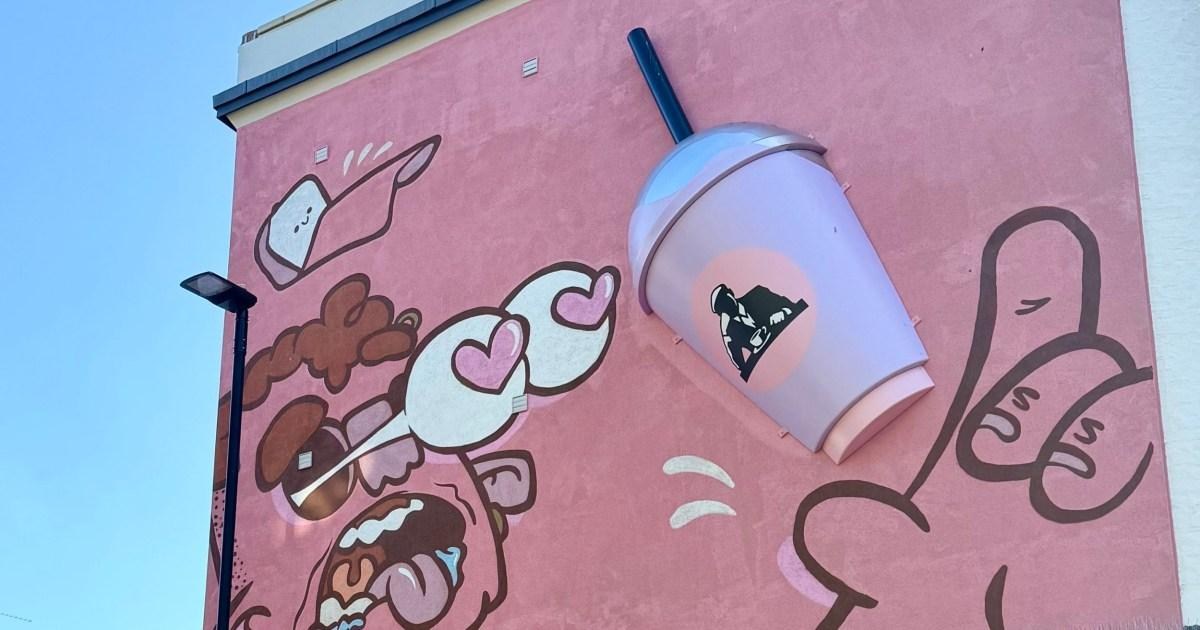
Camden has never been a part of London that likes to play it safe. Known for its music venues, eccentric markets, and a street culture that seems to reinvent itself every few months, the borough has long been a place where creativity is allowed to spill out of galleries and onto the pavement. It’s no surprise, then, that the area has also become known for its 3D avant-garde store installations — pieces that blur the line between shopfront, sculpture, and spectacle. One of those installations, perched on the side of a Joe & The Juice branch in Chalk Farm, became exactly that kind of talking point. For around six months, a giant painted vinyl cup jutted out from the wall above the juice bar, looking more like a piece of pop art than a piece of advertising. It was bold, playful, and hard to miss. But last week, the cup came down. Camden Council had stepped in and ordered its removal, saying it had been displayed without planning permission and that an application to keep it had not yet been approved. And so a crane was brought in, the oversized cup was carefully detached, and a small piece of Camden’s recent visual landscape disappeared as quickly as it had arrived.
The timeline of the installation’s short life raises a few eyebrows. The artwork was first put up roughly six months ago, on the wall along Hartland Road in Chalk Farm, where it quickly became part of the neighbourhood’s cluttered visual identity. For a while, it seemed to fit right in. It was the kind of thing that made people stop, look up, and maybe take a photo. But while the cup may have felt like a natural addition to Camden’s alternative character, it was also, in the eyes of the council, an advertisement — and one that had not gone through the proper channels. A planning application for the giant painted vinyl cup was submitted in February, but no decision had been made by the time the removal order was issued. The council was clear: the structure was displayed without consent and was not in line with planning policy. What makes the situation feel even more frustrating for those who enjoyed the installation is that the people behind it had hoped it would stay in place until at least 2031. That plan is now gone. Interestingly, the pink mural itself, painted by doodle artist Frankie Curtis, will remain on the wall — but only after some adjustments are made to remove the advertisement element. So the art survives, but only in a form the council can accept.
Behind the eye-catching design was a very straightforward commercial argument. In the planning application submitted on behalf of Joe & The Juice, the company described itself as a prominent juice bar and café known around the world for exceptional smoothies, juices, and food. It argued that allowing the business to operate in the space would bring increased employment and opportunities for local people, as well as continued social and economic regeneration throughout the borough. The application also pointed out that the wall along Hartland Road had hosted murals in the past, dating all the way back to 2014, suggesting that the installation was not some strange new intrusion but part of a longstanding local tradition. The proposed signage, it said, had been designed in keeping with the surrounding area of Camden and the growing alternative essence that the locality provides. That phrase — “growing alternative essence” — captures something important. Camden is not a place that wants to look like everywhere else. It has built its reputation on being different, and businesses that operate there often feel a pressure to reflect that identity in their architecture and design. The cup, in that sense, was an attempt to speak the local language. According to the planning documents, the whole mural, including the cup, measured 4200mm by 2250mm — roughly 13.7 feet by 7.4 feet — which, while large enough to be noticed, was hardly an oversized billboard. It was a relatively contained piece of visual personality, yet it still fell foul of the rules.
Camden Council, however, saw things differently. A spokesperson for the council said that the advertisement had now been removed, and confirmed that it was displayed without consent. They acknowledged that an application had been submitted and was still to be determined, but added that the applicant had been advised that it would not be approved because it did not comply with planning policy. This is where the story becomes more complicated than a simple case of art versus bureaucracy. The distinction between a mural and an advertisement can be surprisingly blurry, and it all comes down to intent. A mural is often seen as a cultural contribution — something that adds to the visual richness of an area without directly promoting a product. An advertisement, on the other hand, is designed to draw attention to a business and sell something. The giant cup above Joe & The Juice might have been aesthetically pleasing, but it was also, at the end of the day, a big plastic version of what the shop sells. In planning terms, that made it a commercial sign, and commercial signs are subject to strict controls. The council’s job is not to decide whether something is beautiful or interesting; it is to apply the rules consistently, ensuring that signs do not clutter streets, distract drivers, block sightlines, or give one business an unfair advantage over others. From that perspective, the removal of the cup was less about crushing creativity and more about maintaining order in a shared public space.
What makes this story resonate is not really the cup itself. It’s what the cup represents — and how quickly something that seems so harmless can become a point of conflict between the people who want their streets to feel alive and the systems designed to keep things in check. For locals, the episode might feel like a familiar London story: a playful installation goes up, people grow fond of it, then a council notice arrives and the crane is booked. It’s easy to imagine the disappointment of the artists and the shop staff who saw the installation as a contribution to the neighbourhood, not an infringement. There is also a strange irony in all of it. Camden is a place celebrated for its rebellious spirit, its graffiti, its punk history, its refusal to conform. And yet, like every other part of the city, it still has to operate within the same planning framework as everywhere else. That tension between the borough’s wild character and its need for governance has always existed, but it rarely feels as visible as when a crane rolls up to remove a giant juice cup from the side of a building. The debate it raises is bigger than one shop: how much should public spaces be allowed to become commercial canvases? Where exactly is the line between art and advertising? And who gets to decide what makes a street better rather than worse?
In the end, the removal of the cup raises a question that many cities are still trying to answer. We say we want vibrant, creative high streets, but we also want them to feel orderly, safe, and fair. We celebrate independent businesses and their attempts to stand out, but then we ask them to submit planning applications for almost everything they do. The pink mural by Frankie Curtis will remain part of the wall, but it will be adjusted, changed enough to satisfy the rules while hopefully keeping some of its charm. The planning application is still technically undetermined, but the council’s advice has already made the outcome clear. It’s hard not to feel a certain pang of loss. The cup was only there for six months, but in that short time it had become the kind of thing that made Chalk Farm feel distinct — a small, silly, colourful reminder that high streets can be playful. Now the wall is a little quieter, a little more ordinary. Maybe one day, a properly licensed version of the installation will return, or someone will dream up something even better that goes through the right channels from the very beginning. Until then, the story of the giant cup serves as a gentle lesson for anyone tempted to add a bit of sparkle to their storefront without first asking for permission: in London, even a piece of art that looks like fun is still, in the eyes of the council, an advertisement. And every advertisement, no matter how creative, has to follow the rules. So the next time you walk through Camden and see something strange and wonderful above a shop, take a moment to enjoy it — because you never know how long it will be allowed to stay.