



On the fifteenth of October, in the small hours before dawn, the quiet residential street of Dorking Avenue in Newton Heath, Manchester, became the scene of an unimaginable horror. Police officers, responding to a frantic emergency call at around two in the morning, arrived to find 26-year-old Alisha Samuels lying with multiple stab wounds. Despite their desperate efforts, she was pronounced dead at the scene. Alisha was a young woman with a life ahead of her—a daughter, a friend, a presence that surely filled rooms with warmth and light—and yet within moments, her story was cruelly cut short in the cold air of a street that should have been safe. Neighbours would later speak in hushed tones of the blue lights, the police tape, and the sense that something profoundly unnatural had occurred just beyond their front doors. In the hours and days that followed, Greater Manchester Police launched a full-scale murder investigation, combing the area for witnesses and piecing together a chain of events that had ended so violently. For Alisha’s family, the world stopped. For the wider community, there was grief, fear, and anger. The attack did not happen in some distant place where violence is expected; it happened in a neighbourhood where people raise children, walk dogs, and live ordinary lives. And now, that ordinariness was shattered. The police confirmed that alongside Alisha’s murder, a man had also been seriously injured in the same incident, leading to an additional charge of attempted murder. This was no isolated domestic tragedy, but a violent episode with multiple victims and a trail of trauma that would spread far beyond the pavement where Alisha fell.
Lawrence Johnson, a 26-year-old man who lived on the same street where Alisha was killed, was soon identified as a suspect. On the nineteenth of October, armed officers arrested him on Galsworthy Avenue in Bootle, a significant distance from the scene of the crime, suggesting he may have been attempting to flee or conceal himself. He was charged with murder and attempted murder, and after appearing before Manchester Magistrates’ Court on the twenty-first of October, he was remanded into custody. It was the beginning of what should have been a slow, careful legal process—a process designed to determine guilt or innocence, to examine evidence, and to deliver justice in a measured and dignified way. But while awaiting trial, Johnson found himself caught up in a different kind of justice: the raw, unforgiving code that sometimes takes hold inside prison walls. Over the weekend following his remand, he was reportedly assaulted and robbed at HMP Liverpool in Walton. A video began spreading across social media showing Johnson, dressed in the grey tracksuit of a prison-issue uniform, crowded into a cell with several other inmates. The footage is chilling to watch. A voice behind the camera can be heard saying, “Bro, you’re getting chopped up. Sit down, bro. Smash him up.” Another prisoner then lunges forward and punches Johnson repeatedly, while the man filming continues to taunt. Then comes the final humiliation: “Take his s*** off him.” The video ends with the implication that Johnson was not only beaten but stripped of his meagre possessions, robbed of whatever little he had within the system that was supposed to hold him safely. It is a brutal reminder that, in certain environments, violence is not a rare exception but a currency, and that even those accused of the most terrible crimes can suddenly find themselves at the mercy of others equally capable of cruelty.
The Ministry of Justice, in response to the video and the attack, issued a statement that tried to project control and reassurance. “Violence will not be tolerated in the prison estate, and this incident was swiftly dealt with,” said a spokesperson. They acknowledged the troubling presence of a mobile phone behind bars—the very device used to film the assault and share it with the world—and insisted that such devices are unacceptable. They ordered the immediate removal of the posts and launched an investigation into how the phone had been smuggled into the prison in the first place. But the statement raises more questions than it answers. How does a man who had only been in custody for a matter of days find himself in such a vulnerable position? Why were other inmates able to enter his cell? And what does it say about the state of the prison system when a violent assault can be filmed and shared online with such ease, almost as if it were entertainment? For many, the video serves as a grim reminder that prisons are not sanitised spaces where justice is administered calmly; they are overcrowded institutions housing people with complex histories, unstable emotions, and often profoundly violent tendencies. The fact that Johnson—a man accused of ending a young woman’s life—was himself subjected to violence does not erase his alleged crimes, nor does it bring Alisha back. Instead, it deepens the sense of tragedy, revealing a cycle of harm in which violence begets more violence, and where the search for justice becomes tangled with vengeance, degradation, and the primal instinct to punish. The MoJ’s investigation may discover how the phone got in, but it will struggle to explain why the system failed to protect a prisoner in its care.
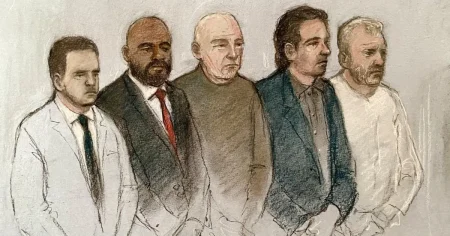
The legal case, meanwhile, continued to unfold. Two other men were also charged in connection with Alisha’s murder and the attempted murder of the male victim. Carl Hardy, nineteen, of Shaldon Drive in Manchester, and Tony Evans, nineteen, also of Dorking Avenue, appeared at magistrates’ court on the twenty-third of October and were remanded in custody. Three men in total now stood accused of playing a part in the horror that claimed Alisha’s life. The sheer number of suspects suggests a coordinated attack, something planned or at least carried out with a collective ferocity that is difficult to comprehend. Greater Manchester Police’s senior investigating officer, Detective Chief Inspector Justin Bryant, spoke publicly about the case with a tone of solemn determination. “We are working tirelessly to establish the full circumstances of this attack, and to provide Alisha’s family with some answers,” he said. “My thoughts remain with them as they navigate this tremendous loss.” His words are a small comfort in the face of such overwhelming grief. The family, meanwhile, were left to mourn. Every day they wait, trapped between the memory of Alisha as she was—vibrant, loving, irreplaceable—and the horrifying reality of how she died. The investigation will continue for weeks, perhaps months, as forensic analysts examine evidence, witnesses are interviewed, and the court prepares to untangle a web of events that began with an ordinary night and ended in bloodshed. For the male victim who survived the attack, the trauma is surely unimaginable, a life scarred by physical injury and the knowledge that he was targeted along with Alisha. The community too is left in the shadow of the violence, struggling to feel safe on streets that no longer seem familiar.
In the midst of this darkness, Alisha’s friend Carris Mallon spoke beautifully and painfully about the woman who was taken. “She was taken far too soon, in such a horrific way,” Carris said. “The world was too evil for her. She was the most precious soul in the whole entire world, not a person she met who could say anything bad.” Those words resonate deeply, illuminating the chasm between the human being Alisha was and the brutal manner of her death. A fundraiser was set up to support her parents, and within days it had raised nearly £16,500 toward a £20,000 target. Every donation is a gesture of solidarity, a way of saying that Alisha mattered, that her family are not alone, and that there is still goodness in a world that allowed such evil to happen. The money will never undo the loss, but it will help with the practical burdens of funeral costs and daily survival as two parents learn to live without their daughter. Friends will remember her laughter, her kindness, her way of making people feel special. They will carry her in their hearts while the legal system grinds toward some form of accountability. And perhaps that is the most human response: not to seek revenge, but to hold onto love, to create meaning out of pain, and to ensure that the name Alisha Samuels is remembered not only for the way she died, but for the way she lived.
Taken together, these events paint a portrait of a world saturated with tragedy, where no one is entirely innocent or entirely safe. Alisha Samuels is the central loss, a bright young woman whose future was stolen in an act of senseless violence. Lawrence Johnson, Carl Hardy, and Tony Evans now face the weight of the law, accused of being responsible for that loss. Whether Johnson was guilty or not, he now carries not only the charge but also the physical scars of his time in custody. The video of his assault, shared across social media, reminds us that suffering is not confined to the victim and her family, but radiates outward, touching even those accused of inflicting it. The prison system, meant to be a place of containment and rehabilitation, instead becomes another arena for cruelty. The Ministry of Justice will investigate the phone, the prison officers will be questioned, and perhaps procedures will be tightened, but the deeper question remains: how do we break the cycle of violence that begins in our streets and continues behind bars? There are no easy answers. There is only grief, justice, and the fragile determination of those left behind to keep going. For Alisha’s family, the road ahead is long and dark, but they are not walking it alone. A community has gathered around them, strangers have offered prayers and money, and friends have spoken out with love rather than hate. In the face of such overwhelming loss, that is the smallest comfort, and perhaps the most important one of all.