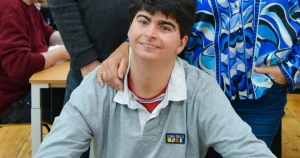


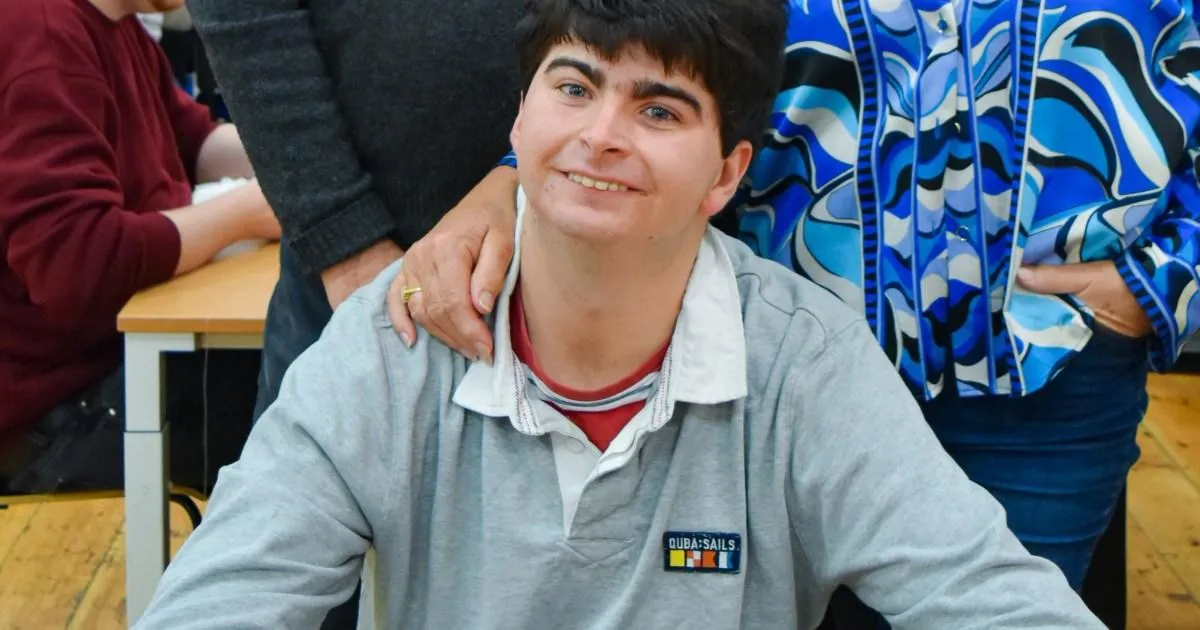
Some encounters are so perfectly improbable that they stay with you long after the handshakes and photographs fade. Such was the case when Prince William walked into the Sweet Surprise cafe in the quiet Somerset town of Ilminster, and a young man named Sebastian Smith looked up from his day and saw not the future King of England, but a pop legend from Minneapolis. Sebastian, 22, who has severe learning difficulties and lives with a rare chromosomal condition called Rubinstein-Taybi Syndrome, was absolutely convinced that the royal visitor was Prince, the iconic singer behind “Purple Rain” and “When Doves Cry.” In a moment of innocent, unguarded delight, he asked the heir to the throne to sing the 1984 hit. It was the kind of mistake that could have left a royal aide wincing, but William took it in his stride, offering the kind of warm, amused response that has become his trademark. The exchange might have remained a sweet local memory, but weeks later the Prince recounted the story on The Graham Norton Show, sending the clip around the world and turning Sebastian into an unlikely celebrity. For Sebastian, the moment was never about protocol or politics. It was about a fan meeting his hero. And for his family, watching their son’s innocent confusion become a source of global joy was both surreal and deeply moving. Sweet Surprise is not an ordinary cafe. It is a training ground for adults with learning difficulties, a place where people like Sebastian are given the chance to learn workplace skills in a supportive and caring environment. The royal visit was a milestone for the community, but for Sebastian it was something far more personal: a chance encounter with the man he believed was his favourite singer. His family later laughed about the fact that he did not hug the Prince, though they suspected he might have cuddled the Princess of Wales had she been there too. The image of Sebastian, beaming with excitement, asking a future king to perform “Purple Rain” is one that has brought smiles to faces across the country. It is a reminder that the best moments in life are often the ones we never plan.
Sebastian’s parents, Claire and Mike, were at home when their phones began to light up with messages. Friends had seen The Graham Norton Show and recognised the story instantly. They knew that the “lovely gentleman” William described was their son. “Our phones went crazy after the Graham Norton Show because our friends knew Prince William had been referring to what Sebastian had asked him,” Claire said. “To be honest, I don’t think Sebastian had any idea who Prince William was, but he’s a massive fan of Prince the singer and can list all his songs and knows all the lyrics.” For a young man with learning difficulties, this encyclopedic knowledge of Prince’s catalogue is nothing short of remarkable. Sebastian can name every track, recall every lyric, and count to ten in six different languages. He can also tell you, within a split second, what day of the week your next birthday will fall on, and he can play the piano. These are the gifts that define him far more than his diagnosis. Rubinstein-Taybi Syndrome is a rare genetic disorder that can affect development, but it has not dimmed Sebastian’s spirit. His mother describes him as “a bundle of joy”—a happy, entertaining young man who loves to cuddle people. The family was a little surprised he didn’t hug Prince William, though Claire joked that he might have cuddled the Princess of Wales had she been there too. It is this combination of vulnerability and warmth that made the royal encounter so endearing. Claire and Mike first began to worry when Sebastian was four or five years old. He was later diagnosed with the rare disorder, but he remained in mainstream school until the age of eleven before moving to more specialist support. Now, as an adult learner at Sweet Surprise, he is thriving. The cafe offers workplace education for adults with learning difficulties, giving people like Sebastian a sense of purpose, community and pride. The royal visit was a very special day for everyone there, Claire said, and Sebastian has been “really enjoying” the experience. The attention that followed has been overwhelming but welcome. For a family accustomed to navigating the challenges of a rare condition, seeing their son celebrated for his innocent mistake felt like a small victory—a reminder that joy can be found in the most unexpected places.
The Sweet Surprise cafe is more than just a place that serves coffee and cake. It is a sanctuary of sorts, a training ground where adults with learning difficulties learn valuable workplace skills in a supportive environment. Owner Jane Morgan has built a space where every person is treated with dignity, and where the simple act of making a sandwich or greeting a customer can be a triumph. When Prince William visited, he did not simply wave and move on. According to Jane, he was genuinely interested in the work being done, and he joked along with the learners, putting everyone at ease. “It was wonderful to see how everyone relaxed and was perfectly at ease with him,” she said. “Prince William was really interested in what we did and joked along with the learners—he was perfect.” The visit was a milestone for the cafe, a recognition of the value of inclusion and the importance of giving every person a chance to contribute. For the learners, it was a day of excitement and pride. For Sebastian, it was something else entirely: a chance encounter with his musical idol, or so he believed. The fact that the “idol” was actually a prince only made the memory richer. Jane could not hide her amusement when she recalled Sebastian’s comments about Prince and “Purple Rain.” “Oh my days!” she laughed. “But Prince William took it all in his stride with great fun. It was very surreal to hear the Prince then mention it on The Graham Norton Show.” Sweet Surprise is part of a growing movement of social enterprises that believe disability should never be a barrier to meaningful work. For the adults who come through its doors, the cafe offers not only skills but also friendship, routine and a reason to get up in the morning. It is a place where differences are accepted, and where small achievements are celebrated. The royal visit brought national attention to this quiet corner of Somerset, and Jane Morgan was determined to make the most of it. She watched with pride as her learners interacted with the Prince, their faces bright with excitement. William, for his part, seemed to understand the importance of the occasion. He did not rush through the visit or treat it as a mere formality. Instead, he listened, laughed and engaged with each person he met. For Sebastian, that meant a conversation about music—and a request that would soon be heard by millions.
When Prince William appeared on The Graham Norton Show, he shared the anecdote with the kind of storytelling ease that has made him one of the most relatable members of the royal family. He described how “one lovely gentleman” in the community had asked him to sing “Purple Rain” during his visit to Somerset. The audience laughed, and the clip quickly made its way onto social media, where it was shared and commented on by people around the world. For Sebastian’s family, watching the broadcast was a strange and wonderful experience. They had been there when it happened; they had seen Sebastian’s innocent assumption and William’s gracious response. But hearing the Prince retell the story on television gave it a new dimension. “Our phones went crazy after the Graham Norton Show because our friends knew Prince William had been referring to what Sebastian had asked him,” Claire said. The family were amazed that such a short conversation could gain so much publicity. In an age of carefully staged royal appearances and tightly controlled media narratives, this was a moment of genuine, unscripted humanity. It showed a side of the monarchy that is rarely seen: a prince laughing warmly at a young man’s mistake, and a young man so lost in his love of music that he forgot, for a moment, who he was really talking to. Prince’s “Purple Rain” is more than a song; it is an anthem of longing and transcendence, a piece of musical history that has touched generations. For Sebastian, it is clearly a source of joy, a thread connecting him to an artist he adores. To hear that he had asked the future king to sing it was both absurd and beautiful. The public reaction was immediate and overwhelmingly warm. Social media users praised Sebastian’s honesty and William’s kindness, with many noting that the Prince’s response was a masterclass in grace. Some joked that William should have humoured him with a few bars, while others pointed out that the Prince probably made the right call by not attempting to imitate the legendary falsetto. For the Sweet Surprise community, the attention was a source of pride. They had hosted a royal visit, and they had given the world a story that made people smile. Claire and Mike watched as their son became an unlikely internet sensation, and they marvelled at the kindness of strangers. “Considering his learning difficulties, it is amazing how he can name all the songs,” Claire said. “So when Prince William arrived at Sweet Surprise, Sebastian just innocently assumed it was Prince the singer!” The innocence of that assumption was exactly what touched so many people.
In the days that followed, the family decided to turn the moment into an opportunity to express their gratitude. With help from his parents, Sebastian wrote a letter to Prince William and sent it to Kensington Palace. In the letter, he thanked the Prince for visiting Ilminster and apologised for mistaking him for the singer Prince. He signed it with characteristic warmth: “Lots of love—Sebastian.” Claire said they hope the Prince gets to see the letter, and that it brings a smile to his face as much as the original encounter did. The letter is a testament to Sebastian’s nature. Despite the challenges of Rubinstein-Taybi Syndrome, he is a young man who reaches out to others with affection and openness. His parents have always encouraged him to embrace life, and he has responded in kind. He can count to ten in six different languages, a feat that requires memory and concentration. He can calculate the day of the week for any future birthday in a split second, a party trick that never fails to amaze. And he can play the piano, finding in music a language that transcends his difficulties. These abilities are not despite his condition; they are part of who he is. Writing the letter was not a simple task. Sebastian’s learning difficulties make some forms of communication challenging, but with his parents’ patient guidance, he was able to put his feelings into words. The letter is short and sweet, much like Sebastian himself. It thanks the Prince for taking the time to visit a small cafe in Somerset, and it apologises for the confusion that led to the “Purple Rain” request. There is no hint of embarrassment in the letter, only sincerity. “We hope the Prince gets to see the letter,” Claire said. “Sebastian is amazing. Despite all his difficulties, he can count to ten in six different languages, he knows what day of the week your next birthday is going to be on within a split second, and he can also play the piano.” These are the details that make Sebastian who he is. He is not defined by his syndrome, but by his curiosity, his memory, his love of music and his enormous heart. The family has always focused on what Sebastian can do, rather than what he cannot. They celebrated his first words, his first steps, his first song. They watched him navigate a world that is not always kind to those who are different, and they saw him emerge as a young man who brings joy to everyone he meets. The letter to Prince William is a reflection of that optimism. It is a way of saying: thank you for seeing us, thank you for listening, and sorry for the mix-up—but also, look at me, I am wonderful.
At its heart, this story is about the power of small moments to bring people together. A royal visit is usually a carefully choreographed affair, with protocols and schedules and polite applause. But Sebastian cut through all of that with a simple, heartfelt request. He did not see a prince; he saw a singer he loved. And in doing so, he reminded everyone that the most meaningful connections are often the ones that catch us off guard. Prince William’s decision to share the story on The Graham Norton Show was a gift. It turned a private moment into a public celebration of kindness, humour and inclusion. It also shone a light on the work being done at Sweet Surprise, a place where adults with learning difficulties are given the chance to learn, grow and belong. For Sebastian’s family, the past few weeks have been a whirlwind. They have watched their son become a symbol of joy, a young man whose innocent mistake made the world smile. They have also watched him grow in confidence, basking in the attention and loving every moment. “Sebastian is a bundle of joy—he really is such a happy lad,” Claire said. “He is so entertaining and loves to cuddle people.” The family’s hope now is that Prince William receives the letter and understands how much his visit meant. They are not expecting a reply, but they know that the memory will last. In a world that often feels divided, this story is a reminder that we are all more alike than we are different. We all want to be seen, heard and understood. We all have heroes we admire and songs we love. And sometimes, just sometimes, a young man in a Somerset cafe can teach us more about grace than any royal protocol ever could. The Prince may not have sung “Purple Rain,” but he gave Sebastian something just as valuable: a moment of recognition, a laugh shared, and a story that will be told for years to come.