

Paragraph 1: The Sky Turns Without Warning
The Caribbean sky, moments before, had been a brilliant, celebratory blue—the kind of saturated, postcard-perfect azure that seems to promise eternal sunshine. Then, without any theatrical warning, it changed. The heavens opened up with a sudden, furious intensity, as if the weather itself had decided to add an unscripted, dramatic twist to a day already heavy with symbolism and ceremony. King Charles III, dressed in a carefully chosen beige suit and a vibrant, optimistic tie, found himself standing in the middle of a cricket pitch at the Sir Vivian Richards Stadium in Antigua, directly in the path of a torrential downpour. The occasion was momentous: a celebration of Antigua and Barbuda’s forty-five years of independence from the United Kingdom. Around him stood the country’s leadership, military chiefs, and dignitaries, all locked in the stiff tableau of official ceremony. But nature, as it so often does, paid no attention to protocol. The wind gusted, the rain hammered down, and within seconds, the carefully orchestrated event was in danger of dissolving into a soggy spectacle. It was a moment that could have been a diplomatic embarrassment, a logistical nightmare, or a footnote in royal history. Instead, it became a surprisingly human portrait of a monarch caught off-guard—a man in his late seventies, momentarily undone by the elements, searching for a simple umbrella while the world watched.
Paragraph 2: A Sovereign’s Comedic Dilemma
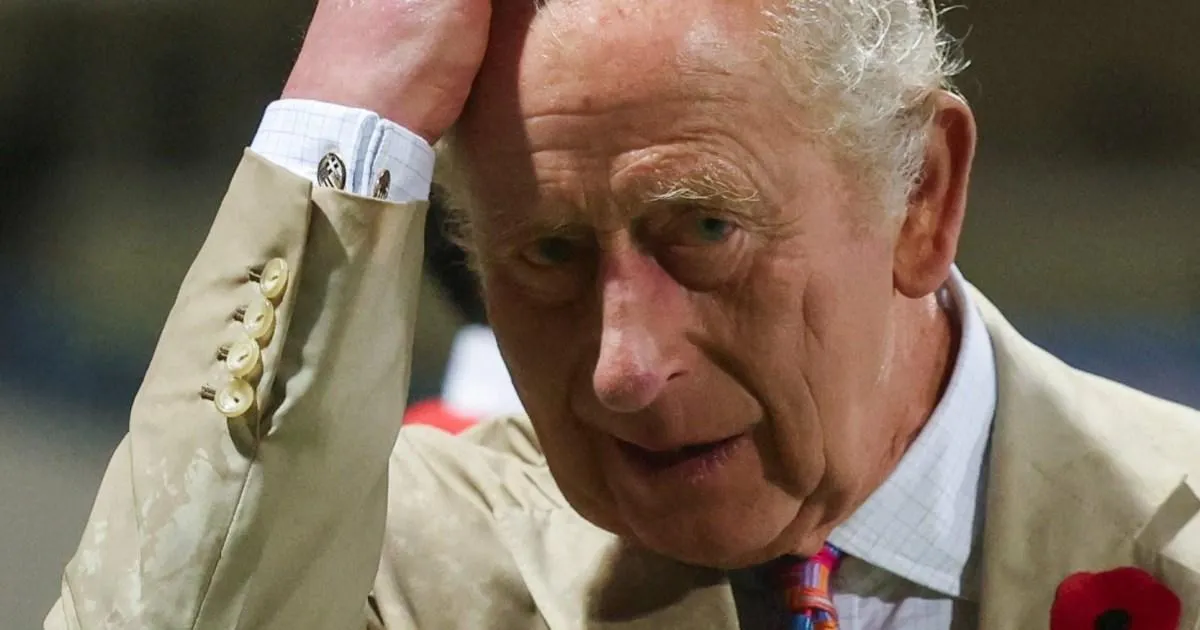
As the first heavy drops turned into a relentless cascade, the reaction of the royal party split into two distinct camps. Queen Camilla, at seventy-nine, had no intention of braving the elements. With remarkable speed, an aide appeared at her side, brandishing a large umbrella, and she was swiftly escorted toward the safety of the royal canopy, where she joined the guests of honour. Once under cover, she seemed to gesture at the sky with a mixture of amusement and exasperation, a silent commentary on the absurdity of the moment. King Charles, however, was left standing in the open, somehow separated from his own protection. The images from that moment are captivating not because they show a sovereign in control, but because they show him distinctly not. He looked around, seemingly perplexed, as if the sudden turn of events had genuinely caught him off guard. He threw his hands into the air, not in a fit of temper, but in a universal gesture of helplessness and plea. To those watching, his body language read as a repeated, frustrated refrain: “Where’s the umbrella? Where’s the umbrella?” It was a scene of royal vulnerability, stripped of the usual polish and pomp. He was not a king commanding his realm; he was just a man getting drenched, waiting for an aide to solve the problem. For a brief moment, the majestic distance between the monarchy and the public collapsed, replaced by a shared, deeply relatable experience: the sudden, irrational fury of unexpected rain ruining a perfectly good outfit.
Paragraph 3: Rain, Resilience, and a Watercress Joke
The downpour ended as abruptly as it had begun, leaving the stadium glistening and the air thick with humidity. Many leaders might have called it a day, retreating to dry rooms and prepared statements. But King Charles, ever the pragmatist, decided to press ahead. The parade continued, and the monarch, now visibly damp but undeterred, made his way back to the small stage. The crowd, which had watched the meteorological drama unfold, greeted him with a wave of cheers and laughter. It was then that Charles demonstrated the self-deprecating wit that has often endeared him to the public. He looked at his soaked trousers, slicked against his legs, and delivered a perfectly timed joke: “I’ve started growing watercress on my trousers.” The line, delivered with a knowing smile, broke the remaining tension and transformed a potential mishap into a moment of warmth. It was a small, human reminder that beneath the orb and sceptre, beneath the weight of history and constitutional duty, there is a person who understands the value of humour. In that instant, the image of the rain-soaked king became less about the awkwardness of royal protocol and more about resilience. He didn’t summon a helicopter; he didn’t demand the crowd be sheltered. He simply acknowledged the absurdity, made a joke, and continued with the ceremony. The parade, now infused with a shared, good-natured energy, proceeded with a liveliness that the dry, scripted version might have lacked.
Paragraph 4: A Tour Steeped in History and Purpose
This lighthearted moment, however, was just one small part of a much larger and more consequential journey. King Charles had begun his Caribbean tour days earlier in the Bahamas, where he joined a vibrant street parade, then travelled onward to Guyana before arriving in Antigua and Barbuda. Queen Camilla had flown out to join him for the latter leg, and the couple were scheduled to attend a series of engagements designed to strengthen ties with the Commonwealth nations. The tour was never meant to be a mere holiday in the sun. It was a carefully calibrated diplomatic mission, carrying with it the weight of a shared and often painful history. In the run-up to the visit, there had been renewed and increasingly vocal calls from Caribbean leaders for Britain to formally apologise for its role in the trans-Atlantic slave trade—a brutal system that had wrecked millions of lives and enriched the United Kingdom for centuries. The king, aware of the gravity of the moment, was expected to address these issues directly in his address to the Commonwealth leaders. His visit was, in many ways, a tightrope walk between celebrating the modern relationships between nations and confronting the uncomfortable truths of the past. Amidst the colourful ceremonies and waving flags, the spectre of history loomed large, demanding not just recognition, but reconciliation.
Paragraph 5: Acknowledging the Unforgivable
The king had already signalled his willingness to engage with this complex legacy. In the Bahamas, he delivered a speech in which he acknowledged that it was “only right” to confront the historic wrongs that had shaped the region. The language was careful, measured, and deliberate, but it marked a significant step forward in the ongoing dialogue about reparations and reconciliation. For many in the Caribbean, those words carried more weight than any ceremonial gesture. The call for a formal apology has been growing louder, with several nations establishing reparations commissions and demanding that Britain account for its historical role in the slave trade. It is a demand that cannot be easily dismissed, and the king’s visit seemed to signal a willingness to listen, if not yet to fully concede. The image of the rain-soaked monarch, so endearing and human, stood in stark contrast to this heavyweight political context. Yet it is often in these small, unguarded moments that leaders are perceived as most authentic. By staying on that cricket pitch, by making his joke about watercress, and by continuing the parade even after his suit was ruined, Charles projected a kind of steadiness. He was not hiding from the storm, just as he seemed unwilling to hide from the harder conversations. The downpour was a fleeting inconvenience; the legacy of slavery is a permanent scar. How Britain and the Commonwealth navigate that scar will define the future of the relationship.
Paragraph 6: The Deeper Meaning of a Soaked Suit
By the time the celebrations in Antigua came to a close, the king and queen had been through a microcosm of the royal experience: the absurd and the profound, the lighthearted and the historically heavy. The photographs from that day capture more than just a bit of bad weather. They capture a monarch who, even at seventy-seven, remains willing to embrace the unexpected, to laugh at himself, and to stand in the rain when the occasion demands it. They also capture a couple weathering the elements together, Camilla safely under cover while Charles faced the storm alone, only to reunite with a shared sense of relief and amusement. The royal tour of the Caribbean was never going to be a simple celebration. It was a delicate dialogue between past and present, between regret and hope. In the coming days, the king’s words to Commonwealth leaders would be dissected and debated, their historical significance weighed carefully. But the memory of that rainy afternoon in a cricket stadium—of a king asking for an umbrella, getting drenched, and joking about watercress—might be the more enduring image. It humanised the crown in a way that no polished speech ever could. It reminded everyone that royalty, despite its grandeur, is still made of flesh and blood, susceptible to the same frustrations and mirths as anyone else. And in doing so, it perhaps made the harder messages about history and reconciliation slightly easier to receive, delivered by a man who was willing to stand in the storm, wet and smiling, while waiting for the sun to return.