


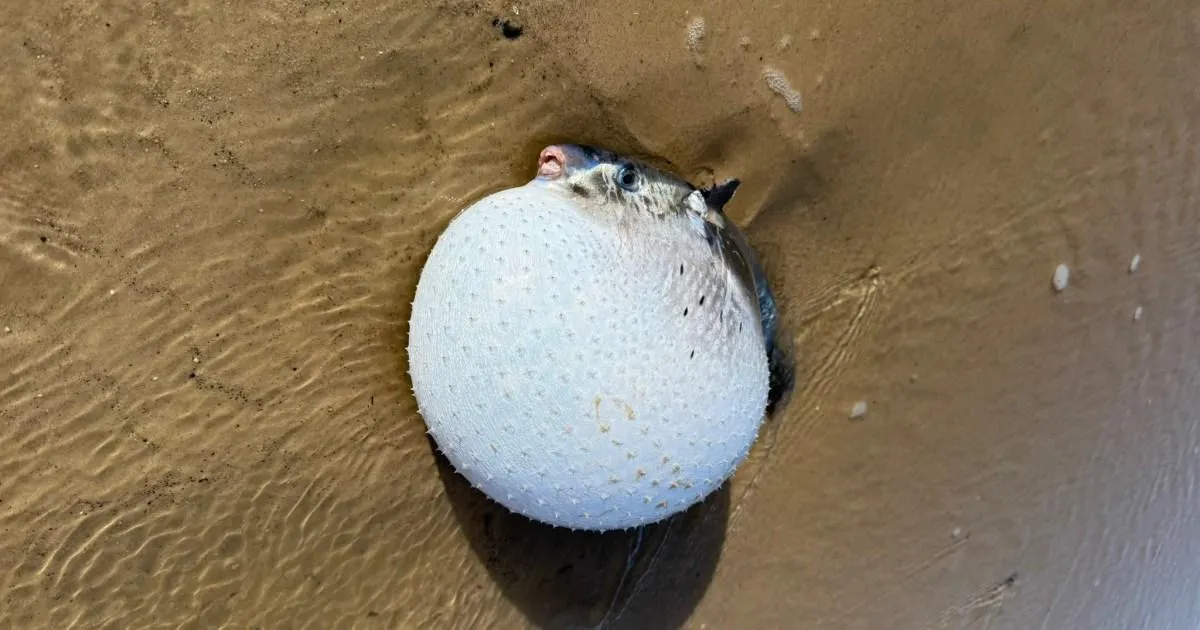
There’s a special kind of quiet that settles on a beach after a storm. The wind has dropped, the waves are tired, and the tide leaves behind a jumble of seaweed, driftwood, and strange things from the deep. It was on just such a morning that Owen Booty, a local diver from Studland, Dorset, went down to Knoll Beach to clear his head and see what the sea had brought in. The sky was still grey, the sand was cold, and the air smelled of salt and wet stones. A few gulls called overhead. Then something caught his eye. It looked like a crumpled plastic bag, half buried in the sand, the kind of thing that makes you sigh and think about litter. But as he walked closer, he realized it was not a bag at all. It was round, pale, and covered in small spines. It was a pufferfish — a creature that belongs to the warm, open waters of the Atlantic, Indian and Pacific oceans, not to the south coast of England. The fish was dead, but no less remarkable for it. In fact, its presence was a small mystery. After Storms Austen and Boelo battered much of the UK, rough seas had apparently carried this tropical traveller hundreds of miles off course and left it on an ordinary English beach, far from everything it knew. For a creature so associated with warm coral reefs and exotic markets, it was a strange and slightly sad sight: a little piece of the tropics, washed up on a cold, windswept shore, miles from home.
For Owen, who spends much of his life under the water and has learned to appreciate the rich marine life that lives right on the Dorset doorstep, the discovery was a complete surprise. “We’re fortunate to have some fantastic marine life right on our doorstep,” he said afterward. “But despite all the time I’ve spent diving locally, I certainly wasn’t expecting to find a pufferfish washed up on the beach.” He had a good idea what it was, but he didn’t want to rely on guesswork. So he took photographs and sent them to the Dorset Wildlife Trust, and also to a friend who works as a marine biologist, to confirm his identification. The answer came back quickly: yes, it was definitely a pufferfish. The Dorset Wildlife Trust confirmed that these fish are a rare sight in the UK, but they do turn up occasionally. “Usually found in open water in the warmer parts of the Atlantic as well as the Indian and Pacific oceans, these fish are a rare sight in the UK, but they do turn up occasionally,” a spokesperson said. The trust also took the opportunity to offer a clear warning to anyone who might come across a similar creature: do not touch it. Pufferfish are not simply odd to look at; they can be dangerous. If you find one, the trust advised, leave it alone and report it to the charity instead. For Owen, the whole experience was a reminder that even a beach he thought he knew intimately could still offer something he had never seen before. He walked away with a strange story to tell and a renewed sense of wonder at the ocean’s unpredictable, endlessly surprising nature.
It is almost impossible to know exactly what happened to this particular pufferfish. It may have been swept up in a current, confused by changing water temperatures, or simply unlucky enough to be in the wrong place when the storms hit. The UK has experienced more frequent spells of rough weather in recent years, and warm-water species are occasionally found further north than they should be. But this fish was not just a little outside its usual range; it was hundreds of miles from anywhere it would normally call home. Pufferfish are not built for long journeys along a rocky, windswept coastline. They are slow swimmers, more comfortable drifting in warm currents than fighting through cold, churning seas. When the storms arrived, the sea became violent, and the fish was likely carried along by forces far stronger than itself. By the time it reached Knoll Beach, it was exhausted and dead. It lay there like a strange, silent witness to the power of weather and the hidden movements of the ocean. For those who found it, the pufferfish was more than just a curiosity. It was a reminder that the sea is always moving, always mixing, and that even the most familiar shores can receive visitors from far away. Maybe, in a changing climate, such sightings will become less rare. But for now, a pufferfish on a Dorset beach is still a remarkable thing, and one that raises quiet questions about how the natural world is shifting all around us.
The pufferfish gets its name from one of nature’s most curious defence mechanisms. When it senses danger, it rapidly fills its stomach with water — and sometimes air — until it balloons into a round, spiky ball that is difficult for predators to swallow. This inflation is not just for show. The fish’s skin is covered with tiny spines that stand on end when it puffs up, making it an unappealing mouthful. But the real danger lies in what is hidden inside. Pufferfish contain tetrodotoxin, a potent poison that can be lethal to humans. If the spines pierce someone’s skin, the toxin can enter the bloodstream and cause serious illness or even death. It is not the kind of creature you want to pick up out of curiosity. Despite their cute name and comical appearance, pufferfish are among the most poisonous animals in the ocean. The toxin is found in their skin, organs, and sometimes their flesh, and there is no known antidote. For a small fish, it carries an enormous amount of chemical protection. This is why the Dorset Wildlife Trust was so quick to tell people not to handle any pufferfish they find. A dead fish can still be dangerous, and the spines are sharp enough to pierce human skin. On a cold beach, with the wind blowing and the tide retreating, it might have been easy to mistake it for a piece of litter. But picking it up would have been a very bad idea.
In some cultures, this danger has not stopped people from eating pufferfish. In Japan, it is known as fugu, and it is considered a luxury dish. Highly trained chefs spend years learning how to remove the toxic parts so carefully that the remaining meat is safe to eat. It is a delicacy that carries an element of risk, and part of the thrill is the knowledge that a tiny mistake could be fatal. Pufferfish are also eaten in other parts of East Asia, where they are prepared with great care and respect. But for an ordinary beachgoer in Dorset, there is no need to take such risks. The message from the Dorset Wildlife Trust is simple: do not touch. If you see a pufferfish, or any other unusual marine animal, leave it where it is and report it to the charity. This helps scientists to track unusual sightings, understand how ocean currents are changing, and protect both people and wildlife. It also allows experts to identify whether a fish arrived naturally or whether something odd is happening below the waves. There is something strangely beautiful about the idea of a pufferfish washing up on a British beach. It is a tiny piece of a faraway world, carried to our shores by wind and weather. But beauty can be dangerous, and this particular traveller was best admired from a distance. Owen Booty did the right thing: he looked, he photographed, he reported, and he left the fish alone. His discovery became a reminder of how much we still have to learn about the ocean and its inhabitants.
In the end, the pufferfish found on Knoll Beach was a small but powerful symbol of the unexpected. It had travelled hundreds of miles, through storms and cold currents, only to end up on a stretch of sand where the only pufferfish anyone expected to see was on a television screen or in a fish market. For Owen, the moment was not just about the fish itself, but about the way it made him see the familiar beach differently. “We’re fortunate to have some fantastic marine life right on our doorstep,” he said, and he was right. The waters around the UK are full of dolphins, seals, seabirds, and countless other creatures that we often forget about as we walk along the shore. But every now and then, the sea sends us a visitor that reminds us how connected our small island is to the wider world. The pufferfish may have been dead, but its presence was alive with questions. How did it get here? What else might be coming next? And what does it mean for the health of our oceans? As the tide came in and the beach began to disappear under the waves, the pufferfish was probably covered by water, claimed once more by the sea that brought it. But the story of its strange journey will stay with those who saw it, and with anyone who hears about it. It is a quiet, slightly melancholy tale of a creature far from home, but it is also a reminder of the endlessly surprising nature of the natural world. We should all be a little more curious, a little more careful, and a little more grateful for the strange and wonderful things that wash up on our shores.