
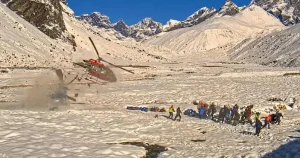

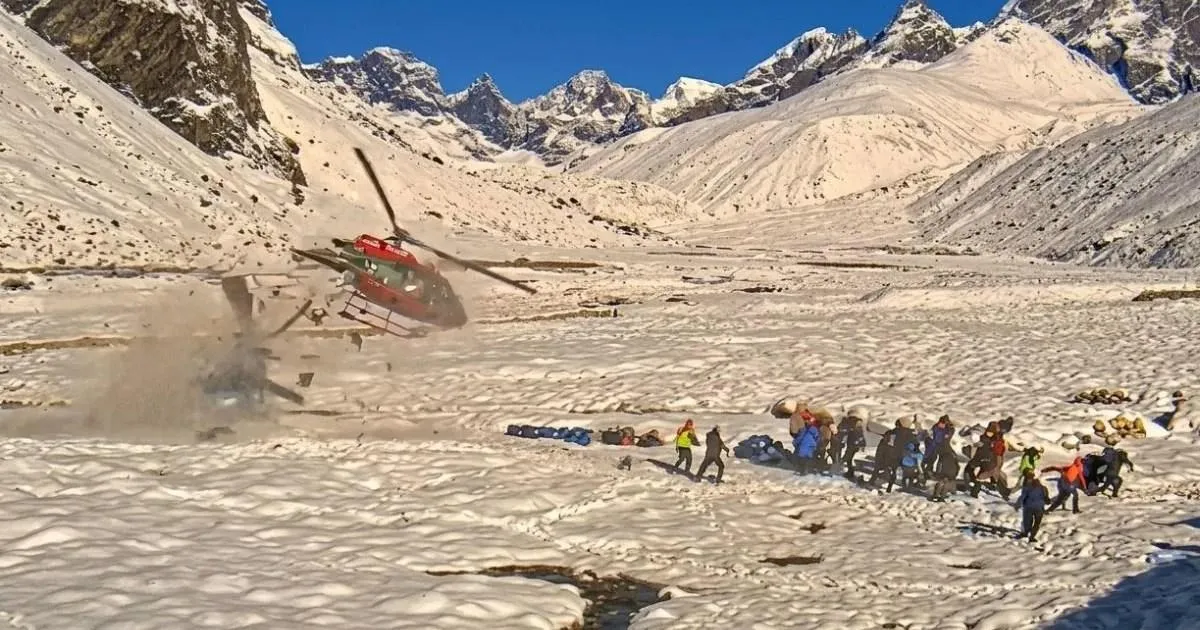
High in the Himalaya, in the thin, cold air of Nepal’s Solukhumbu district, a morning of adventure turned into a moment of horror. It was just after 8am local time, with the sun beginning to spill over the great peaks, when two helicopters descended toward a small helipad at Pheriche, a remote settlement on the path to Mount Everest. The helipad, tucked into a narrow passage at the foot of the world’s tallest mountain, is a familiar sight for trekkers, climbers, and local guides. On this morning, a crowd had gathered nearby, some preparing for treks, others waiting to fly out. They watched as the two aircraft, one blue-and-white, one red, circled low over the snowy ground, their rotors kicking up ice and wind. The plan must have been simple: land, exchange passengers, and move on. But in a few terrible seconds, the plan disintegrated. The helicopters touched each other in mid-air. The blue-and-white aircraft’s rotor struck the other fuselage, and it plunged to the ground, landing upright but wrecked. The red helicopter followed, crashing onto its side with its rotor blade digging into the ice. Onlookers screamed and scattered, running for safety as the blades sliced through the frozen surface. When the noise finally stopped, the horror became clear. A tourist was dead, another passenger was injured, and the pilots, though alive, were hurt. The event, captured on video and witnessed by dozens of people, would be replayed around the world. But for those standing in the cold that morning, it was not footage. It was a nightmare unfolding in front of their eyes, a reminder that even the most carefully managed journeys can end in catastrophe.
The video of the crash is the kind of footage that stays with you. It shows the two helicopters approaching the landing zone in the shadow of Everest, barely above the ground, their engines humming as they search for the right position. The landing area is nothing more than a clearing in the high-altitude valley, surrounded by unforgiving terrain. The helicopter pilots were working in conditions that would challenge anyone: thin air, shifting winds, and the pressure of a busy morning with people waiting on the ground. In the clip, the aircraft appear to be moving in a slow, delicate ballet, but the dance goes horribly wrong. The blue-and-white helicopter’s rotor clips the body of the red aircraft, and in that instant, the laws of flight turn against them. The blue-and-white machine falls hard, hitting the snow with a jolt that must have rattled every bone inside. It somehow stays upright, but it is clearly damaged. The red helicopter crashes onto its side, and its rotor blade carves a groove into the ice as onlookers flee. The human reaction is visceral: people run, their arms raised, their bodies reacting before their minds can process what they have just seen. The video does not capture the smell of fuel, the sound of crying, or the cold wind that suddenly feels sharper and more dangerous. But you can imagine it. You can imagine the climbers and hikers who had come to this place to experience wonder, only to find themselves witnessing death. The crash was not on a distant mountain face, not in some hidden crevasse, but right there in front of them, in a place where they had stood moments before, waiting for a photo or a ride. In a way, the shock was shared by everyone who watched, even through a screen. It is impossible not to feel the weight of that moment, the sudden fragility of life in a landscape so vast and indifferent.
The victim has been identified as Vasanth Kumar Balaramaramadu, a 47-year-old tourist from Chennai in southern India. He had travelled far from the warmth and noise of the city to the frozen heights of the Himalaya, leaving behind a world of color and rhythm for a landscape of white silence. It is heartbreaking to think of him as a passenger on that helicopter, perhaps excited, perhaps nervous, looking out at the mountains and glaciers one last time. His death is not just a statistic in a news report; it is a family torn apart, friends who will gather in shock, a home that will feel empty. The other passenger, a 49-year-old man from New Zealand, was injured in the crash. He survived, but his life will be changed forever. He will carry the memory of the impact, the pain of his injuries, and the deep awareness that he came within seconds of losing everything. The pilots of both helicopters, their names not released, were also hurt, though their injuries were described as minor. They were taken to Kathmandu, the capital, for treatment, leaving behind a scene of wreckage and unanswered questions. In the hours after the crash, Nepali police and rescue teams worked quickly to recover the dead and care for the living. The mountain community is small, and news travels fast. Local people who live in the shadow of Everest understand risk better than most; they know that every flight, every step on a glacier, every turn of a rotor blade carries a chance of disaster. But understanding risk does not make grief any easier. It only makes it more real, more intimate, more woven into the fabric of life in this extraordinary and unforgiving place.
The accident occurred at the Pheriche helipad, located in Ward 4 of the Khumbu Pasang Lhamu Rural Municipality, a narrow stretch of land lying directly beneath the immense presence of Mount Everest. This is not a large airport with control towers and long runways. It is a high-altitude strip of ground, often covered in snow, surrounded by steep slopes and glacial moraine, where pilots must rely on skill, experience, and a bit of luck. The helicopters involved were operated by Fishtail Air and Air Dynasty, two companies known for flying in the Everest region. They were attempting to land at the same time, in the same small clearance, in what appears to have been a tragic failure of coordination. In such tight conditions, with little room for error, the margin between a safe landing and a disaster is measured in meters and seconds. The popularity of the region only adds to the pressure. Every year, up to 60,000 people trek to Everest Base Camp, a number that continues to grow. The Sagarmatha National Park, which surrounds the area, welcomes more than 100,000 visitors each season. The busiest months are April and May, and again in October and November, when the skies are clear and the weather is relatively stable. These are also the months when the air is filled with helicopters ferrying supplies, rescue teams, and tourists. For many visitors, a helicopter ride is the highlight of their trip, a chance to see the world’s highest mountain from the air. But the very thing that makes it magical—flying close to the peaks, landing in remote villages—also makes it dangerous. The crash at Pheriche is a stark reminder that the Himalaya demand respect, and that no amount of technology or experience can guarantee safety.
In the aftermath, the focus shifted to rescue and investigation. The injured New Zealand man was rushed to medical care, and the pilots were evacuated to Kathmandu for treatment. The body of the Indian tourist was recovered, and Nepali authorities began the difficult task of notifying his family. For the local community, the crash was both a tragedy and a call to action. Rescuers moved quickly, doing their jobs in freezing temperatures, carrying the wounded away from the wreckage. The two helicopters lay damaged on the snow, their rotors bent and broken, a silent testament to the violence of the impact. Questions will now be asked about how two experienced pilots could collide in an open area. Investigators will study the video, examine the weather conditions, and look into the procedures used by both helicopter companies. There may be changes to landing protocols, stricter rules about separation, or new restrictions on when and how helicopters can approach the same pad. But no investigation can undo what happened. A man from Chennai will never go home. A traveler from New Zealand will live with memories he cannot erase. The pilots will replay that split second over and over in their minds, wondering if there was something they could have done differently. And the trekkers who were standing there, watching the helicopters come in, will carry the images with them for the rest of their lives. They came to the Everest region to be challenged, to see beauty, to test themselves. They did not expect to see death. The mountain, which is the source of so much wonder, can also be a source of profound sorrow, and this crash is one of those moments when the beauty and the brutality of the Himalaya are impossible to separate.
The crash near Everest Base Camp is more than just an accident in a remote corner of the world. It is a human story, made of grief, survival, and resilience. It reminds us that the places we love for their grandeur and majesty are also places of immense risk. Every year, tens of thousands of people travel to the mountains to stand at the foot of Everest, to breathe its air, to test their own limits. They do so because the mountains inspire something deep in the human spirit, a desire to confront the vastness of nature and come away changed. But the mountains are indifferent. They do not care about our plans, our timelines, or our dreams. They simply are. The two helicopters crashed in front of onlookers, in a place where so many personal stories begin. Now, one of those stories has ended, and another has been permanently altered. The survivors, the rescue workers, the families, and the community all have to find a way to go on. They will do so because that is what people do. The wreckage will be cleared, the helicopters will eventually fly again, and the trekkers will continue to come. But on that patch of snow, near the helipad at Pheriche, something important was lost. A life. A sense of safety. A certain innocence about the magic of the mountains. The rest of the world will move on, distracted by other stories and other headlines. But for those involved, the memory of this disaster will remain, etched into their hearts as deeply as the mountains are etched into the sky. The best way to honor the dead is to remember them, to learn from what happened, and to work toward a future where the skies above Everest are a little safer for everyone who travels there.