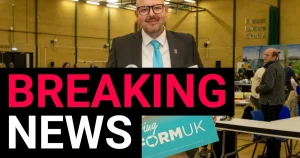


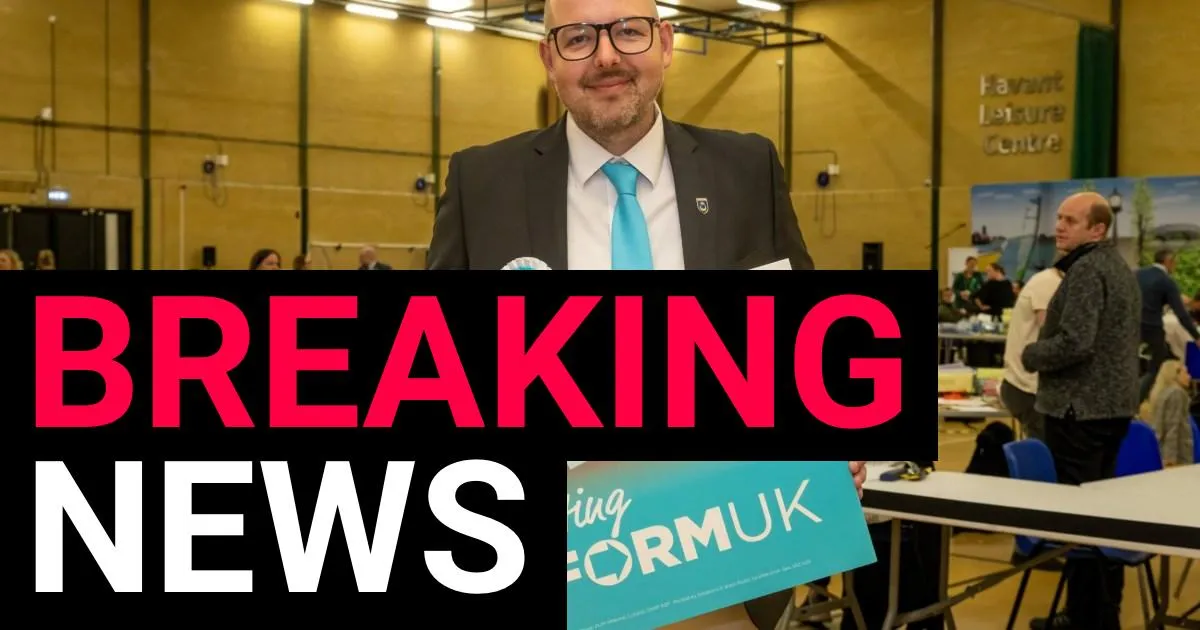
George Madgwick, a 37-year-old Reform UK councillor known for his loud and visible presence in Hampshire politics, is set to appear before Portsmouth Magistrates’ Court on Wednesday to face charges that have sent shockwaves through the local political scene. The charges are staggering in both their number and their nature. Madgwick has been charged with 35 offences, including 12 counts of rape, alongside multiple accusations of sexual assault, making and distributing indecent images of a child, and a range of other serious crimes. The charges follow an investigation by Hampshire and Isle of Wight Constabulary that involved four complainants, all of whom were 16 or 17 years old at the time of the alleged offending. For a man who had become a familiar face through protests and political campaigning, the news has landed like a thunderbolt. The man who once posed with Nigel Farage and spoke passionately about immigration and national identity now stands accused of some of the most serious offences that can be brought against a person in English law. The contrast between his public persona and the private allegations could hardly be more jarring, and the months ahead will be defined by a legal process that will examine every detail of the accusations.
To understand the gravity of the situation, it is necessary to look at the full breadth of the charges against him. Madgwick faces 12 counts of rape, which alone would mark this as an exceptionally serious case. But the list does not stop there. He has also been charged with eight counts of actual bodily harm, two counts of assault by penetration, two counts of sexual assault, and two counts of controlling and coercive behaviour. In addition, he is accused of making indecent images of a child in two separate instances and distributing an indecent image of a child in one instance. There is also one count of stalking, one count of making a threat to kill, one count of false imprisonment, one count of criminal damage, one count of theft, and one count of causing or inciting the sexual exploitation of a child. The alleged offences are said to have taken place between 2008 and 2021, a lengthy timeframe that points to a complex and deeply troubling investigation. The fact that the complainants were all teenagers when the alleged abuse occurred adds another layer of gravity to the proceedings. These are not minor or ambiguous allegations; they are detailed accusations that will require careful scrutiny in a courtroom. For the four people at the centre of the investigation, the decision by the Crown Prosecution Service to charge Madgwick will have been the result of months, perhaps years, of waiting and hoping that their testimony would be taken seriously.
The political fallout was immediate. Reform UK, the party Madgwick represented, moved quickly to distance itself from him. A spokesman for the party said: “Cllr Madgwick has been suspended from Reform UK with immediate effect.” That statement was short, clinical, and unequivocal. But Madgwick himself has not simply disappeared from public view. In a message posted on X, formerly Twitter, he announced that he had resigned as Reform UK leader for Hampshire Council and made clear that he intends to fight the charges. He wrote: “I am shocked and dismayed at the charges brought against me. Whilst the charges are extremely serious, I will say unequivocally that I am innocent of the allegations against me. Due process must take its course and the legal process must be followed without hindrance. I considered it responsible to resign as Reform UK leader in Hampshire Council and I will continue as an independent until I’m cleared. I will not make any further statement now, or in the future, on this in any capacity. I will deactivate my social media shortly until due process has concluded.” Those words carry the weight of a man who knows his life has been turned upside down, yet who is determined to maintain his innocence publicly. Whether that claim of innocence will withstand the scrutiny of a trial remains to be seen, but for now, he is entitled to the full protection of the law and the presumption of innocence that underpins the British justice system.
The Crown Prosecution Service has also released a statement explaining why the case has been brought. A spokesperson said: “The Crown Prosecution Service has decided to prosecute George Madgwick for serious sexual offences, including multiple counts of rape. He has also been charged with making a threat to kill, false imprisonment and stalking. Our prosecutors have worked to establish that there is sufficient evidence and that it is in the public interest to bring the case to court. We remind all concerned that proceedings against the defendant are now active and that he has the right to a fair trial. There should be no reporting, commentary or sharing of information which could in anyway prejudice these proceedings.” That final warning is not simply legal boilerplate. It is a reminder that, in the age of social media, public opinion can easily spiral out of control and influence the outcome of a case before a jury has even heard the evidence. The full list of charges against Madgwick is as follows: 12 counts of rape; eight counts of actual bodily harm; two counts of assault by penetration; two counts of sexual assault; two counts of controlling and coercive behaviour; two counts of making an indecent image of a child; one count of distribution of an indecent image of a child; one count of stalking; one count of threats to kill; one count of false imprisonment; one count of criminal damage; one count of theft; and one count of causing or inciting the sexual exploitation of a child. Each of these charges will have to be considered individually by the court, and Madgwick will have the opportunity to respond to each one through his legal team.
The context of Madgwick’s public life makes the case all the more striking. Until recently, he was an active campaigner on social media, frequently posting about his work for Reform UK and boasting about knocking on thousands of doors for the party. He was involved in organising protests against migrant landings in Gosport, a role that placed him at the centre of a heated national debate about immigration. Photographs show him alongside Zia Yusuf, Reform UK’s Home Affairs Spokesperson, in the aftermath of those protests, standing with the kind of righteous indignation that has become characteristic of the party’s street-level activism. He was also involved in promoting protests against Wetherspoons during a row over poppies, a story that seemed to capture a certain kind of political culture: loud, symbolic, and unapologetically confrontational. In March, he was pictured with Nigel Farage at The Wellington pub in Portsmouth, giving the former UKIP leader a tour and basking in the reflected glory of a man who has done more than anyone to reshape British politics over the past decade. For anyone who had followed his career, Madgwick appeared to be a rising figure in the movement, someone willing to put in the hours on the ground and take the fight to whoever he saw as the enemy. That image has now been shattered, replaced by a far darker narrative that will be played out in the courts.
What happens next will be determined not by political affiliation, but by the evidence. The case against Madgwick is now active, and the justice system will move at its own pace. There will be hearings, legal arguments, and eventually, if the case proceeds, a trial in which a jury will have to decide whether the charges have been proven beyond reasonable doubt. For the complainants, the coming months will be gruelling. They will be asked to relive traumatic experiences, to give evidence in front of strangers, and to submit themselves to cross-examination. For Madgwick, too, the process will be punishing, regardless of the outcome. His career, as it stood, is effectively over in the short term; even if he is acquitted, the stain of such serious allegations may never fully wash away. The case also raises uncomfortable questions for the political party that welcomed him into its ranks. Reform UK has positioned itself as a party of law and order, and its swift suspension of Madgwick shows an awareness of the reputational danger. But the deeper lesson is more human. People are not simply the sum of their public appearances. A man can stand beside national leaders, speak passionately about causes, and still be accused of terrible things in private. The law demands that those accusations be examined fairly and without prejudice, and that the accused be given the chance to defend himself. In the end, the courtroom is the only place where the truth can be established. Until then, both Madgwick and his accusers must live in the strange, suspended state that exists when a case this serious is awaiting trial. The public, meanwhile, is asked to reserve judgment. That is not always easy, especially when the allegations are so disturbing, but it is the foundation upon which justice is built. For now, George Madgwick is presumed innocent. The coming weeks and months will reveal whether that presumption can survive the weight of the evidence against him.