

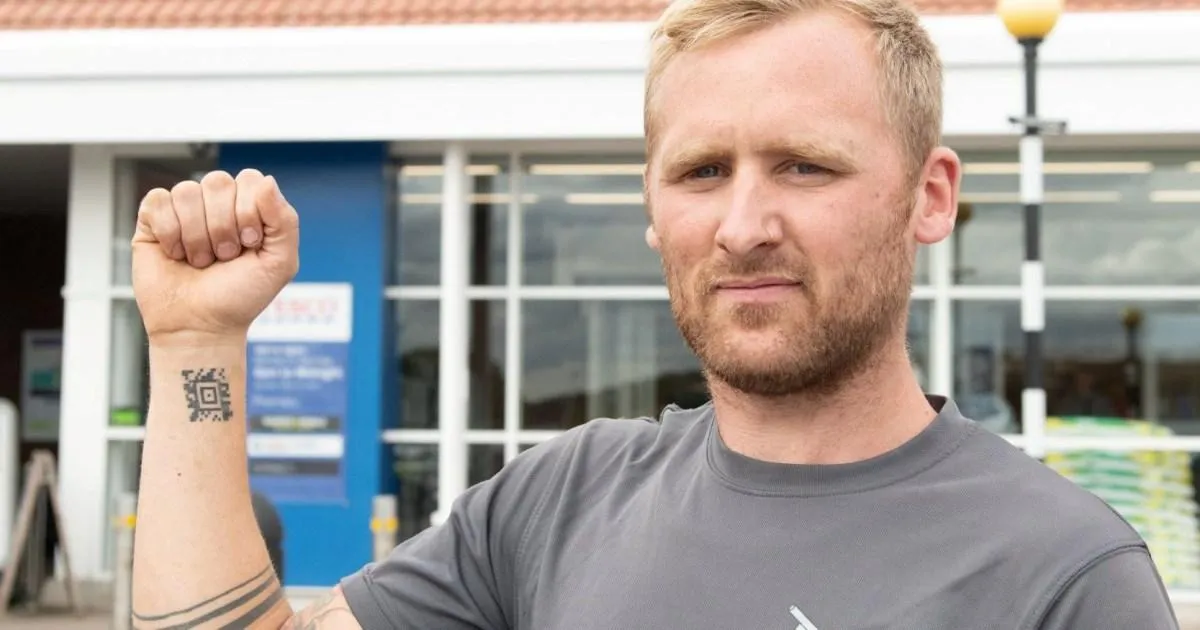
Some people mark life’s big moments with tattoos: a child’s name, a lost parent, a line from a song that carried them through hard times. Dean Mayhew, a 34-year-old father of three from Bideford, chose something different. He had his Tesco Clubcard QR code tattooed on his right forearm in July 2022, after months of thinking about it. The idea was born out of a common supermarket annoyance: he kept forgetting his loyalty card. Again and again, he watched his total climb because he couldn’t lay his hands on the little piece of plastic that would have cut the price. It was frustrating, a small but persistent irritation that seemed to follow him to the checkout. Then one day he looked at the Clubcard in his wallet and saw not a card but a code. If he could scan that code, he would never need to remember the card again. The thought sat with him for months, half-joke, half-plan, until he finally booked an appointment at A Star Tattoo in Chessington, Surrey. He still remembers the feeling of walking out with the ink on his skin. It was a strange kind of freedom. The next time he stood in front of a cashier at his nearest Tesco, he held out his arm and asked to be scanned. The cashier didn’t believe it at first. She looked at his arm, then at his face, then back at the tattoo. “Sometimes when I go in there, the cashier doesn’t believe it’s real,” he later said. “I have to tell them, ‘Just scan it, please!’ and they’re shocked.” It worked. The scanner beeped, the discount appeared, and Mayhew knew that his peculiar experiment in permanent loyalty had paid off. At that moment, it must have felt as though he had cracked the code of modern grocery shopping. He had made a loyalty scheme part of his own body, a tiny piece of supermarket branding fused with his skin, and it was saving him money. But that feeling, the sense of having won some small victory over the checkout, would not survive the changing economics of the following years. The man who had made Tesco a permanent part of his body would eventually find himself wondering whether Tesco deserved the honour.
At first, Mayhew enjoyed the novelty. He would walk into the supermarket, roll up his sleeve, and watch the reaction unfold. Other shoppers would stare, cashiers would call colleagues over, and someone would always ask whether it actually worked. Yes, he would say, with a grin, and stand aside so they could watch him use his arm to buy his groceries. For a while, the tattoo was a source of pure fun, a party trick that also happened to be genuinely useful. But fun has a way of fading when every weekly shop turns into a battle with the budget. Mayhew began to notice that the savings offered by his Clubcard were not what they once were. The prices on the shelves seemed to rise faster than the discounts could keep up, and the so-called Clubcard deals, the special prices reserved for members, no longer felt like rewards. They appeared, to him, like a way of making shoppers think they were getting a bargain while the store quietly moved its stock. “I don’t even shop at Tesco anymore, they’re a rip off,” he said. Even a modest midweek shop, just a few days’ worth of food for him and his family, was costing around £200. That is a huge sum for any household, let alone a family with three children. The maths no longer made sense. He could go to Morrisons or Asda, walk down the same aisles, pick up similar items and pay less. It was as simple as that. He began comparing receipts in his head, not out of obsession but out of necessity. When you have three children, the weekly food shop is not a lifestyle choice; it is a fixed cost that has to be managed. Every pound saved is a pound that can be spent elsewhere, and when the savings stopped happening, the equation changed. It wasn’t that he wanted to leave Tesco. It was that Tesco, in his eyes, had left him first. So, after more than a year of staying away, he stopped pretending. Tesco was no longer his supermarket. It was just a place he used to go, and the tattoo on his arm, once a badge of commitment, had become something more awkward—a reminder that even the cleverest idea can be overtaken by reality.
Mayhew’s experience fits into a wider pattern. Shoppers across Britain have been reappraising their supermarket loyalties as food prices remain stubbornly high. The days when you simply went to the same store every week because that was where you had always gone are fading. Now the rituals of daily life are more consciously measured. Research by Which? looked at 93 common supermarket items across eight of the country’s most popular chains and found a significant gap between the cost of the same basket of goods at different retailers. For an average weekly shop, Asda was the value option, totalling £186.71. At Tesco, the same items came to £193.45 without a Clubcard. The famous loyalty card, the very card Mayhew had inked into his arm, could bring the total down to £187.71—still slightly more than Asda. A difference of one pound and a few pence might not sound dramatic, but over a month it is nearly five pounds, and over a year it becomes a sum that matters. For many families, choosing the right supermarket is now one of their most important financial decisions, a small decision made once a week that quietly shapes how far their pay packet reaches. The fact that a loyalty card could not quite match the competitor’s ordinary prices says something about how supermarket pricing strategies have changed. The real price, the price a store asks from anyone without its card, has become less a headline and more a fiction. The card is no longer a thank-you for loyalty; it is the key to the actual price, while non-members are left paying something closer to a penalty. This was the market Mayhew was navigating. His tattoo, once a neat shortcut to the lower price, now seemed to speak to a different era. He had made a permanent decision based on a temporary mood in the economy. It happened to many people, in less visible ways, every time they signed up for a contract or chose an energy tariff or picked a mortgage deal. The difference is that Mayhew’s decision was written in ink.
Yet the tattoo has not lost all its usefulness. In fact, it still earns its place in Mayhew’s life in small, practical ways. On his lunch break, he will sometimes stop at a Tesco, grab a meal deal—a sandwich, a drink, a bag of crisps—and let the scanner read the QR code on his arm. “No one can complain about a meal deal, you know, £3.50 for a drink, crisps and sandwich. I use it for that,” he said. There is a lightness in that, a sense that the supermarket may have lost his weekly custom but has not entirely lost his custom. The tattoo remains part of his daily routine, not because he believes in Tesco anymore, but because it still gives him a small discount on an affordable treat. It also still gives him something else: a story. The tattoo is the kind of thing people notice, and when they notice, they ask questions. He tells them how he got it, why he got it, and whether it was painful. He tells them about the cashiers who refuse to believe it is real. He tells them about the beep of the scanner and the look of disbelief on people’s faces. It is, as he said, “just a laugh.” He has no regrets, even though the supermarket he once declared loyalty to has fallen out of favour. “It’s in the past, you know. And it’s a conversation starter. It’s just a laugh, isn’t it?” There is a maturity in that attitude, a refusal to let a decision made in one moment poison the rest of his life. Permanent does not always mean serious. Some of the most important things in life can be approached with a sense of humour. He occasionally looks at his forearm and tries to remember what he was thinking when he chose this permanent reminder of a supermarket loyalty scheme. He doesn’t feel embarrassed. He doesn’t feel the need to justify it. It simply is what it is: a curious mark on a body that has lived a little, a bit of youthful whimsy that has aged into something more interesting. In a culture that tends to demand regret for any choice that doesn’t age perfectly, Mayhew offers a refreshing alternative. A bad decision, if it is honest and funny and memorable, can become a good story.
His switch away from Tesco is not a dramatic act of protest. There is no boycott, no angry letter, no campaign. It is simply a quiet calculation, repeated every week, about where the food money will go furthest. In that way, it reflects something larger about the relationship between British shoppers and the supermarkets they have been loyal to for decades. Loyalty cards were originally sold as a way of rewarding regular customers. In return for giving supermarkets their data, customers received discounts, vouchers and points. Over time, the system became more complicated. Prices for cardholders differ from prices for non-cardholders, and the gap has become so normal that few people question it. But when the cost of living rises, shoppers start to look more carefully at the bottom of the receipt. They start to compare, and they start to notice that a loyalty card is not automatically the cheapest option. Mayhew noticed exactly that. By switching to Morrisons or Asda, he could shave enough off his weekly shop to make a difference to his family’s budget. The choice was not ideological. It was practical. Nor is it unique. Many shoppers are now mixing and matching supermarkets, buying the cheapest items wherever they happen to be, rather than tying themselves to one brand. The supermarket that wants your loyalty has to earn it, every single shop, because the cost of living leaves no room for sentiment. In this environment, a loyalty card is just another factor in the calculation, not a reason to ignore the numbers. The advertising departments may still dream of customers like Mayhew, people willing to make the brand part of their identity, but the customers themselves have become harder to please and easier to lose. Only a few pounds separate one supermarket from another, but for a family like Mayhew’s, those pounds are not abstract. They are the difference between going to bed with a sense of security and staying awake worrying about the bills. Something as ordinary as a weekly shop has become one of the central arenas in which modern household budgets are won or lost. Shoppers know this. They have become experts at comparing prices, at mentally calculating the cost per kilogram, at spotting when a “discount” is really a way of shifting goods nobody wants. And when they find that the supermarket they trusted has stopped offering them a genuine deal, they leave. Not with anger, perhaps, but with a quiet sense of certainty. That is what happened to Mayhew. The man who once wore his loyalty on his skin now wears the knowledge that no brand should ever take that kind of devotion for granted.
Dean Mayhew’s tattoo is an extreme illustration of a universal truth: the business of buying food is deeply personal. It sits at the centre of family life, just as much as birthdays or school runs. It is where the abstract pressure of inflation becomes concrete. And it is where people learn, over time, what really matters to them. In the end, what matters is not a brand, not a colour, not a mascot, and not a card, no matter how many points it collects. What matters is being able to feed the people you love without feeling cheated. Mayhew has found a way to do that. He has lost none of his ability to laugh at the strange situation his tattoo has left him in. He may have drifted away from Tesco, but he has not become bitter towards it. The tattoo has become a historical document, a record of a particular moment in his life when a loyalty card seemed worth going under the needle for. He looks at it now and sees not a mistake but a memory. “It’s in the past,” he said. “And it’s a conversation starter. It’s just a laugh, isn’t it?” That sense of humour is perhaps the most human response to a difficult economic climate. Prices rise, loyalties shift, plans go awry. A shopping list changes. A supermarket misses out. But a person who can turn all of it into a story, who can hold out his arm to a stranger and invite them to scan his tattoo, has found a way to keep control of something much bigger than groceries. He has kept his sense of self. The ink will eventually fade, as all ink does. The QR code may one day become too worn to scan. The scanner may fail to read it, and the cashiers will no longer be shocked. But the story will remain, and the man will remain, and the lesson will remain: even in a world of complicated pricing and increasingly expensive supermarkets, you can choose where you put your money. You can choose where you go, and you can choose not to let your choices define you. Dean Mayhew made a permanent decision in 2022. It didn’t stand up forever. That’s okay. Some things were never meant to be forever.