

For Stephen and Anna Saunders, the Croatian island of Brač had promised a week of sun-bleached relaxation: a waterfront room at the four-star, all-inclusive Gava Waterman resort, cocktails by the sea, and long, unhurried dinners with friends. The couple had traveled from Rainham in Kent, arriving on September 7, and settled into the kind of holiday where the biggest decision was whether to lie by the pool or on the beach. There had been wildfires on the island for several days, but a guide had explained them away as a natural occurrence sparked by lightning strikes. Stephen remembered being told on Friday that the situation was under control, and that tourists had little to fear. Still, it was hard not to notice the ash that began to fall from an otherwise beautiful sky, or the strange orange glow that hovered over the hills after dark. On the evening of September 12, the couple went out to dinner with friends, and the distant unease became harder to dismiss. The orange glow was no longer vague; it was close, and ash was drifting into their drinks like an unwelcome seasoning. Anna, 52, described the moment with a kind of quiet disbelief, remembering the surreal mundanity of trying to enjoy a meal while the sky was slowly filling with smoke. The resort staff had reassured guests repeatedly that everything was fine, that the authorities had the blaze contained, but nature was about to rewrite that narrative in catastrophic and terrifying fashion. The holiday that was supposed to be a memory of golden afternoons and Adriatic breezes was about to become a memory of something far more primal: the desperate struggle to escape a wall of fire.
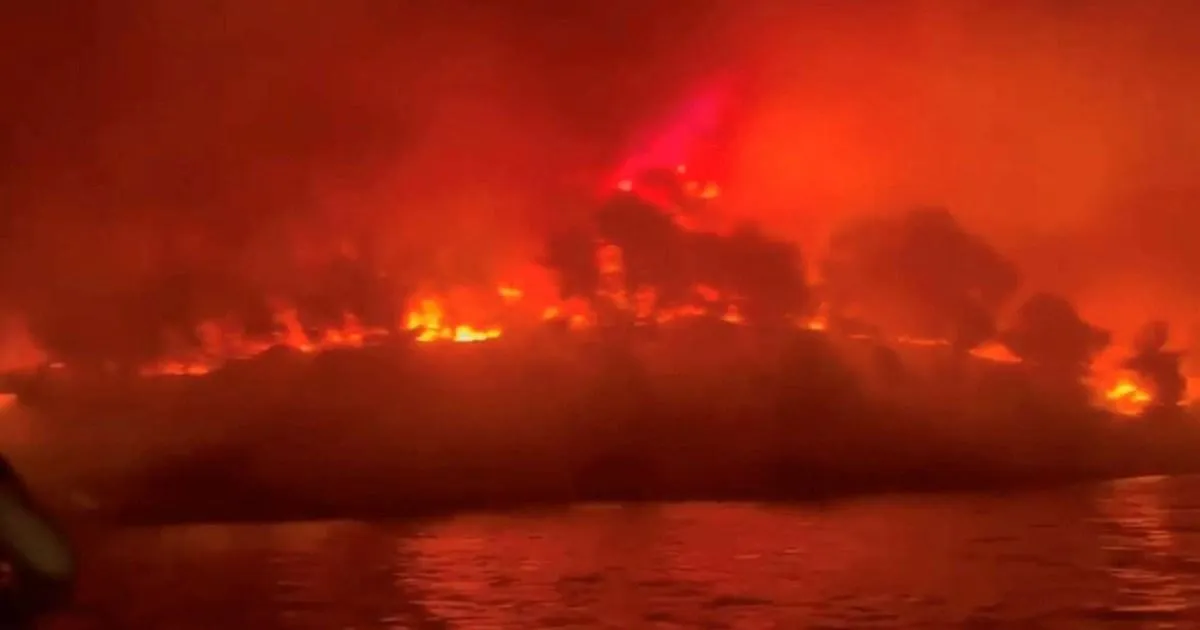
Just after 9:30pm, the power died at the hotel. In the sudden blackness, the gravity of the situation finally broke through the layer of reassurance. Anna and Stephen hurried back to their room and packed a small bag, half-ashamed and half-panicked, telling themselves it was just in case. But within minutes, a friend came with the kind of news that turns blood cold: the trees right next to the hotel were on fire. The embers were already blowing across the grounds, carried by a hot wind that seemed to be feeding the flames. Anna said she quickly changed her shoes and ran with her husband toward the sea, expecting to find staff, lights, some organized response. Instead, there was only darkness and the roar of fire. No one from the hotel was there to guide them. The fire was shooting across the hillside with terrifying speed, descending on the bay faster than anyone could have predicted, and the couple instinctively understood that the only place left to go was the water. They were not alone. Hundreds of other guests had reached the same conclusion, clustering onto wooden platforms and wading into the shallow sea as smoke and flames closed in around the cove. Anna remembered the terror in the crowd, the sheer number of people packed together on the platforms or standing waist-deep in the water, unable to do anything but watch the inferno advance. They were completely trapped, with no way off the beach, no escape route, and no one in charge. The smoke was thick enough to sting the eyes, the heat intense enough to feel like a physical weight, and burning embers rained down from above like a terrible, fiery hailstorm. It was, Anna said, absolutely terrifying. Families clung to each other, elderly guests struggled to breathe, and every instinct to run was met by the simple, awful fact that there was nowhere left to run.
Help eventually came from the sea. Firefighters arrived and began organizing a desperate maritime evacuation, while local boat owners—fishermen, sailors, ordinary residents of Brač—turned their vessels toward the bay without hesitation. Stephen estimated that around 50 boats came to rescue those trapped on the beach, and he praised them with an emotion that still trembled in his voice. Were it not for those firefighters and local people, he said, he did not know what would have happened. In the chaos, Stephen also found himself helping an elderly couple who had become stuck in the hotel’s automatic glass doors, a small moment of heroism in a night full of confusion. He described the terrible journey down the steep, dark resort path toward a rocky beach, with families, elderly guests, and disabled visitors all trying to find their way in the dark while the fire closed in behind them. There was no emergency lighting, no discernible evacuation route, and the reception desk was empty. Within minutes, the trees around the beach were burning, flames leaping above the heads of the terrified crowd. People were jumping into the sea, scrambling onto anything that floated, and trying to get away from the smoke. The couple was eventually moved to accommodation in Split in the early hours of Sunday morning—which happened to be Anna’s birthday. There could hardly have been a more surreal way to mark another year of life: sitting in a makeshift shelter, exhausted and smoke-stained, trying to process what they had survived. They returned home to Kent on September 14, but the danger had not ended when they left Croatian waters. Anna said she and her husband were not sleeping properly, that they would close their eyes and relive the whole night over and over. The trauma had burrowed into their minds, turning the holiday into a recurring nightmare. Stephen said their luggage was expected to be recovered, but other guests had lost everything, and he was planning to lodge a formal complaint with both the hotel and TUI, along with others who had shared the ordeal.
When Waterman Hotels and Resorts finally responded, its tone was careful and measured, acknowledging the obvious fright and trauma while pushing back against one specific accusation: that guests had been abandoned by the resort team. The spokesperson said they did not seek to diminish or challenge anyone’s individual experience, and recognized that the evacuation had unfolded differently for different people. They pointed to the resort’s layout, the sudden loss of electricity, the heavy smoke that made visibility nearly impossible, and the extraordinary speed with which the fire advanced. In such conditions, they argued, guests in different parts of the property naturally had different information and different experiences. But the hotel was adamant that their staff had not deserted their posts. Initially, the team had followed official instructions from authorities and emergency services, who had reportedly told them not to evacuate guests. Then, as conditions changed with what they described as extraordinary speed, an extreme shift in wind drove the fire directly toward the resort. The reception manager made the decision to activate the alarm and start the evacuation. Employees stayed to help guests navigate the chaos, and the final group of staff only left on the last boat, after establishing that the guests had gone. Other employees traveled through the fire itself to reach guests and colleagues. The hotel insisted that many guests had since sent messages of thanks, even as it conceded that not everyone had the same experience. With more than 360 guests spread across a large resort, no electricity, thick smoke, and a fire moving at exceptional speed, it was almost impossible, the spokesperson argued, for information and assistance to reach everyone at the same time. They said they understood some guests felt they lacked guidance in critical moments, and insisted those experiences were being taken seriously. But, they added, it was equally important to accurately represent the courage of the employees who remained and risked their own safety to help others.
The hotel’s statement went further, acknowledging the night as an “extraordinary emergency” in which conditions changed minute from minute. It described the courage and extraordinary efforts of firefighters and emergency services, the solidarity of local people who brought their boats to evacuate guests, and the commitment of their own employees as things that should not be called into question. These acts of bravery, the spokesperson said, were a source of profound gratitude and pride, and the main reason a far more tragic outcome had been avoided. At the same time, the company promised to examine its own actions with the same seriousness, conducting a detailed review of the night’s events, including procedures and communications, to identify lessons that needed to be learned. They acknowledged that Saturday night had been deeply traumatic for guests, employees, and the local community alike, but insisted that alongside that trauma, there was a story of extraordinary courage, solidarity, and the willingness of people to help one another in exceptionally dangerous circumstances. TUI UK also issued a statement, expressing sympathy for those affected, insisting that customer safety was their highest priority, and saying that local teams had been supporting impacted travelers while working closely with the hotel and local authorities. They thanked the emergency services for their response to a rapidly developing situation. For Stephen and Anna, though, statements and promises of review could not undo the memory of that night. The couple had not simply lost a few days of vacation; they had lost the sense of safety that makes a holiday feel like a holiday. The roar of the fire, the weight of the smoke, the sight of panic on the faces of strangers—these were now the souvenirs they carried home. And as they considered the formal complaint, they were not seeking to punish the hotel, but to make sure that no other family would have to stand in the dark, surrounded by flames, wondering if anyone was coming to save them.
To read the story of the Saunders and their fellow guests is to hold two truths at once. The first is that the night on Brač became a textbook case of a disaster moving faster than human systems could respond: a fire that had seemed like a distant concern becoming a living thing, racing down hillsides and swallowing the sky. The second is that, amid the panic and the failures of communication, there was also an outpouring of ordinary human decency that saved lives. The local boat owners did not wait for permission; they saw the flames and came. The firefighters did not have a perfect plan; they improvised, directing a marine rescue from a beach where the heat was unbearable. And even the hotel staff, whatever their initial missteps, eventually found themselves in dangerous conditions, guiding guests through blackened corridors and staying until the last boat was away. That does not erase the terror Anna described, nor the fact that she and her husband spent minutes thinking they might not survive. It does not console the family who lost their luggage, or the elderly guests who could not move quickly enough, or the anniversary of a birthday that will forever be tied to smoke and screams. But it does explain why, when Stephen speaks of the rescue, his voice fills with gratitude despite everything. The human heart is capable of holding both horror and thankfulness at the same time. Anna’s sleepless nights are a reminder that trauma is not rational; it does not care about legal responsibility, or official statements, or the fact that everyone got home safely in the end. Her mind is still on that platform, watching the flames, feeling the heat, hearing the desperate cries of people who had been laughing over cocktails only hours earlier. In the end, the true lesson of the Brač wildfire is not about blame, but about humility: the recognition that nature can outrun any reassurance, and that survival depends on the courage of ordinary people who choose to act when the moment demands it. For Stephen and Anna, that moment has become a part of them. They will likely return to normal routines, to work and daily life, but they will never quite shake the smell of smoke or the image of the sea filled with strangers clinging to hope. They were among the lucky ones. They got to come home. And perhaps, in sharing their story, they offer a warning and a testimony to the rest of us: that holiday paradise is fragile, that words like “under control” are only as strong as the wind that carries them, and that when the fires come, it is not the brochures or the booking confirmations that matter—it is the hands reaching out in the dark, the boats that appear from nowhere, and the stubborn human will to live.