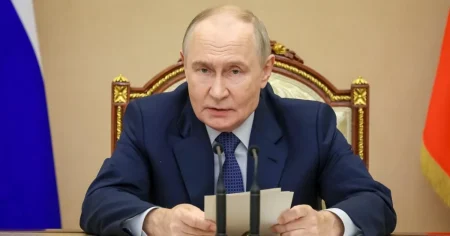


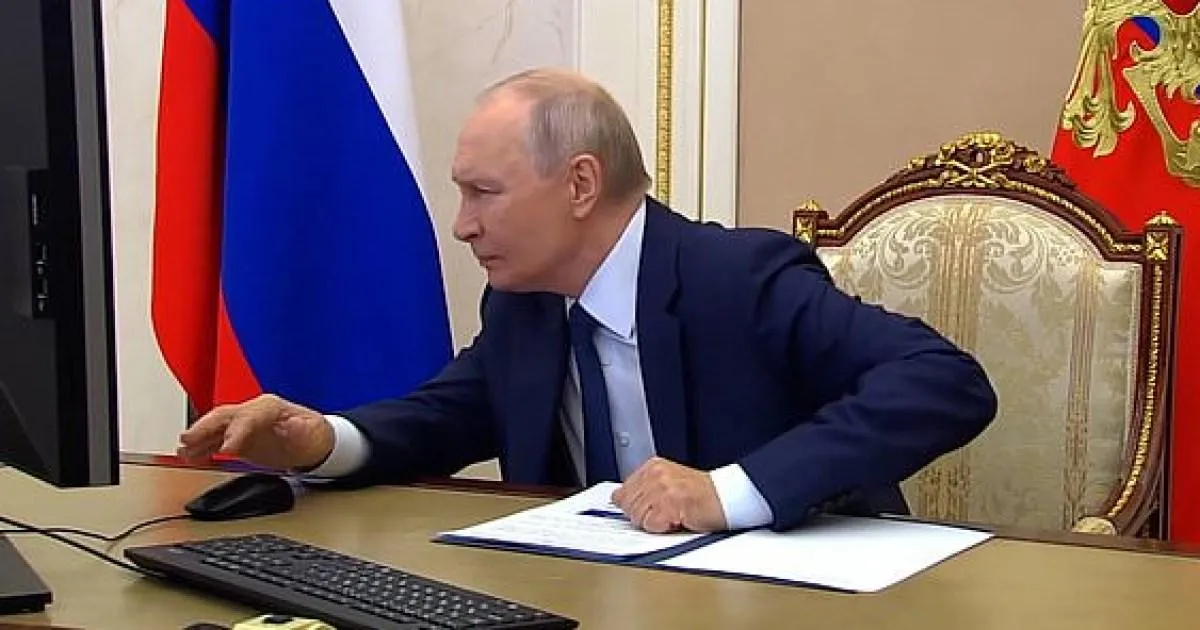
Most Vladimir Putin stories tend to be heavy with tension—talk of strikes, assassinations, and the constant drumbeat of war. But every once in a while, the Russian president gives the world something entirely unexpected: a moment of unintentional comedy. That is exactly what happened when Putin cast his vote online in Russia’s State Duma elections, which ran from September 18 to 20 and determine the makeup of the lower house of parliament. The footage of the 73-year-old leader attempting to navigate the digital voting system became an instant hit—not because of any political drama, but because of the painfully relatable way he handled a computer. There he was, the man who has rattled NATO and ordered invasions, sitting in front of a screen, squinting intensely at the monitor and struggling to control his mouse. At one point, he inches closer to the display, as if hoping that proximity will somehow make the interface more understandable. His left hand stays clenched in a fist on the desk, a small gesture of tension that made the whole scene feel less like a state function and more like a senior citizen trying to file a tax form online. When he finally completes the process, Putin allows himself a small, satisfied smile, nods approvingly at himself, closes his folder, and rises from the chair as though he has just conquered an extremely difficult digital mountain. It was a tiny, human moment—and the internet absolutely seized on it.
Social media did what social media does best: it turned the footage into a festival of memes, jokes, and affectionate mockery. The comments came thick and fast, each one finding a different angle on the president’s vintage approach to technology. One user, @GlushkoDenys, chimed in with a quip that mixed humor with a pointed political observation: “Could someone please activate the old man’s Windows? A nuclear power, and they still can’t afford a license.” That line captured the absurdity of the situation perfectly—here is a man who commands one of the world’s most formidable militaries, and yet he appears to be running an outdated, unlicensed operating system on his computer. Others focused on the hardware itself. @1_spp poked fun at what they called Putin’s “2008 Dell monitor,” while @SpHirinn remarked that the president looked like he had “never used a computer” in his life. The comparisons to everyday family moments were perhaps the most relatable of all. @MarioNawfal laughed, “Bro looks like my uncle playing Solitaire on Windows XP 🤣,” capturing the image of a middle-aged or older man squinting and straining at a screen, completely out of his depth. The jokes kept rolling: @stuartgurba branded him “Grandpa Putin,” while @DusanAcimCoder wryly noted that they couldn’t wait for people to start editing the footage into something else entirely—turning the voting moment into a video game session or some other fictional activity. This flood of humor did more than just mock the Russian leader; it humanized him in a way that state media never could. For a few hours, he wasn’t the feared autocrat who sends tanks across borders. He was just an old man struggling with technology, no different from countless grandparents trying to figure out how to use a smartphone or send an email.
Of course, the comedy of the moment also highlighted a deeper irony. The election Putin was participating in was not some minor administrative exercise, but a significant political event—the selection of members of the State Duma, the lower house of the Russian parliament. Polls indicated that his United Russia Party was likely to secure the majority of seats, which meant that, for all intents and purposes, the outcome was never really in doubt. The image of Putin fumbling with his mouse stood in stark contrast to the political machinery he controls. He may not be able to operate a computer with ease, but he has spent more than two decades consolidating power, reshaping Russia’s political landscape, and ensuring that elections go the way his party wants them to go. International observers and critics have long questioned the fairness and transparency of Russian elections, but within the country, the process is presented as a triumphant exercise in democracy. The video of Putin voting was,supposed to be a piece of carefully managed state imagery—a leader participating in the civic ritual to show the public that their voices matter. Instead, thanks to a mouse and a monitor, it became a viral moment that punctured the carefully crafted aura of invincibility. There is something almost poetic about that. Technological struggles are a great equalizer; they remind us that even the most powerful people on Earth are still subject to the same mundane frustrations as the rest of us. But in Putin’s case, that trivial vulnerability felt especially striking, because the political system he oversees is built so heavily on the projection of strength, control, and competence.
Yet, even as the internet laughed, a much darker reality was unfolding behind the scenes. While the election drama occupied the world’s attention, European leaders were bracing for what they saw as a looming threat from the Kremlin. Putin’s struggles with his computer mouse were amusing, but the concerns of Western intelligence agencies were anything but. An intelligence source told The Telegraph that Russia was laying the groundwork for a “stealth mobilisation” that could follow the weekend’s election. The phrase “stealth mobilisation” might sound like bureaucratic jargon, but what it describes is deeply alarming: a quiet, deliberate process of preparing for a military escalation without making the dramatic public announcement that would trigger immediate international alarm. According to the source, these were not just hypothetical plans but “administrative preparations” already in motion. The election, in this interpretation, was not merely a political ritual—it could serve as a cover for further moves against Ukraine and, potentially, against the NATO countries that have been supporting Kyiv. The timing was hardly coincidental. With the election behind him, Putin would have the domestic political cover to make difficult decisions without immediately facing a political backlash at home. European leaders, already on edge after months of war and hybrid attacks, were watching the developments with growing unease.
Nowhere was that unease more visible than in Poland, which has been one of Ukraine’s most vocal and committed allies. Poland’s Prime Minister, Donald Tusk, took the unusual step of issuing a public warning to his own parliament and, by extension, to the rest of Europe. Tusk warned that Russia would likely carry out hybrid drone and rocket strikes on European countries supporting Ukraine, but crucially, it would try to pass these attacks off as “accidental.” This is a crucial point, because it reveals the cunning nature of the threat: the goal is not necessarily to cause maximum destruction outright, but to create a sense of chaos, confusion, and fear. If a drone hits a Polish farm or a rocket damages infrastructure in Romania, Russia can claim it was a mistake, a navigation error, or the result of Ukrainian air defense. This creates an enormously difficult situation for NATO. If the alliance responds forcefully, it risks escalating into a direct conflict with a nuclear-armed state. If it does not respond, it signals weakness and allows Russia to continue probing NATO’s borders with impunity. Tusk called this a “real risk” of destruction, and his words carried weight because Poland shares a border with Ukraine and is acutely aware of what is at stake. In his speech, Tusk said that Putin’s goal would be to “paralyse or at least weaken the motivation of Nato countries.” In other words, the drones and rockets are not just weapons of physical destruction; they are tools of psychological warfare, designed to erode public support in Western nations and make their leaders think twice about continuing to arm Ukraine.
When you step back and look at the full picture, the juxtaposition is almost surreal. One day, the internet is laughing at Vladimir Putin for looking like someone’s grandfather struggling with a computer mouse, and the next, European leaders are warning about the real risk of war. But these two images are not as contradictory as they might seem. The same man who cannot comfortably operate a 2008-era Dell monitor is also the man who has ordered missile strikes across an entire country, destabilized European security, and forced NATO to reconsider its eastern defenses. His technological awkwardness may make him look old and out of touch, but it would be a grave mistake to translate that into underestimating him. Autocrats often thrive precisely because they are underestimated; people look at their quirks and ineptitudes and assume they cannot possibly be as dangerous as their rhetoric suggests. But Putin has proven time and time again that he is ruthlessly calculating, willing to take risks that other leaders would not dare, and comfortable with a level of human suffering that is hard for most people to comprehend. The memes about his voting struggles were a moment of shared humanity, a reminder that even the most seemingly untouchable figures are still flawed and awkward in everyday life. But the real story is not the old man in front of the computer monitor; it is the man who is quietly preparing for another phase of conflict while the world focuses on his smile. Humanizing him does not make him harmless. It makes him both easier to understand and, in a strange way, even more frightening, because it shows that ordinary human frailties can coexist with extraordinary ruthlessness. The same man who cannot figure out how to click a mouse without squinting is perfectly capable of ordering a stealth mobilization that could plunge Europe further into crisis. And that is not a joke. It is a reality that European leaders, and the rest of the free world, must take seriously every single day.