

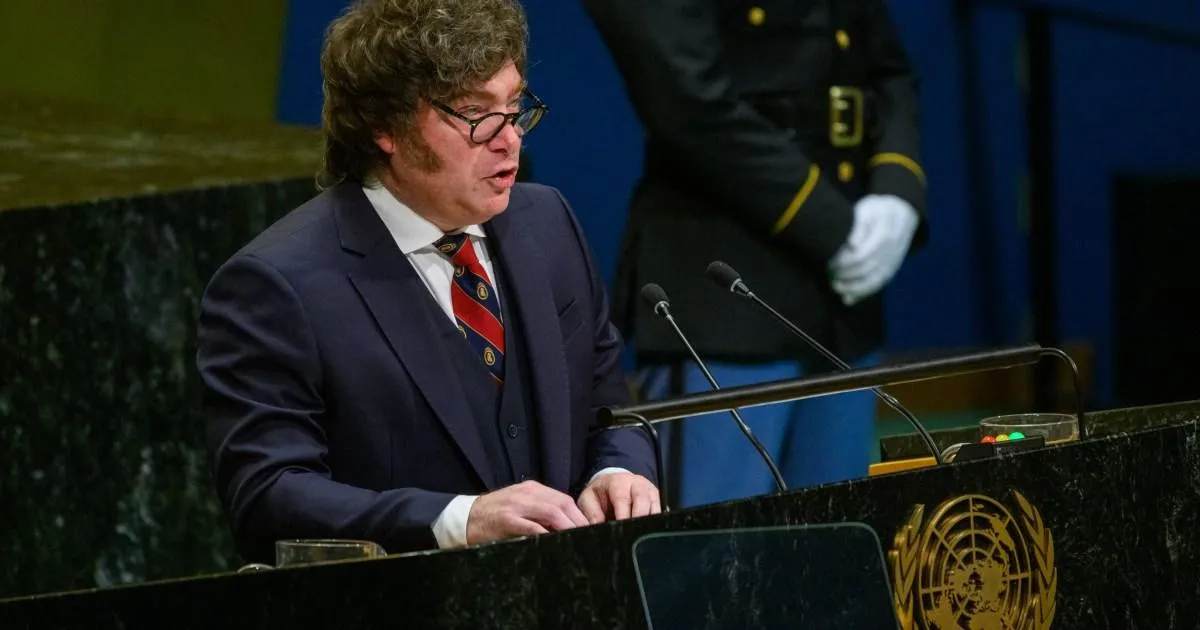
Javier Milei stood before the United Nations General Assembly in New York and turned a routine diplomatic speech into something closer to a rally. With the world watching, Argentina’s President made the Falkland Islands—the islands Argentina still insists on calling the Malvinas—the emotional and political centrepiece of his address. It was, by any measure, a diplomatic slapdown. Milei accused the UN of having chosen “to look the other way” on a sovereignty dispute that Argentina has nursed for generations, and he promised that his government would stop waiting for the international community to do the right thing. “We are going to take matters into our own hands through legal and economic action,” he said, and he called that approach “a peaceful, practical and effective defence.” There was a sharp edge to his tone. For far too long, he argued, Argentine governments had been satisfied with empty rhetoric, attending conference after conference and making speeches that changed nothing. Now, he said, his country would pursue the Malvinas as “a national cause,” and he framed it as a matter of justice, memory and national dignity. It was the kind of speech that makes diplomats shift in their seats—partly because it was passionate, but mostly because the passion was aimed at rewriting the rules of a dispute that has outlived generations.
To understand why those words carried such weight, you have to stop thinking of the Falklands as a distant dot on the map and start thinking about the people who live there. They are not characters in someone else’s political drama. They are a small, close-knit community scattered across a remote and beautiful group of islands in the South Atlantic, with a connection to the land and sea that goes back more than a century and a half. In 2013, the islanders were given a chance to speak for themselves. In a referendum observed by international monitors, they were asked whether they wished to remain a British Overseas Territory or become independent. The result was almost unanimous: 99.8 percent voted to stay British. There was nothing ambiguous about it. There was no narrow majority, no angry split. The people who actually call the Falklands home chose, freely and democratically, to keep their British identity. Milei’s response was to dismiss their decision entirely. Self-determination, he argued, simply does not apply here, because “the population was implanted by the occupying power on a territory whose sovereignty is in dispute.” He insisted that the principle of self-determination exists to liberate colonised people, not to legitimise situations arising from colonisation. It is a line that Argentine leaders have used before, but coming from Milei, with his combative style, it sounded less like a legal theory and more like a declaration that the islanders’ voices do not count. For the people of the Falklands, the message could not have been clearer: in Milei’s eyes, they are not really a people at all, just an inconvenient presence on land that once belonged to someone else.
There is also a more practical reason why this fight is no longer just about flags and speeches. Milei has pledged to move beyond rhetoric and make life difficult for anyone doing business in the waters around the Falklands. His government has already imposed sanctions on people and firms involved in oil exploration in the area, and it says it will file a criminal complaint against Navitas Petroleum, an oil company operating offshore. He is also pushing a security bill that would expand the military’s role in protecting what Argentina sees as its own critical infrastructure. In other words, Buenos Aires is using every peaceful lever available—courts, regulators, licensing rules, diplomatic pressure—to choke off the economic activity that has helped the Falklands thrive. Oil is the great game changer. For decades, the islands’ wealth was tied up in fishing and sheep farming, but the discovery of offshore oil reserves changed the calculus. The same waters that are rich in fish are now at the centre of a global search for energy, and both sides know what is at stake. For Argentina, this is not just a matter of sovereignty; it is about resources, jobs, investment and international influence. For the islanders, it is about their survival as a community. They have spent years building businesses, families and a future in a place that is not easy to live in. Now they watch as a much larger nation tries to decide the shape of that future from thousands of miles away, with a plan that would treat their homes as a contested zone rather than a living community. Milei made it clear that Argentina is not prepared to sit back while foreign companies drill for oil in what he considers Argentine waters. But his legal and economic campaign brings its own dangers: the more pressure he applies, the more he pushes the islanders further into British arms.
Britain has responded with a mix of quiet diplomacy and public defiance. The British UN delegation issued a statement after Milei’s speech, saying: “The United Kingdom has no doubt about its sovereignty over the Falkland Islands. The United Kingdom is steadfast in its support for the Falkland Islanders’ right of self-determination.” The statement went on to say that islanders have as much right to determine their political status and freely pursue their economic, social and cultural development as any other people. On the domestic front, Andy Burnham, the Mayor of Greater Manchester and one of the most recognisable Labour politicians in the country, insisted that the UK “will stand firm in the face of any threats” to the sovereignty of the islands. The British Prime Minister also raised the issue with President Donald Trump during their talks on the sidelines of the UN assembly, a sign that London understands the real battle may be for influence in Washington as much as for legal victory in New York. Britain has long relied on the support of the United States in this dispute. The special relationship may be awkward to define, but when it comes to the Falklands, Washington’s neutrality has been a tricky balancing act for decades. In 1982, the United States was technically neutral, but in practice Washington provided crucial support to Britain as it fought to recapture the islands from Argentina’s military invaders. That support made a decisive difference. So when Trump recently suggested that he might reconsider Washington’s neutral stance on the sovereignty of the islands, and went as far as to question whether Britain could even defend the territory because of its domestic troubles with immigration and energy, alarm bells began ringing in London. For the Falkland Islanders, the idea that the American president might tilt toward Buenos Aires is not an abstract diplomatic puzzle. It would be a direct threat to their security and their way of life.
The shadow of 1982 hangs over all of this. It was the invasion of the Falklands by Argentina’s military junta that triggered a brief and bloody conflict which killed 255 British servicemen, 655 Argentinians and three Falkland Islanders in just over seventy days. The numbers may be small in the context of the Cold War or the great battles of the twentieth century, but every one of those deaths represented a family that had to learn to live without someone they loved. Young men died on the freezing seas, in the rocky hills, and in the air above the islands. Many of their bodies were never recovered. For Britain, the war became a test of national will, and the word “Falklands” came to mean something deep and enduring—a moment when a faraway group of islands could still stir the patriotic imagination of an island nation. For Argentina, the war was a tragedy and a humiliation from which the country has never fully recovered. The junta that started it collapsed, but the sense of loss did not disappear. The idea of the Malvinas still runs through Argentine culture like a river, fed by school lessons, museum exhibitions, political speeches and football chants. Milei knows this. He may talk about economic reform and global markets, but he also understands that the Malvinas remains one of the few subjects that can unite Argentines across the political divide. By making the islands the centrepiece of his UN speech, he was attaching his own political future to a cause that is older than Argentina itself as a modern nation. It was a calculated political gamble, and the fact that Trump is reportedly close to Milei only adds another layer of complexity. If Washington’s traditional neutrality starts to tilt, the entire diplomatic ground beneath the Falklands could shift.
At the heart of the dispute stands a question that no amount of legal argument can easily answer: who gets to decide where people belong? Milei argues that the islands were seized from Argentina in the nineteenth century and that the current population is a relic of British colonisation. He points to the fact that the United Nations has a long history of resolutions urging the two sides to negotiate, and he says the international community has failed to do its duty. There is some force to the idea that the United Nations has not always known how to handle a dispute that pits two principles against each other: the principle of self-determination and the principle of territorial integrity. But the islanders make a powerful counter-argument. They were there before Argentina existed as an independent state, they have voted overwhelmingly to stay British, and they believe it is deeply unfair that a powerful state can simply claim their homeland because it wants the land and the resources around it. They are not asking to be a burden on anyone. They have built a functioning, modern society in one of the most isolated places on Earth. They run schools and hospitals, they produce food, they manage their own affairs, and they have developed strong local institutions that represent their interests. Their votes are not just a formality; they are an expression of a lived identity. Milei can call them a planted population, but the islanders see themselves as the legitimate inheritors of generations of history. They are not looking for a fight, but they are prepared to stand their ground. Perhaps the most important thing to remember is that behind the rhetoric, the oil deals and the military posturing, there are human beings on both sides of this dispute. In Buenos Aires, the Malvinas is a memory of pride and pain. In Stanley, the capital of the Falklands, it is a fact of daily life. And unless leaders in London, Buenos Aires and Washington are careful, that human reality may be lost in the noise. The Falkland Islands were at peace before most of today’s leaders were born, and they deserve to be at peace long after this political chapter has closed. The only way that can happen is if everyone involved remembers that a homeland is more than a line on a map, and that the people who live there should have the final say over the future they share.