

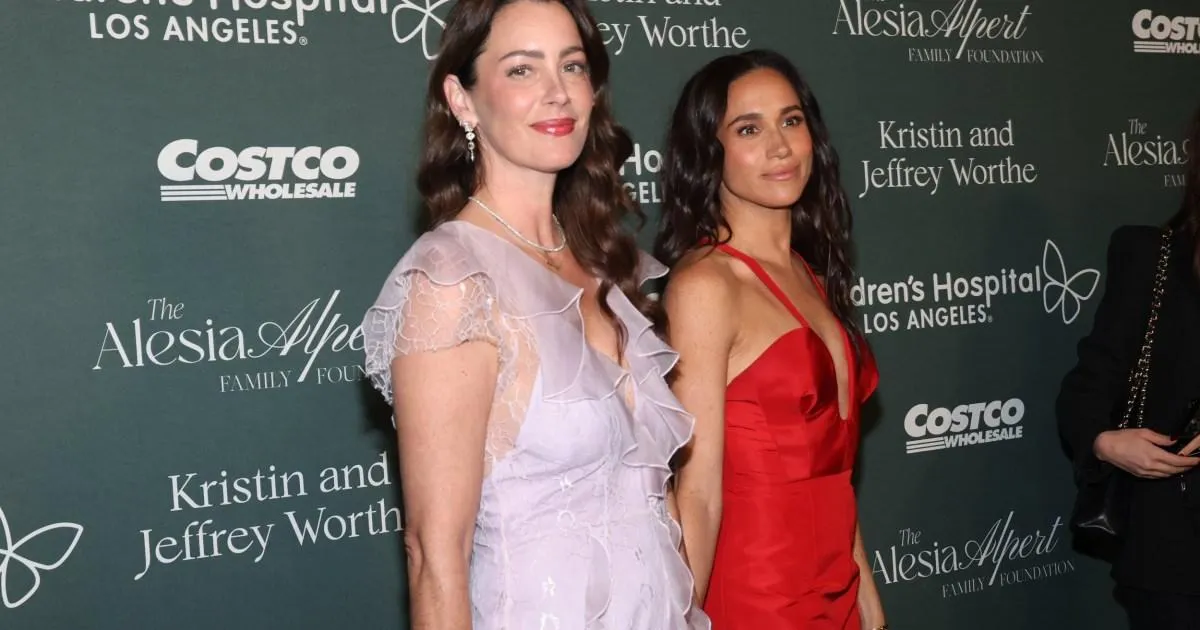
There is something almost unbearably moving about watching a friend be welcomed home—especially when that friend is Meghan, the Duchess of Sussex, a woman whose every arrival and departure has been measured, judged, and turned into a headline. Kelly McKee Zajfen, Meghan’s friend and self-described “bestie,” seems to understand this intuitively. The photographs she shared on Instagram from her recent trip to the United Kingdom are not polished royal portraits. They are candid, tender, slightly unsteady images, the kind of photos you take because you never want to forget the feeling of being with someone you love in a place that means something. In one, Meghan is sitting in a pub with Kelly’s six-month-old son Jack on her lap, her head tilted down toward him, smiling with the relaxed ease of a woman who is not performing. In another, Harry is lying on the floor playing with Jack, his body language loose and playful in a way that feels entirely domestic. There is also a moment in the montage showing Princess Lilibet, from behind, peering at baby Jack as he lies on a sofa beside his mother—a tiny, unplanned glimpse of family life that has no official purpose other than to exist. These are the images that people describe as “loving,” and they were matched by the reception the Sussexes received everywhere they went. Kelly’s caption was simple and profound: “To everyone we’ve met or bumped into, thank you for being so loving to my friend. It’s been beautiful to witness. She missed you too!” The phrase “She missed you too” is striking. It dissolves the distance between a public figure and a public, suggesting that Meghan’s relationship with the UK is not one of cold estrangement but of complicated, affectionate memory. The “loving” reception was not necessarily a parade or a red carpet; it was the collection of everyday courtesies—a nod in a village, a warm exchange in a pub, a moment of privacy granted or a conversation allowed—that together add up to a homecoming. For someone who has spent years being told she was unwelcome, those small moments must feel like oxygen.
Kelly went on to fill in the texture of those days in a way that feels almost like a diary entry. “There’s something so special about getting a taste of this magical place with my bestie, and having my sweet Jack along for the adventure,” she wrote. She spoke of seeing “this sweet chapter through her eyes and daily adventures,” and of experiencing “so many little firsts with Jack by my side.” She ended with a line that sounds like it belongs in a greeting card but feels utterly earned: “Family time is just what the heart ordered. With a side of mashed peas and fish n chips! All of it has filled my heart.” It is the kind of caption that makes you feel as though you are sitting at the next table, eavesdropping on a conversation between two women who have known each other long enough that they no longer need to explain themselves. Kelly first appeared in Meghan’s Netflix lifestyle show, With Love, Meghan, which gave audiences a glimpse of her natural, unforced presence in Meghan’s world. She is not a palace insider or a royal commentator; she is a friend, a mother, a co-founder of the Alliance of Moms, an organisation that supports young parents in the Los Angeles foster care system. Her presence in Meghan’s life is a reminder that the Duchess has built a chosen family around herself, as many people do when their natal family becomes complicated. The world she and Kelly share is full of ordinary rituals—baby bottles, walks, pub lunches, the pinch and tug of caring for children. There is no grand strategy in these images, no palace-approved messaging. There is only friendship, which, in the midst of a life that has been endlessly narrated by outsiders, is perhaps the most radical thing Meghan can offer to the public. It is also, of course, a form of testimony: Kelly’s words are evidence that the woman at the centre of so much controversy is living a real, complicated, and tender life.
The backdrop to this intimate reunion is the Sussexes’ return to the UK just over a month ago—a dramatic reversal after they quit the working monarchy and moved to the United States six years earlier. To understand why the trip matters, one has to remember how hard the leaving was. There were tears, accusations, a painful family rift, and a very public battle over privacy and security. The couple spent half a decade building a new life in California, launching charities, making documentaries, raising their children in a sunny, structured world far removed from the palaces and tabloids of London. To come back is not just to revisit old haunts; it is to reopen the question of where home really is. Kelly’s posts frame the return as a “sweet chapter”—a phrase that feels chosen with care. It does not erase the past. It does not pretend that everything is resolved. It simply acknowledges that, for now, the Sussexes are trying to find a rhythm in the UK, with walks and pub lunches and new daily routines. The “new home” Kelly mentions is not just a house; it is a symbol of a second chance, a place where the couple can perhaps be a family without being royalty-in-exile. It is also, inevitably, a place where they must confront the complex feelings that swirl around them—feelings that have not disappeared simply because they have crossed the Atlantic. The fact that this chapter is being witnessed through the eyes of a close friend makes it feel less like a political statement and more like a restorative act. Family time, as Kelly said, is what the heart ordered. And yet, as the article makes clear, the heart alone cannot solve everything, and the practical realities of life in Britain are already testing the couple’s hopes.
The first cracks in the idyll have already appeared, and they are deeply human. Prince Archie and Princess Lilibet were pulled out of their new school after only two days. The reason was not a tantrum or a change of heart; it was the traffic. The area around the school was so congested that the couple’s private security team struggled to keep the convoy together during the school run. For most parents, heavy traffic is an annoyance, a reason to leave five minutes earlier. For the Sussexes, it is a security failure—a reminder that they cannot exist in the world the way other families do. The decision to withdraw the children so quickly must have been agonising. No parent wants to yank their child out of a classroom after 48 hours, especially after the turbulence of a transatlantic move. But the desire for safety, and the fear of what could happen if that safety is compromised, overrides the desire for stability. The children are said to have transferred to a new school, but the episode reveals the extraordinary pressure that sits underneath even the most mundane aspects of their lives. It also reveals a painful irony: the Sussexes left the UK partly to escape an environment they felt was unhealthy for their family, and they returned hoping to find a kinder, quieter existence. Yet the very act of returning has placed them back in a landscape where a school run becomes a security operation, where the fate of a child’s education can be changed by the flow of traffic. There is something almost absurd about it: a convoy of security vehicles idling in traffic outside a primary school, and a decision about a child’s future reduced to logistics. It is a reminder that, for this family, home is never just home. It is also a negotiation with the outside world, a constant calculation of risk and benefit, of openness and protection.
Above and beyond the practical difficulties, there is a deeper unease about the couple’s place in the British establishment. The King authorised a letter that was circulated to senior government stakeholders, reiterating that Harry and Meghan are “private citizens” and setting out guidance on how they should be treated. The message was clear: the working monarchy and the Sussexes are now separate entities, and official institutions should not conflate the two. Harry and Meghan were reportedly caught off guard by the instruction. They are waiting to hear whether they will be granted taxpayer-funded security, and they have expressed a preference for the term “public figures” over “private citizens.” Semantics, in this context, are not trivial. “Private citizen” sounds like a demotion, a bureaucratic way of saying that you no longer matter, that you are on your own. “Public figure” acknowledges that, whatever the official relationship with the Palace, they remain visible, influential, and vulnerable. The distinction is especially painful for Harry, a man who was born into royalty and has spent half his life trying to define himself outside of it. To be told that you are private is to be told that the gates have closed behind you, even while you still need a security detail to keep you safe. The letter, authorised by his father, the King, was a necessary administrative step for the monarchy, but for the Sussexes it must have felt like another reminder that they are no longer inside. They have returned to the country, but they have not returned to the institution. That gap between physical presence and official belonging is where much of the tension lives. It is also where the loneliness of their situation becomes most visible: they are close enough to be scrutinised, but not close enough to be protected by the old structures. They are, in effect, suspended in a limbo that no term, whether “private citizen” or “public figure,” can fully capture.
In the middle of all this, Kelly McKee Zajfen has become a kind of human anchor. She is the friend who shows up, who posts the photos, who says the words out loud that Meghan perhaps cannot say herself. Kelly’s significance extends beyond the Instagram post. Earlier this year, Meghan wore an “All Mama, All Heart” T-shirt on a trip to Australia. The shirt, with its red heart and message, supports the Alliance of Moms, the organisation Kelly co-founded to help young parents in the Los Angeles foster care system. It is a small gesture, but it speaks volumes about the bond between the two women. They are not just friends; they are collaborators in a shared belief that motherhood and community can be sources of healing. Kelly’s presence in the Sussexes’ lives offers a reminder that Meghan has not lost herself in the machinery of royal life, whatever else may be uncertain. She has people outside the institution who know her not as the Duchess of Sussex but as Meghan, the friend holding a baby, the mother worrying about school runs, the woman who still wears a T-shirt that declares her heart belongs to her children. The homecoming Kelly describes is not perfect. It is crowded with complications: security convoys, official letters, clashing vocabularies, old wounds. But it is also, at least in the moments Kelly chose to share, full of tenderness. “She missed you too,” Kelly wrote. That sentence, addressed to the UK, is also a message to all of us who have watched this story from afar. It says that Meghan is capable of missing, of longing, of returning, of hoping. It says that the narrative is not over. It says that a friend was there to witness it, and that what she saw was love. In the end, that may be the most accurate summary of this strange, complicated, human chapter: the Sussexes are trying, and they are not alone. Whatever the future holds—whether they stay in the UK or return to California, whether the security questions are answered, whether the Palace ever fully makes room for them again—these small, unguarded moments will remain part of the story. A baby on a lap in a pub. A man playing on the floor. A friend writing a caption that makes the world feel a little less angry. That is what Kelly captured. That is what “She missed you too” really means.