


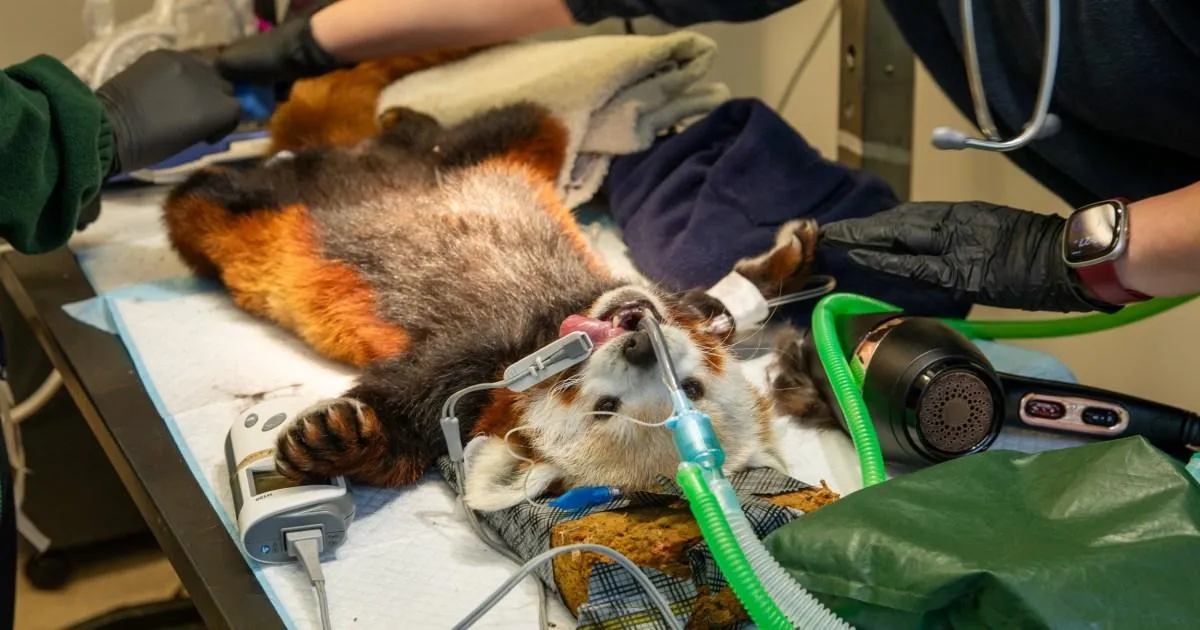
Anyone who has ever cared for an animal knows the particular dread that arrives when a beloved creature suddenly refuses to eat. The food bowl stays full, the usual enthusiasm vanishes, and a quiet alarm begins to sound in the back of your mind. That was exactly the situation at Edinburgh Zoo when keepers noticed that Bruce, an 11-year-old red panda, had gone off his food. Bruce is not just any red panda. He is a member of an endangered species, one of fewer than 10,000 believed to remain in the wild, and the zoo’s only red panda. His human carers had watched him thrive for years, exploring his enclosure, nibbling bamboo, and curling up for long naps high in the trees. So when his appetite dimmed, they did not hesitate. They made the decision to place him under general anaesthetic, a serious step for any animal but especially for a small tree-dwelling creature whose wild cousins live in the remote high-altitude forests of the Himalayas. The procedure would allow vets to examine him head to tail, without causing stress or distress. It was a risk, but it was one the team was willing to take to find out what was wrong. The image that emerged shows Bruce lying calmly on a veterinary table, surrounded by monitoring equipment, his striking rust-red fur, dark legs and ringed tail making him look both vulnerable and utterly endearing. For the keepers watching, it must have been a tense moment. They had no idea what they would discover. A dental issue? Something internal? A far more serious diagnosis? In the end, the answer turned out to be surprisingly simple—and very human. Like many of us when a tooth starts to ache, Bruce simply wanted to avoid eating. It is a small detail, but it makes the whole story strangely relatable. The team at the Royal Zoological Society of Scotland had prepared carefully, checking dosages and monitoring equipment, determined to make the procedure as smooth as possible for such a special animal.
When vets at the Royal Zoological Society of Scotland finally got a close look at Bruce, they were relieved to discover that the only real problem was a poorly tooth. That revelation immediately transformed the tone of the whole ordeal. A sore tooth is painful, of course—anyone who has dealt with a toothache knows how debilitating it can be—but it is also eminently treatable. The offending tooth was removed, and the team took advantage of Bruce’s unconscious state to give him what they affectionately described as a full-body MOT. They checked his heart, his lungs, his overall condition. They examined his fur, his weight, his mobility. They ran through every check and recheck they could think of, determined to make sure that nothing else was lurking beneath the surface. General anaesthesia is always a delicate business. For a red panda, whose natural habitat is the high-altitude temperate forests of the Eastern Himalayas and south-western China, there are many factors to consider. His body would have been monitored constantly, with veterinary staff tracking his breathing and heart rate throughout. The fact that he made it through with flying colors is a testament to the skill and care of the Edinburgh Zoo team. After the tooth was removed, vets gave him a clean bill of health. They had gone in expecting the worst, perhaps, or at least bracing for complications, and instead they found a simple, fixable problem. The relief in the official announcement is almost tangible. The Royal Zoological Society of Scotland later shared the story in a matter-of-fact way, but the warmth behind the words is clear. Bruce was not seriously ill. He was not suffering from some hidden disease. He simply had a bad tooth, and now that bad tooth was gone. It was the best possible outcome in a situation that could easily have been much more serious, and it was a reminder that sometimes the smallest problems are the ones that cause the greatest worry.
Now, Bruce is back to doing what he does best. The zoo has reported that he is making an excellent recovery, once again exploring his enclosure in search of bamboo and taking characteristically peaceful naps high in the trees. For an animal who spends much of his time sleeping on branches and moving gracefully through his environment, a return to normalcy is the ultimate sign of health. There is something deeply comforting about the image of Bruce settling back into his familiar routines. The bamboo is being eaten. The treetop perches are being occupied. The red panda is, in every meaningful way, himself again. His recovery is a reminder of the quiet bonds that form between animals and the humans who care for them. Zoos are not merely places to display creatures; they are places where keepers learn the personalities of individual animals, noticing when something is off, recognizing the subtle cues that precede a health crisis. Bruce’s keepers knew him well enough to see that his loss of appetite was not just a passing mood. They trusted that instinct and acted on it, and because they did, a small dental problem was caught before it could become something much worse. It is easy to take an animal’s wellbeing for granted when it seems healthy, but the people who work with endangered species understand that every individual matters. Bruce matters. His health matters not only because he is a beloved character at Edinburgh Zoo, but because he is part of a species that is fighting for survival. Every red panda that thrives in human care is a piece of a larger conservation story, and every successful veterinary intervention is a small victory in that ongoing effort. Watching Bruce climb and nap again is a joy not just for his keepers, but for everyone who loves the natural world.
Bruce’s story becomes even more poignant when you learn a little about his history. Born in 2015, he arrived at Edinburgh Zoo the following year, and he has been a familiar and cherished presence there ever since. Today, he is the zoo’s only red panda, a role that carries with it a certain responsibility. He is also a grandfather—a fact that gives his survival an extra layer of meaning. His granddaughter, a three-year-old red panda named Priya, was moved from Edinburgh to the Highland Wildlife Park in March of this year. There she has been joined by a one-year-old male named Flyn, and keepers are hoping that the two will eventually produce cubs as part of ongoing efforts to protect the species. In that sense, Bruce is not just a solitary red panda enjoying his golden years; he is part of a family tree that stretches into the future. The hope is that Priya and Flyn’s eventual offspring will help bolster a population that is under severe pressure in the wild. Bruce, meanwhile, continues to serve as a living link to that future, a reminder of why conservation efforts matter. It is impossible to say whether an animal like Bruce understands the role he plays in the broader narrative of his species. But the humans around him certainly do. Every effort to keep him healthy, from routine checkups to emergency dental surgery, is part of a larger commitment to ensuring that red pandas do not disappear from the Earth. And the fact that Bruce’s granddaughter is now settling into a new home with a potential mate is a sign that the story is continuing, generation after generation, in the careful hands of zoos and wildlife organizations.
To truly understand why Bruce’s sore tooth matters, it helps to appreciate what kind of animal he is. Red pandas are often mistaken for relatives of giant pandas, but despite the shared name, the two species are not closely related at all. Red pandas belong to their own family, Ailuridae, and genetic studies have shown that they are more closely related to raccoons, skunks, and weasels than to the black-and-white bears that share their common name. They are ancient and distinctive creatures, sometimes described as living fossils, and they have carved out a specialized niche in the high-altitude temperate forests of the Eastern Himalayas and south-western China, including parts of Nepal and India. These forests are cool, misty, and rich in bamboo, which makes up the bulk of a red panda’s diet. They are also, crucially, places where red pandas can climb. Bruce’s species are excellent climbers, with sharp claws and flexible ankles that allow them to descend headfirst down trees, a skill few mammals possess. They spend much of their lives aloft, sleeping on branches, using their long, bushy tails as wraparound blankets during naps. In the wild, a red panda might spend hours each day foraging for bamboo, moving through the canopy with surprising grace for an animal that looks so cuddly and slow. Yet this beloved species is in trouble. The International Union for Conservation of Nature classifies red pandas as endangered, and their population is continuing to fall. The reasons are many and interconnected: deforestation, habitat loss, and poaching all take their toll. As forests are cleared for agriculture and development, red pandas lose the only homes they have. As their habitats fragment, populations become isolated, making it harder for them to find food and mates. And although they are protected by law in many countries, they are still hunted illegally for their striking fur. Fewer than 10,000 red pandas are believed to remain in the wild, a number so small that every individual counts—including a recovering toothache patient at Edinburgh Zoo.
In the end, Bruce’s story is a small, gentle reminder of the fragility and resilience of wildlife. A sore tooth is not a dramatic life-or-death crisis. It is a routine medical issue, the kind that any creature might face. But for an endangered species, even the smallest health problem can feel momentous, because the loss of any individual is a loss to the entire genetic pool. The staff at Edinburgh Zoo understood that when they decided to put Bruce under general anaesthetic. They understood it when they removed his tooth, when they ran their checks, when they announced to the world that he was doing well. And they understand it now, as they watch him once again munching on bamboo and dozing in the trees. Bruce’s recovery is a testament to the quiet, often invisible work that goes on in zoos every day—the feeding schedules, the observation, the veterinary exams, the careful planning for future generations. It is also a reminder that conservation is not always about grand gestures. Sometimes it is about noticing that an animal has stopped eating and deciding to find out why. Sometimes it is about pulling a sore tooth and being grateful that nothing worse was found. Sometimes it is about a grandfather red panda, still full of life, still climbing trees, still teaching us something about the value of every single creature on this planet. For the team at Edinburgh Zoo, and for everyone who follows these stories with warmth and concern, Bruce’s sore tooth will be remembered not as a crisis, but as a moment when caring humans came together to help an endangered animal in need. And that is a story worth celebrating.