


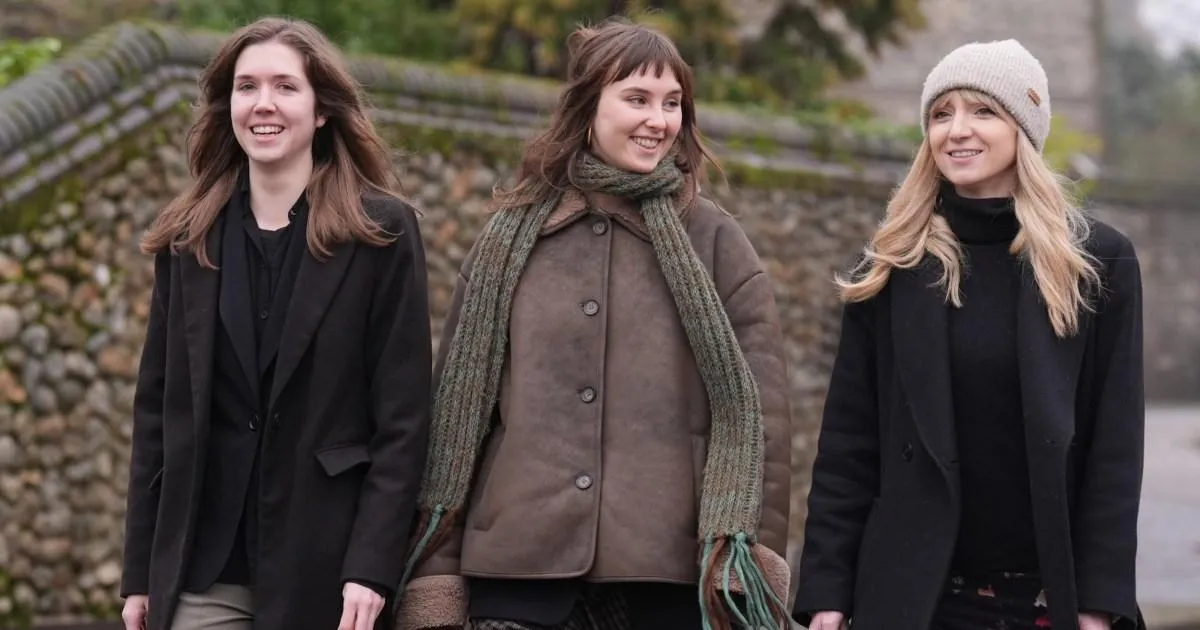
On a damp Norfolk morning sometime in 2023, three women made a decision that would alter the course of their lives: they stepped into a field on the King’s Sandringham Estate, gathered three young lambs into their arms, and walked away. Rosa Sharkey, Sarah Foy, and Rose Patterson were not farmers, poachers, or thieves in any conventional sense. They were animal rights activists, members of the group Animal Rising, and they believed with every fibre of their being that those lambs were being taken not into safety, but toward a slaughterhouse. To them, the action was not theft; it was rescue. Months later, all three found themselves standing in the wood-panelled courtroom of Norwich Crown Court, facing a jury that would decide whether their compassion was a crime. When the foreperson delivered the unanimous guilty verdicts after three hours and forty-eight minutes of deliberation, the women absorbed the word “theft” like a blow. Yet their story never quite fit the simple shape of a crime. It was a collision of law, morality, suffering, and the profound, difficult question of what one person owes an animal in danger.
Throughout the trial, the three women did not deny that they had taken the lambs. Instead, they challenged the very meaning of dishonesty. In statements given to police, they insisted that King Charles himself would have consented to the lambs’ rescue, had he known the fate that awaited them. Their defence was built on a belief that the monarch, a man who has spoken of his love for the environment and his respect for nature, would not have wanted his animals to die in the brutal, industrial conditions of a slaughterhouse. They argued that they had acted openly, publicly, even proudly, and that their actions were driven by a moral compass rather than greed. Crucially, they claimed there was no dishonesty—the mental element required for theft—because they genuinely believed the owner would have said yes. The jury was asked to peer into their minds and judge whether such a belief was honestly held. For the defence, barrister Sarah-Jane Ewart painted a portrait of Sharkey as a woman who “cares deeply” about the climate and animal welfare, someone who “just wanted to rescue animals and spark conversation with someone powerful, the King.” It was an unusual defence, one that forced the court to consider whether a pure motive can ever wash the stain from an illegal act. The courtroom also heard that a van driver, who was not on trial, had transported the three lambs to a sanctuary after the women had taken them. The lambs had not vanished into the black market; they were not hidden for profit. They were delivered to a place of safety, where they would be allowed to live out their lives without fear of the knife. This detail, perhaps more than any legal argument, captured the strange, altruistic heart of the case.
The most haunting moment of the trial came not from a lawyer or a witness, but from Rose Patterson, who chose to represent herself in court. Patterson spoke not of legal technicalities but of memory and sound. She told the court that she had been inside a slaughterhouse, and that she had heard the animals’ screams. The words hung in the air, visceral and unbearable. She was not speaking abstractly about animal welfare statistics or carbon footprints; she was speaking about the terror of creatures who know what is coming. In her closing speech, she returned again to the King, saying she believed Charles “wouldn’t want his lambs sent to a slaughterhouse that’s violating the law.” It was a striking argument, invoking not just kindness but legality: perhaps the slaughterhouse itself was operating outside the rules. Patterson’s voice trembled with the conviction of someone who had witnessed something she could not unsee. She did not want to be a martyr, nor did she seem to relish the attention. She wanted to explain that the moment you hear the screams of an animal who is about to die, you cannot pretend you did not hear it. You cannot look away and go home to your dinner. You cannot sit with the knowledge that a lamb’s life is measured only by its weight and its price. That emotional testimony underscored the profound discomfort at the heart of the case: these were not cold conspirators, but women whose consciences had been wounded by the world, and who chose to act when others preferred to look away.
When the verdicts were delivered, Judge Anthony Bate turned to the three defendants, who sat together in the back row of the well of the court, and offered a glimpse of leniency. “I have in mind a community order and some unpaid work,” he said. It was not a declaration of war, not a prison sentence, not the crushing weight of moral condemnation. It was a judicial acknowledgement that these were not dangerous offenders. They were women whose crime was born of conviction, and the legal system, while unwilling to excuse their actions, seemed willing to respond with restraint. They were instructed to speak to a probation worker, and the prospect of formal sentencing was set for later that afternoon. The moment carried an almost surreal quality: activists who had imagined themselves on the right side of history were now being processed through the machinery of the criminal justice system, trading their ideals for appointment times and community service forms. Yet there was no bitterness in their posture, no defiant outbursts. They listened quietly, their faces pale but composed. Perhaps they understood that the trial was the price of their protest. Or perhaps they believed, even in that moment, that the lambs were worth every hour of unpaid work, every appointment with a probation officer, every judgmental headline. The judge’s measured tone left room for that possibility, suggesting that justice, even when it convicts, can still recognize the difference between a malicious act and a principled one.
The strangest chapter of the story unfolded away from the courtroom, in the days immediately after the lambs were taken. The three women did not flee into hiding. They did not cover their tracks. Instead, the following day, they went to Windsor Castle, the royal residence, to try to tell police what they had done. Armed officers standing guard outside the gates did not engage with them, perhaps unsure what to make of these earnest young women carrying a confession. Undeterred, the trio made their way to Windsor police station and there attempted to report their actions. It was an extraordinary gesture, one that blurred the line between criminal and citizen. They were not trying to evade responsibility; they were trying to announce it. They wanted the world to know that they had taken the lambs, that they were not ashamed, and that they were ready to face the consequences. This was activism as theatre, as truth-telling, as a public invitation to debate. It was also deeply human: they wanted to be seen, to be heard, to force a conversation that polite society often avoids. By presenting themselves voluntarily, they underlined their claim that they had nothing to hide. In their minds, they had committed an act of grace, not greed, and they were willing to stand before anyone—police, press, or monarch—to justify it. The image of those three women walking calmly to a police station, carrying the weight of a deed they considered holy, is one that lingers long after the legal proceedings have ended.
In the end, the trial raised questions that no courtroom can fully answer. Was it theft, or was it mercy? Is there a higher law that justifies breaking a lower one? The animal rights movement has long wrestled with these questions, from the suffragettes of the early twentieth century to the climate protesters of today, and the three women at the centre of this case were merely the latest to take up that uneasy mantle. Public opinion remains divided. Some will see them as naive, even arrogant, imposing their beliefs on a King and his property. Others will see them as heroes, willing to risk their own freedom for the sake of living creatures who have no voice in the halls of power. The lambs themselves, of course, will never know that they were at the centre of a national trial. They will never understand that three women stood in a courtroom and argued for their right to live. They will never read the headlines or hear the judge’s words. But they are alive. That is the fact that cannot be reversed, the truth that remains after all the debate and legal argument fade away. Rosa Sharkey, Sarah Foy, and Rose Patterson may now carry criminal records, but they can also carry the quiet knowledge that three lambs are breathing because of them. Whether that makes them thieves or saints is not for a jury alone to decide. It is a question that will continue to haunt us, because it is not really about sheep at all. It is about the kind of world we want to live in—and the lengths we are willing to go to build it.