

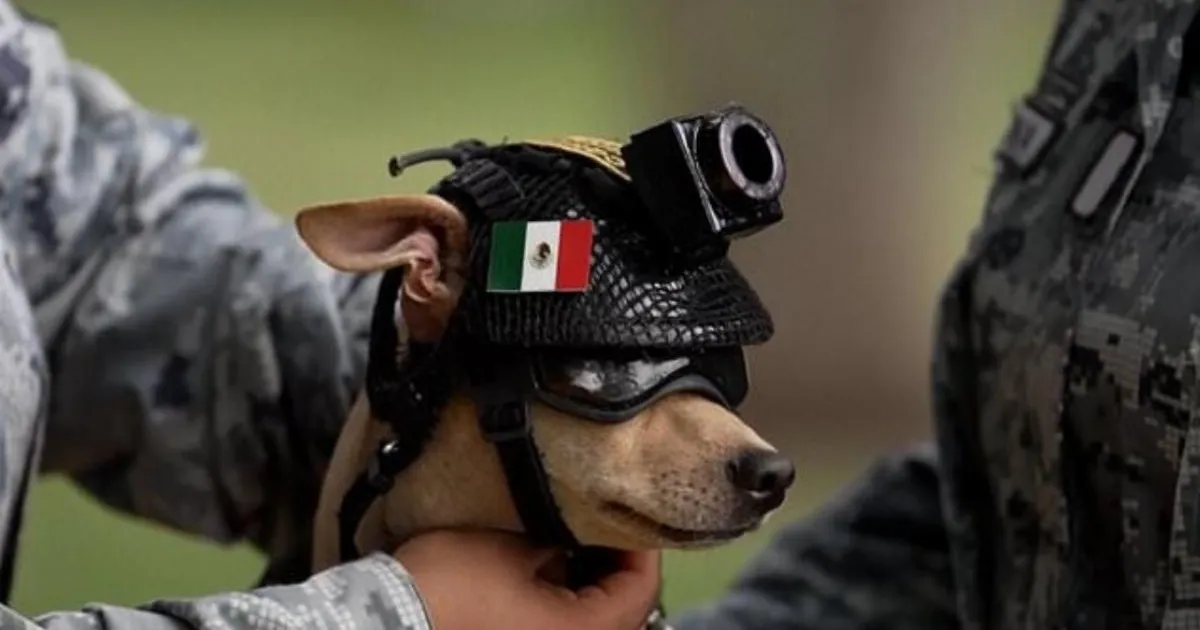
When most people picture a military or police working dog, the image that comes to mind is almost always the same: a large, muscular German Shepherd, a Belgian Malinois, or perhaps a Labrador Retriever, moving with precision, focus, and intimidating strength. These are the breeds that have long dominated the world of bomb detection, search-and-rescue, and tactical operations. Their size, intelligence, and training make them natural allies in high-stakes environments. But Mexico’s National Guard has decided to do things a little differently. Instead of a towering, powerful canine, they have adopted a tiny Chihuahua named Comando, an eight-inch-tall, fifteen-pound ball of energy who looks more like a beloved lapdog than a military operative. And yet, in his own small way, Comando is proving that courage and determination have nothing to do with size. He has his own fitted vest, a pair of miniature goggles, and a head-mounted camera—all designed to help him assist with important work, even as he serves as an unofficial mascot for the entire National Guard. He may not be able to take down a suspect or charge into a dangerous firefight, but he carries himself with the quiet confidence of a dog who knows he has a job to do, and that job matters.
Comando’s story began about six months ago, when he was just a puppy. His previous owners, an elderly couple, had reached a point in their lives where they could no longer provide him with the care and attention he needed. It’s a familiar and heartbreaking situation for many animals—people who love their pets but simply cannot keep them. What makes Comando’s story different is what happened next. Rather than being placed in a shelter or rehomed quietly, the tiny Chihuahua was adopted by Mexico’s National Guard, a branch of the country’s security forces that has been fighting an ongoing and often brutal battle against organized crime. From the moment he arrived, Comando seemed to understand that he was part of something bigger than himself. He has been training alongside soldiers and officers, learning to navigate obstacle courses, search for people in need, and work in environments that would overwhelm many larger, more experienced animals. He has also become a beloved fixture at bases and training facilities, a small, furry reminder that even in the middle of serious and dangerous work, there is always room for warmth, joy, and a little bit of levity. His size, which might once have been seen as a limitation, has become one of his greatest strengths—he can squeeze into tight spaces, move quickly, and do it all with an enthusiasm that is genuinely contagious.
Comando’s bravery has already been put to the test. During one training session, he was placed in a scenario designed to evaluate his instincts and confidence. The course was challenging, filled with obstacles that would make even the most seasoned working dog pause. As Comando approached, something caught the attention of the handlers. A fully trained, much larger dog that had been working alongside the National Guard suddenly froze, unwilling or unable to move forward. It was a moment that could have thrown anyone off. But Comando did not hesitate. He jumped into action, navigating the course with speed, agility, and a remarkable sense of purpose. His tiny legs carried him over ramps, through tunnels, and across balance beams, and when he reached the end, he looked up as if to say, “See? I told you I could do it.” The contrast between the two dogs was striking—one small and untested, the other large and experienced—but in that moment, Comando proved that heart and determination can overcome even the most intimidating challenges. Lieutenant Debora Hernandez, who has worked closely with Comando, said that his presence has reminded many of the people in the National Guard that “beneath the uniform, we are human beings.” It is a simple but powerful message, one that has resonated deeply in an institution that is often defined by discipline, toughness, and emotional restraint.
In a country as complex and violent as Mexico, the decision to embrace a small Chihuahua as both a working dog and a mascot might seem unusual, but it speaks to a larger truth about how people cope with the pressures of dangerous and demanding jobs. The National Guard is on the front lines of a conflict that has shaped Mexican society for decades, and the toll it takes on the men and women who serve is immense. They face cartels that are heavily armed, deeply entrenched, and willing to do almost anything to protect their territory and their profits. They witness violence that most people can barely imagine, and they do so while trying to maintain their own sense of purpose and humanity. It is in this context that Comando has become so important. He cannot stop a bullet, find a hidden cache of drugs, or bring down a cartel leader. But he can do something that is arguably just as valuable: he can make people smile. He can remind them why they chose to serve in the first place. He can provide a moment of peace and joy in the middle of chaos, and he can show them that even in the darkest of times, there is still good in the world worth protecting.
Mexico’s security crisis did not begin overnight, and it will not be solved overnight. For years, the country has been caught in a devastating cycle of violence, driven by cartels that fight each other for control of drug routes, territories, and the enormous profits that come from the drug trade. Forced disappearances, murders in broad daylight, and mass graves have become tragically common, especially in regions where cartels have established strongholds. The roots of this conflict run deep, stretching back to the late twentieth century and the arrest of Miguel Ángel Félix Gallardo, known as “the Godfather,” in 1989. Gallardo’s capture marked a turning point, but it also set off a chain of events that would eventually fracture the cartels into smaller, more violent factions. The strategy of going after top cartel leaders—commonly known as the “kingpin” strategy—has been criticized for creating a vacuum at the top, leading to violent power struggles and a dramatic increase in bloodshed. Current President Claudia Sheinbaum, like her predecessor, has spoken out against this approach, arguing that targeting individual leaders only leads to more chaos and more suffering. She has remained popular with many Mexicans, but public confidence in the government’s ability to provide security remains fragile. She is under intense pressure to show results, and the National Guard is one of the primary tools she has at her disposal.
Comando’s role in all of this is small, in both the literal and figurative sense. He is not going to change the course of Mexico’s drug war or bring an end to the violence that has plagued the country for so long. But his story is a reminder that heroism comes in many forms, and that sometimes the smallest acts of courage can have the most profound impact. He represents hope, resilience, and the idea that no matter how small or insignificant you might seem, you can still make a difference. For the men and women of the National Guard, he is more than just a mascot—he is a symbol of why they do what they do. He is a reminder that behind the uniforms, the weapons, and the armor, they are human beings, with all the fear, love, and vulnerability that comes with being human. And in a country that has seen far too much violence and suffering, that reminder is priceless. So let Comando be known not just as a tiny dog with a big vest and a head-mounted camera, but as a small but mighty reminder that even in the midst of chaos, there is still room for compassion, courage, and hope. He may not be able to save the world, but he is doing his part, and that is something worth celebrating.