

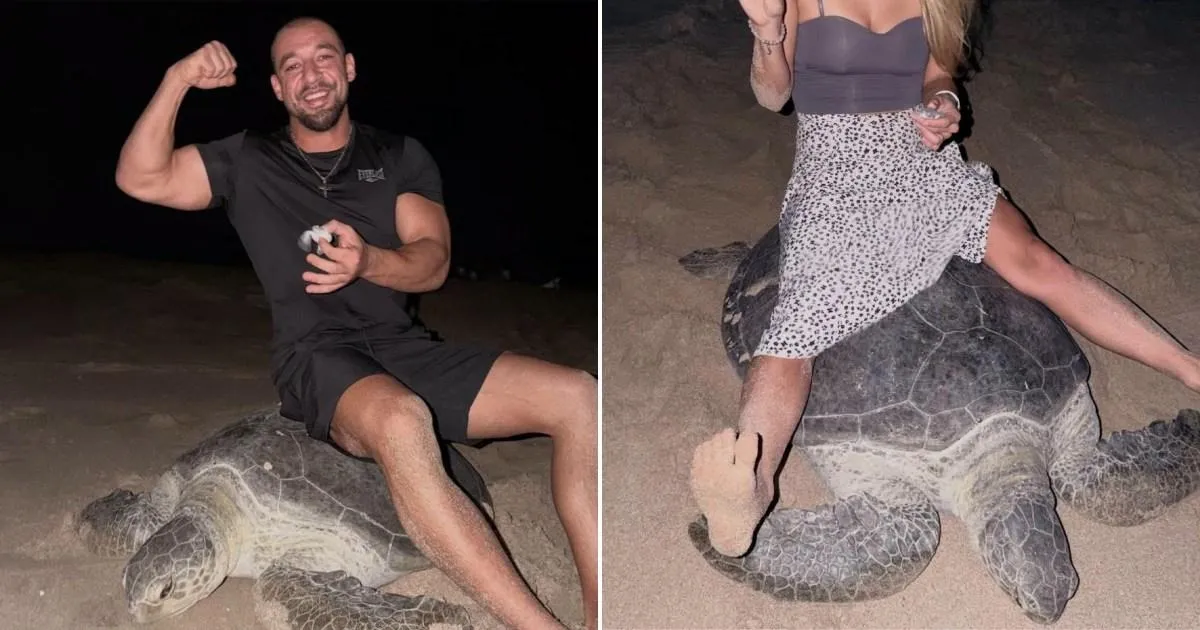
It begins with laughter on a beach, the kind of carefree sound that usually belongs to a holiday postcard. But the scene captured in Ras Al Jinz, Oman, was anything but carefree for the animal at the center of it. A Ukrainian fitness influencer, Vadym Oleynik, was filmed sitting on the back of a large sea turtle as it desperately tried to crawl away across the sand. The turtle moved beneath him, its elderly body straining against the weight, and he slipped off—only to climb back on and keep laughing. Another tourist, Olena Kravchenko, also took her turn on the animal’s shell, treating a living creature like a piece of fairground furniture. If that wasn’t painful enough, the footage also showed Oleynik holding a tiny turtle hatchling in his hands, its small fins flapping as it struggled to break free from his grip. The videos and photographs were shared online, and within days they had traveled far beyond that quiet Omani coastline, sparking anger, sadness, and a global conversation about how we treat wild animals when we think nobody is watching. What happened in Ras Al Jinz was not just a moment of carelessness. It was a reminder that our hunger for unforgettable photos can sometimes make us forget that the animals in those photos have their own lives, their own instincts, and their own right not to be used.
Ras Al Jinz is one of the most important sea turtle nesting sites in the world, a place where green turtles return generation after generation to lay their eggs in the same warm sand where they themselves were born. It is a fragile, almost sacred place, and the people who work there devote their lives to protecting the creatures that arrive each night under the cover of darkness. To see a grown man sit on one of those ancient animals, and then laugh while a hatchling squirmed in his fist, felt like a violation of everything the site stands for. The footage was eventually highlighted by Biologicamente, an Italian conservation project, and the organization did not hide its feelings. It described the behavior as disgusting, unpleasant, and a clear case of exploitation, mistreatment, and abuse. The group stressed that no serious conservation organization would ever allow its volunteers to sit on turtles for a selfie, and it reported the matter to the authorities. For people who work with sea turtles, this was not a harmless joke. Every second of handling causes stress to animals that are already vulnerable, and for hatchlings, being handled by human hands can mean the difference between reaching the ocean and never making it at all. The panic in the turtle’s movements can be seen in the video, and the tiny hatchling’s flapping fins tell their own story. It was not smiling or posing. It was fighting to survive.
To understand why this incident mattered so much, we have to slow down and think about what it means to be a sea turtle. These are creatures that live in a world of ocean currents and deep blue silence, and they come ashore for one of the most miraculous journeys in nature. Lying on the sand, with no way to defend themselves, they are completely vulnerable. They trust the darkness and the stillness of the beach. When a group of strangers surrounds them, when hands reach out and bodies press down on their shells, the experience is not a photo opportunity. It is a threat. Mother turtles may abandon their nesting efforts if disturbed, and hatchlings that are handled can become disoriented, confused, and too weak to make the long crawl to the waves. The long-term consequences are hard to see in a single video, but they are real. Conservationists have spent decades building signs, fences, and education programs to remind visitors to keep their distance, to watch without touching, to let the animals do what they have done for millions of years. And then a social media influencer arrives and undoes some of that work in a single afternoon. The people of Oman, and the local communities around Ras Al Jinz, rely on turtles not just for ecological balance but for responsible tourism. They want visitors to come and marvel at these animals, because that awe can turn into protection. But each incident like this makes it harder to defend the idea that people can be trusted near wildlife. It is not just an insult to the animal. It is an insult to every guide, researcher, and volunteer who has ever spent a long night on the sand, keeping watch over a nest, hoping that the hatchlings will make it to the sea.
When the backlash began, Oleynik issued an apology on Instagram. He addressed Oman’s Environment Authority and the organizations working to protect green sea turtles, and he admitted that he had failed to follow the rules. He said he had not intended to cause the turtle any harm or pain, and that he had made a mistake. On its surface, this apology may sound sincere. But for many people, it rang hollow. The video showed a man who seemed to know exactly what he was doing, who laughed as the turtle tried to escape, who found amusement in the animal’s obvious distress. The fact that he called it a mistake seems to miss the point. It was not a slip of the tongue or a misstep on the sand. It was a deliberate act—a choice to treat a wild animal as if its only purpose was to provide a thrill and a backdrop for a camera. And yet, if we are honest with ourselves, some part of this story is familiar. We live in a world where the line between experiencing nature and consuming it has become dangerously thin. We have all seen people pose with animals at tourist attractions, ride elephants, hold tigers, or snap photos of dolphins as they are forced to perform. We may even have done something like it ourselves, without thinking about what it cost the creature. The outrage is warranted, but it should also be accompanied by reflection. Why do we so often feel the need to touch, to hold, to sit on, to own the wonder of a wild thing? Why is a photo not enough unless it shows us physically dominating something beautiful? Those questions matter, because they force us to look beyond one influencer and into the culture that made him think this was acceptable.
Oman’s Environment Authority confirmed that the incident at Ras Al Jinz was under investigation and that legal measures had been taken against those involved. This was an important step, not because punishment alone can undo the harm, but because it sends a clear message: wild animals are protected, and ignoring the rules has consequences. Officials reminded visitors that people at turtle nesting sites are forbidden from touching, approaching, or disturbing the animals, and they urged tourists to watch from a safe distance and report any violations. The law is on the side of the turtles, and that matters. But laws can only do so much. What we really need is a change in the way we see wildlife. A turtle on a beach is not a playground, not a photo prop, not a story to brag about at dinner. It is a living being with its own needs, fears, and purpose. The best kind of tourism is the kind that leaves no trace, the kind that lets the animal walk away as if we were never there. The kind that teaches us something about humility. When we watch a sea turtle from a respectful distance, when we stand quietly and let it do its ancient work, we are not missing out. We are gaining something far more meaningful: the knowledge that we have been trusted with something precious. The people who protect Ras Al Jinz do not want to keep the turtles hidden. They want to share them with the world, but in a way that honors the animals, not exploits them. That is the responsibility that every visitor carries when they step onto that beach.
In the end, this story is not really about one man and one turtle. It is about all of us, and the choices we make in the presence of the natural world. It is easy to point at Vadym Oleynik and feel angry, and that anger is justified. But the more difficult challenge is to ask ourselves how we can do better. The next time we see a wild animal, whether it is a turtle on a breeding beach, a bird on a fence, or a deer in the mist, we can choose to be a witness rather than a conqueror. We can choose to take a photo from a distance, to keep our hands to ourselves, to let the creature live its life without interruption. That is the kind of respect that conservationists dream of, and it is the kind of behavior that will ensure these animals are still here for our children and grandchildren. The turtle in the video probably returned to the water, carrying with her the memory of a strange and frightening encounter. But the images will not fade. They will remain as a reminder that the world is full of beautiful, fragile lives, and that our presence among them should be gentle. We can laugh with joy when we see wildlife thriving. We can share videos that inspire awe and wonder. But we should never, ever sit on a creature just to be closer to it. True closeness with nature does not come from grabbing it. It comes from letting it be free. And if this sorry episode teaches us anything, it is that freedom is the greatest gift we can give to the wild—and the only memory worth carrying home.