


Here is a summarized and humanized version of the content, expanded into six paragraphs for a reflective, narrative tone.
It is a strange and unsettling time when a fictional television thriller can trigger a formal diplomatic warning from a nuclear-armed state, but that is exactly what happened this week after Sky One premiered its five-part drama, The Wargame. The show, which landed on screens last week, imagines a terrifyingly plausible scenario: a Russian attack against Britain, followed by a spiral of retaliation and counter-retaliation. In the series, when the UK finds itself isolated and fighting for survival, the prime minister makes the grim decision to order strikes against the Russian cities of Murmansk and Kaliningrad. The latter, in particular, is a name most British viewers might have heard only in passing—a small, strategically vital piece of Russian territory wedged between Poland and Lithuania, far from the Russian mainland. But to Moscow, the very mention of an attack on Kaliningrad is not just a plot device; it is a red line. The Kremlin, through its embassy in London, reacted with a fury that felt far removed from the world of make-believe, issuing a stark warning that any British or NATO military action against Russian territory would be met with “all means at Russia’s disposal, including nuclear weapons.” It was a chilling reminder that, in an age of hybrid warfare and information conflict, even a work of fiction can become a battleground.
The Russian embassy’s statement, posted on its official Telegram channel and shared on Twitter, was as blunt as it was alarming. It explicitly referenced The Wargame, but it also pointed to an article in The i Paper that described Kaliningrad as Putin’s “greatest weakness.” The article, which quoted a former NATO official who admitted that “Russia knows it’s a vulnerability,” suggested that NATO could theoretically blockade the region or even challenge Russian sovereignty there. For Moscow, this was too much. The embassy’s message was unmistakable: do not test us. “Those advocating plans to blockade or strike Kaliningrad should have no illusions about the consequences,” it read. “Any British or NATO military action against Russian territory would be met with a response using all means at Russia’s disposal, including nuclear weapons.” It is a terrifying phrase to see attached to a television show, but it also exposes a deeper truth about how the current Russian leadership views the world. In this telling, Russia is not seeking confrontation, but if pushed, it will respond with devastating force. The fact that such a statement was triggered by a drama series says a great deal about the fragile state of international relations and the increasingly thin line between military planning, public rhetoric, and popular entertainment.
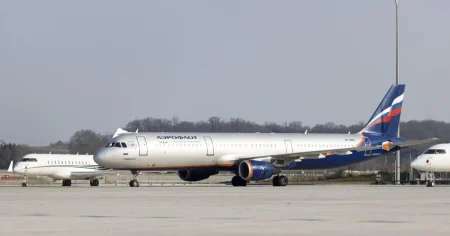
To understand why Kaliningrad looms so large in Moscow’s fears, it helps to look at the region’s history and geography. Once the site of the German city of Königsberg, Kaliningrad was severely bombed during the Second World War and then absorbed into the Soviet Union, becoming a heavily militarised outpost on the Baltic Sea. During the Cold War, its secrecy and strategic importance grew as it became the home of the Soviet Baltic Fleet. Today, it remains a peculiar anomaly: a piece of Russia entirely separated from the Russian mainland by land, accessible only by sea or air. To the west lies the Baltic Sea; to its borders sit Poland and Lithuania, both now members of NATO. The region is physically cut off from Russia proper by a hundred miles or more of foreign territory, and yet it remains a vital part of Moscow’s military posture in Europe. For ordinary visitors, the area is marked by razor wire fences separating it from Poland and Lithuania, a stark visual reminder that this is not a normal border. For the people who live there, the enclave is home—a place where families raise children, go to work, and try to live normal lives in the shadow of one of Europe’s most dangerous geopolitical flashpoints. The same razor wire that tourists photograph is a daily fixture for locals, who have learned to live with the strange, suspended reality of being citizens of a country that is separated from them by an increasingly hostile border.
What makes The Wargame particularly unsettling, however, is not just its subject matter but its casting. The show stars real-life politicians playing themselves, including Conservative MP and now Lord, Michael Gove as a wartime Prime Minister, Nicola Sturgeon as Deputy Prime Minister, Penny Mordaunt, Sayeeda Warsi, and Kim Darroch. Anthony Scaramucci, briefly the White House communications director, even steps into the role of NATO’s Secretary General. This deliberate blurring of reality and fiction gives the drama a documentary-like weight, making viewers feel as though they are watching a future that could plausibly unfold. The idea of recognisable public figures grimly navigating the end of the world is both gripping and deeply uncomfortable. It turns political debate into a rehearsal for catastrophe. Based on a Sky podcast of the same name that began airing in June last year, the series is clearly designed to provoke discussions about preparedness, defence strategy, and the terrifying consequences of miscalculation. But for many viewers, the use of actual politicians adds an eerie layer of realism. It is one thing to watch a fictional actor declare war in a movie; it is quite another to see Gove in the role of prime minister, staring down a nuclear threat, especially when the political personalities on screen are the very people who might one day have to make such decisions in real life.
The fictional chaos of The Wargame is, of course, set against the very real backdrop of the war in Ukraine, which has already spilled into the neighbourhood in ways that have heightened tensions across Eastern Europe. Poland, a key NATO country that shares a border with Kaliningrad, has become used to the sound of scrambling warplanes as Russian aircraft and drones probe the edges of NATO airspace. Lithuania, too, has seen a worrying increase in drone activity linked to Moscow, and the region as a whole is on high alert. For the people living in the Baltic states and eastern Poland, the threat is not abstract. They hear the sirens and the engines. They watch as military convoys move along highways. They live with the knowledge that a miscalculation—or a piece of dangerous rhetoric from a Russian official—could turn the hypothetical conflict in The Wargame into a real one. Kaliningrad, for its part, has seen its own tensions rise. The war in Ukraine has made the enclave even more important to Moscow, which sees it as a strategic pier into the heart of Europe, and to NATO, which sees it as an uncomfortable splinter under the skin of the alliance. The comments from the Russian embassy, then, reflect not only anger at a television show but also the sharp anxiety of a leadership that feels itself surrounded, outgunned, and potentially outmanoeuvred.
In the end, the row over The Wargame is a sobering illustration of how fragile our world has become. It is easy to dismiss a TV drama as entertainment, to watch the bombs fall and the politicians panic from the safety of our living rooms. But the reaction from Moscow shows that words, images, and hypothetical scenarios have real power. When the Russian embassy warns that an attack on Kaliningrad would be met with nuclear weapons, it is reminding us that the events of a television series, however fictional, are rooted in the same strategic calculations that occupy the minds of real military planners every day. It is also a human story. Beyond the rhetoric and the missile ranges, there are people on both sides of the line—residents of Kaliningrad who have relatives in Russia but cannot easily cross the border, Baltic families who remember what it was like to live under Soviet rule, and British and European citizens who never expected to hear talk of nuclear war in their lifetimes again. The human reaction to The Wargame is not fear alone; it is also a fragile hope that this is all still fiction. The most important lesson from this strange diplomatic outburst is that we must take seriously the dangerous language that leaders use, even when it is triggered by a television program. We must not normalise the idea that nuclear conflict is inevitable or that a region like Kaliningrad is just a chess piece to be threatened. For all the posturing, the most human response remains a desire for calm, for dialogue, and for a world where the juiciest plotlines stay on the screen, where the characters in a drama can go home after filming, and where the warnings of embassies do not keep us up at night.