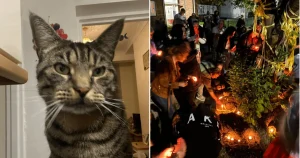

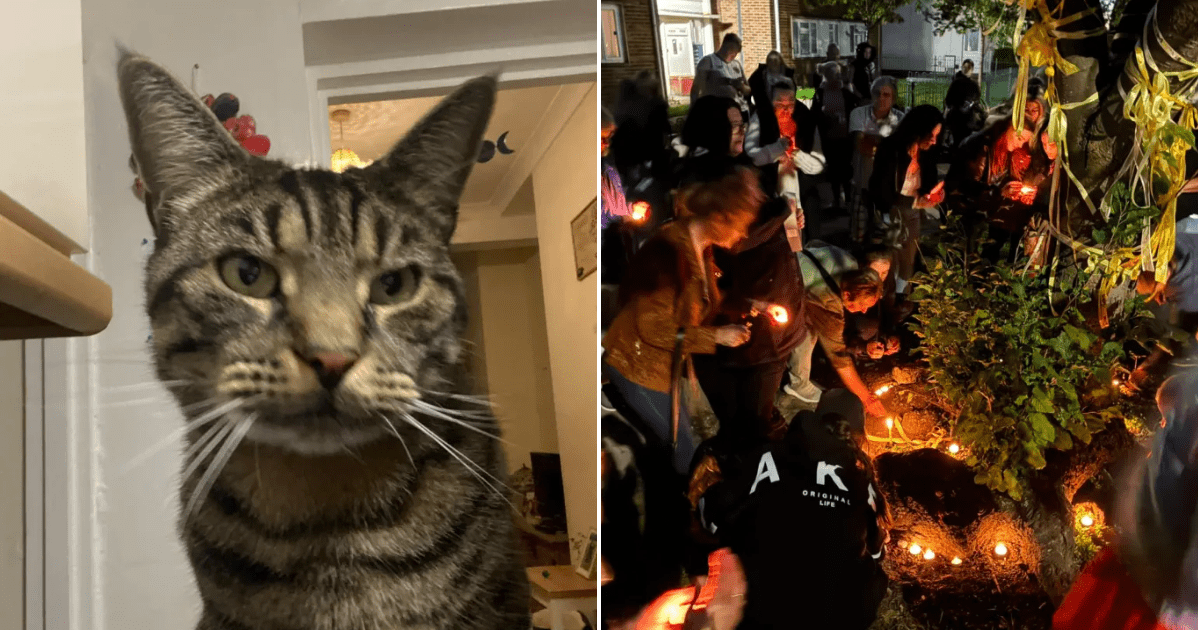
On a cool autumn night in west Hull, more than a hundred people gathered outside a modest flat building on Appleton Road, holding candles and hugging one another beneath a sky heavy with grief. They were not mourning a person, but a cat—a beloved rescue tabby named Max. Max, a friendly creature with a distinctive white-tipped tail, had vanished from the shared garden of his home on September 14. His owners, Louise, 45, and Lisa, 47, had searched, waited, and hoped through endless anxious hours. Five days later, their worst nightmare took a grotesque turn when Max’s severed tail was found stuffed through the communal letterbox of their flat complex. On September 19, the couple discovered his body in woodland near Cropton Road. The vigil was their way of transforming horror into tenderness, a candle-lit stand against an act of cruelty that no one in this quiet community could comprehend. Neighbors called Max a “lovely cat,” a small soul who had somehow become a thread connecting them all. The gathering was not just about a missing pet; it was about confronting the fact that someone had deliberately harmed an innocent animal and then, with unspeakable cruelty, returned part of his body to the people who loved him. As Lisa later told the crowd, “Max shone a light in our darkest days; we won’t give up until we get justice done.” In that moment under the glow of candlelight, grief and anger fused into something more powerful: a determination not to let Max’s death be forgotten. It was an ordinary neighborhood, but that night it became a witness to the devastating impact of animal cruelty, and a quiet promise to remember not how Max ended up, but how he lived—with a cheeky face, a loving heart, and a spirit that had rescued his owners just as much as they had rescued him.
The vigil itself was a study in quiet defiance. People placed candles under Max’s favorite tree, its branches wrapped in yellow ribbons scrawled with messages of love and loss. Some cried. Others simply stood in silence. Lisa, fighting back tears, reminded everyone why they had gathered. “We have to remember the good memories and his cheeky face—not how he ended up but how he lived. He was an amazing cat,” she said. She added: “Max will never be forgotten, he’s leaving a legacy of pure love and joy that will never be replaced.” Those words seemed to hang in the air as mourners paid their respects. Among them was Lydia D’Aulerio, a resident of Birmingham who had driven more than three hours just to be present. “We should stand together against animal abuse, it is horrific,” she said. The distance she traveled says something important about how stories like Max’s ripple outward. He was not just a neighborhood cat; he was a symbol of every animal who has been harmed by human cruelty, and every family that has loved a pet only to have that love turned into grief. The yellow ribbons were a humble but powerful memorial—each one a tiny flag of defiance, a refusal to let Max’s death be reduced to a statistic. The candlelight softened the edges of the night, and for a while, the people who gathered there were not strangers or neighbors but a single community bound by shared shock and shared love. For Louise and Lisa, the support was overwhelming. To see more than one hundred people stand in the cold for a cat—not because they had to, but because they cared—was a small light in a very dark week. Lisa thanked the police for going “above and beyond” by analyzing Max’s tail for forensic testing, but she made clear that the investigation alone would not heal the wound. The vigil was the first step in what promised to be a long journey toward justice, and no one was going to walk it alone.
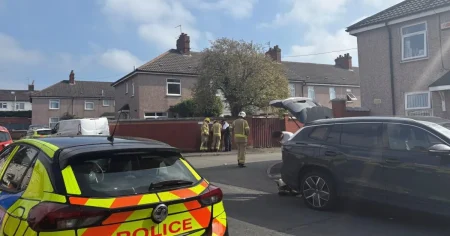
To fully understand the grief, one must understand the timeline of Max’s disappearance and the horror that followed. Max was last seen on September 14, in the shared garden of the flat on Appleton Road. For five agonizing days, Louise and Lisa waited, called his name, and posted appeals online. Then came the discovery that shattered any remaining hope: Max’s white-tipped tail had been pushed through the communal letterbox—a deliberate, vicious act designed not just to harm the animal but to torture his owners. On September 19, the same day police were called at around 12:30 pm to reports of the tail, the couple found Max’s body in nearby woodland off Cropton Road. The juxtaposition of these events—the mutilation, the return of a body part, the final discovery of a broken little body—painted a picture of calculated cruelty that left even seasoned investigators shaken. Humberside Police confirmed that an investigation had been launched “to establish the full circumstances leading up to the incident” and that they were in contact with relevant partner organizations. In a statement, they said: “Officers attended the scene and an investigation was launched in an attempt to establish the full circumstances leading up to the incident, and officers are in contact with relevant partner organisations.” More importantly, the tail was being subjected to forensic testing, a sign that authorities were taking the case seriously. Lisa turned to the public for help, starting a JustGiving page to raise money for “justice for Max.” At the time of writing, more than 130 people had contributed around £1,500. On the fundraising page, Lisa poured out her anguish: “The dastardly coward who took our Max, killed, mutilated and then returned part of his body to us through our letterbox. Someone out there must have information or evidence that can help arrest this evil entity who committed the heinous crime against an innocent, helpless animal.” The words are raw, and they should be. Max was not just a cat; he was family. And in a country where more than 15,000 pet cats are currently missing, according to the National Pet Register, his story is a painful reminder that behind each disappearance is a family waiting helplessly, and for some, a tragedy beyond comprehension.
Max’s death did not occur in a vacuum. It sent a shockwave through the community, and it was felt especially keenly by other cat owners, many of whom said the attack had put them off letting their pets outside. The fear is understandable: if someone could do this to Max—catch him, kill him, mutilate him, and then deliver his remains to his owners—what might they do to other animals? This anxiety settled over the neighborhood like a fog. James Everett, a resident of nearby Cropton Road, was careful with his words. His grandmother had found Max’s body, a discovery no one should ever have to make. “It’s been tough for everyone, there’s been a very uneasy atmosphere,” he said. That unease was echoed by Simone Robinson, a neighbor who described Max as a “lovely cat” and said the events had “shaken” the community. “Max was just a poor, innocent animal—it makes you think, what would they do next?” she asked. She admitted that since finding out what happened, she has been holding her own five cats a little tighter every day and every night. Her words capture the emotional shift that occurs when violence intrudes into ordinary life. Pets are supposed to be safe at home, curled on sofas, waiting by windows. The idea that someone could turn that sanctuary into a crime scene is terrifying. For many, Max’s death is not only a grieving story but an exposure of vulnerability. If the perpetrator is willing to harm a helpless cat, what stops them from harming a child, an elderly person, or a neighbor? This is why the community gathered, why the JustGiving page raised over a thousand pounds in such a short time, and why strangers traveled hours to stand in candlelight. It is the recognition that cruelty toward animals is often a gateway to cruelty toward humans, and that standing against one act of violence is standing against all violence. The atmosphere may be uneasy, but it is also united. In the days after the vigil, neighbors watched each other’s homes more closely, locked their cat flaps, and made sure their own pets were safe. Max’s death had turned them from passive residents into active guardians.
At its heart, the story of Max is a story about the bond between humans and animals. Louise and Lisa described Max as a rescue cat who “shone a light in our darkest days.” That phrasing is significant. Rescue animals often arrive with their own histories of abandonment or trauma, and sometimes they rescue us right back. Max was not just a pet; he was a source of comfort, a steady presence, a reason to smile. To have him taken in such a brutal way is a betrayal not only of his trust but of the entire relationship between people and the animals they love. The vigil was a response to that betrayal. It was a way of saying that Max’s life had value, that his death mattered, and that the people who loved him would not simply move on. It was also a way of reclaiming his memory from the horror of his final days. As Lisa reminded everyone, “We have to remember the good memories and his cheeky face—not how he ended up but how he lived.” This is the difficult work of grief: holding the good alongside the terrible, refusing to let cruelty define a life that was full of love. The threat of animal abuse is real and widespread. In the UK alone, thousands of pet cats go missing each year, and while many are lost or taken by accident, far too many are victims of human cruelty. Charity organizations and animal welfare groups repeatedly warn that acts of violence against animals are often underreported and under-prosecuted. But the vigil for Max was not about statistics. It was about one cat, with a white-tipped tail, who loved his owners and was loved in return. It was about the privilege and responsibility of caring for a creature who depends on you completely. For the people who stood in the cold that night, Max was not a symbol or a cause; he was a friend. And when a friend is murdered, you don’t just let it go. You light a candle. You tie a ribbon. You hold your own pets closer. You speak out. And you demand justice. That is what the vigil meant, and that is why it mattered.
The investigation into Max’s death is ongoing, and police have urged anyone with information to come forward. Humberside Police asked anyone with relevant details to call the non-emergency number 101, a request that was repeated in news stories and on social media. Lisa’s JustGiving campaign continues to grow, with donations coming in from people who never met Max but who were moved by his story. The money is intended to support efforts to find the person responsible, and to ensure that the case remains in the public eye. But justice, in this case, is not only about punishment. It is about sending a message that animal cruelty will not be tolerated—that an innocent, helpless animal does not deserve to die at the hands of a coward. It is about giving Louise and Lisa a chance to close a chapter that opened with a disappearance and descended into nightmare. And it is about honoring the memory of a cat who, in life, brought love and joy into a world that can sometimes feel dark. As the candles burned out and the yellow ribbons fluttered in the night breeze, the people of Appleton Road began the slow process of healing. They may never know exactly what happened to Max, or why someone chose to do something so unspeakably cruel. But they know that his death did not go unnoticed. More than a hundred people stood witness. Neighbors held their cats tighter. Strangers traveled miles to pay their respects. And two women, Louise and Lisa, stood in the middle of it all, exhausted but defiant, promising that Max would never be forgotten. His white-tipped tail may have been returned to them in horror, but his true legacy is the love he left behind. In the end, that is what will matter. Max was not just a “lovely cat”; he was a reminder of how much capacity we have for tenderness, and how much we must defend it. The investigation may take weeks or months, and there may never be a moment of perfect closure. But the community has already given one to Max: a night of candlelight, a chorus of voices, and a promise that his life was meaningful. That promise is not just for Max. It is for every animal, everywhere, whose life is cut short by senseless violence. It is a promise to hold tight to the ones we love, and to stand together against cruelty—not in anger, but in love.